A few student’s work in knitwear and more: Sumyu Li, Roisin McAtmaney, Ning Lai Tam. The catwalk show broadcast at the Raphael View Gallery, V&A, London.The University of the Arts London link. London College of fashion blog. H&M multi national Design Award 2012.
Archive for February, 2012
UK College Fashion
Tuesday, February 28th, 2012More on those slanting lace leaves
Tuesday, February 28th, 2012What follows is not a formal pattern, rather an illustration of the process I sometimes use to solve needs in my own knitting.
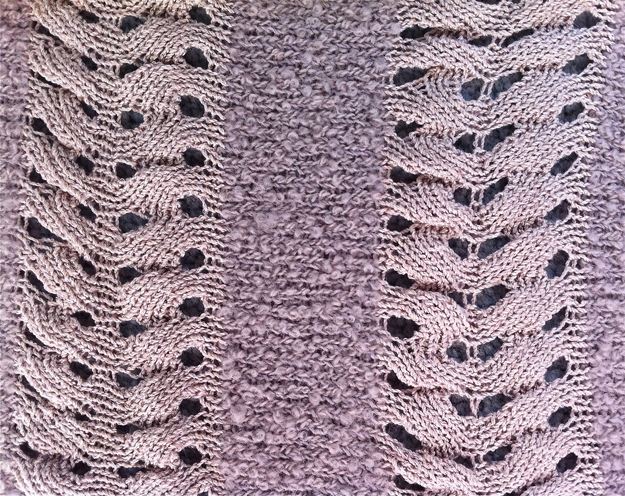
On 2 needles and growing my version of the HK slanting leaves scarf: knit on US #8 needles, yarn is 60%silk and 40% wool
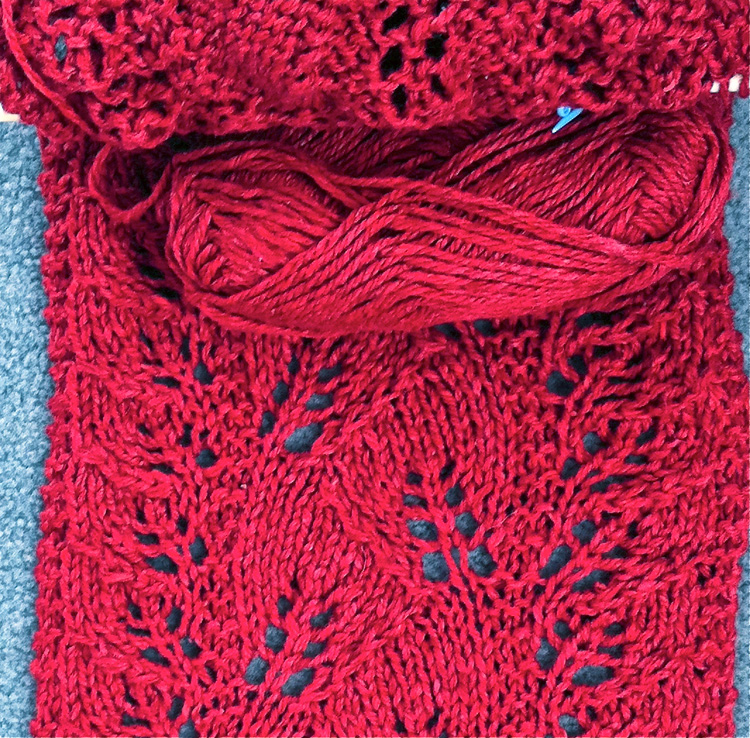
hand knit graph to follow at a later time
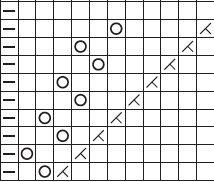
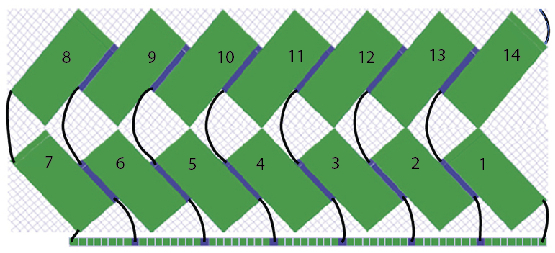
Translating this pattern for use with lace carriage is impractical for a range of reasons. A beginning analysis of the pattern for possible hand transfer or for development of a “cheating” punchcard for use with hand techniques is seen below. Numbered circles = stitch placement in repeat where the lace hole needs to occur, the second number illustrates the number of stitches that need to be moved over on the needle bed and the direction of the move
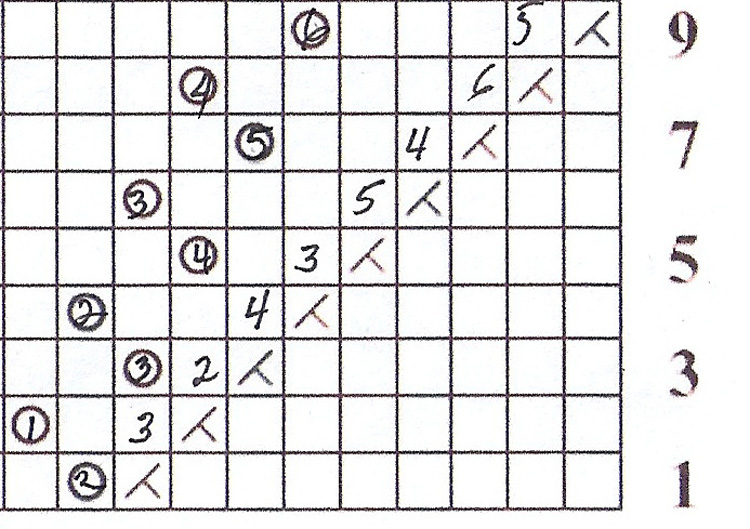
Bunches of these help, the multiple transfer 7 prong tools were made and marketed for Brother, Studio, Empisal (4.5mm), and even Passap at one point (needle space on Passap is different, they also had a wider range of transfer tools than those for Japanese KMs)
tools of the trade in required transfer configurations
sample knit from looking at a graph
first punchcard to help with needle selection:
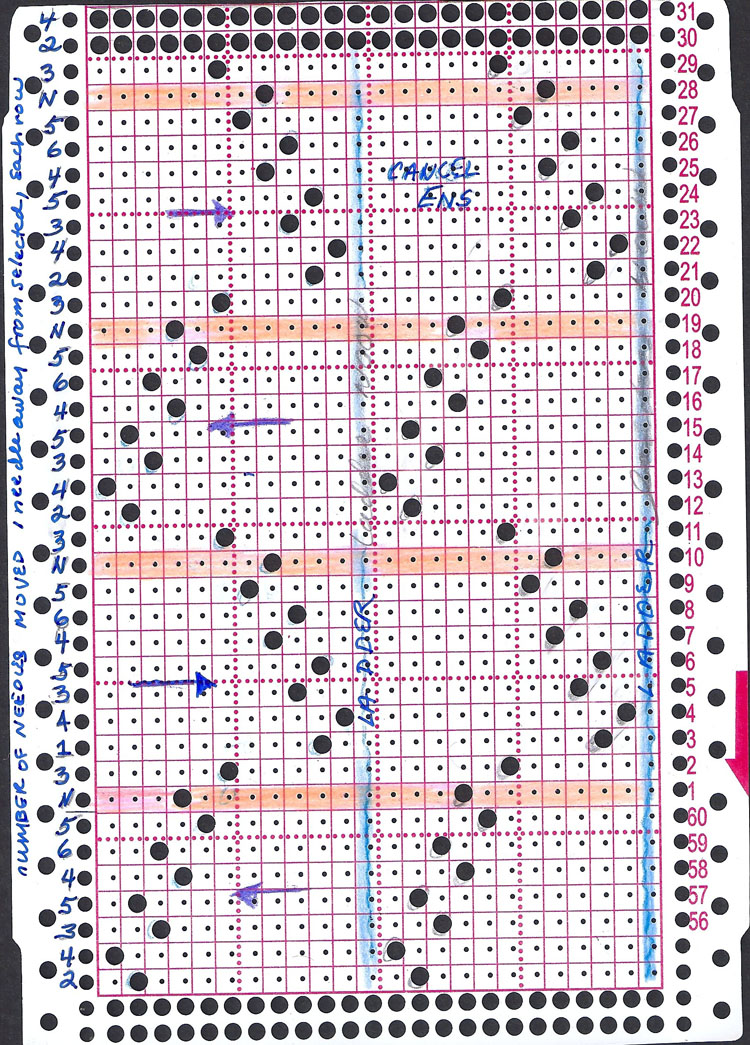
Numbers on left show how many stitches need to be moved to create the hole in the place where the needle is selected; they do not reflect design rows directly, since the card is read seven rows below eye level; large arrows indicate direction for moving stitch groups, with the horizontal colored stripe showing the beginning of each new transfer sequence; vertical blue rows show placement for needles out of work, and the resulting ladder. The garter stitches in the hand knit have been eliminated.
The above card worked, but if one has a bulky, limited prongs on transfer tools, or short attention span an even easier approach might be to have all needles placements required for move on each row selected
the second punchcard
Now come attempts at a possible border trying to “match” top and bottom of knit: would prefer not to have to deal with issues of mirroring in center vertical and horizontal axis of scarf to get top and bottom to “match” . There is enough else to track.
not liking the size of the ladders
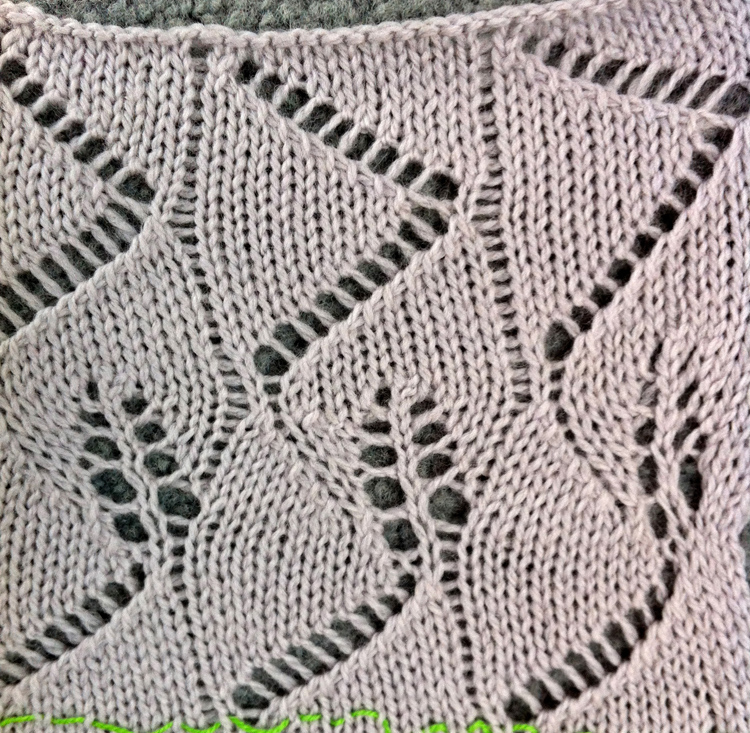
The swatch below is a bit closer to “like” and to eliminating the ridge at the center of the “triangles” that is formed if transfers occur in the usual manner and “hole” is then filled in with a purl ridge to eliminate it. The “ladder line” below is marked, showing results from different attempts to fill in the empty needles resulting from moving the stitches. Top and bottom edgings are created by chaining as one would do a chain stitch cast on, behind the knitting on the needle bed, in front of the knit side of the fabric. If knit on the bulky a garter edging could be hand knit first, placed on the KM, the piece knit in turn, then taken off onto HK needles again for adding garter stitch rows at the other end.
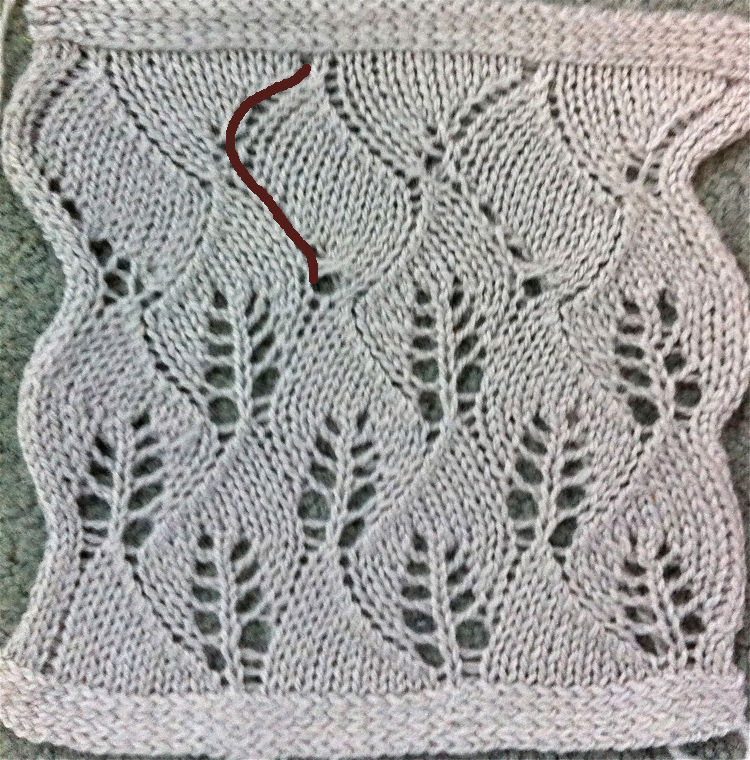
Getting closer to goal: ladder space more uniform, “linked” border rather than chained one above, still need to sort out how many repeats without the leaf lace “veins” to work at top and bottom of “scarf
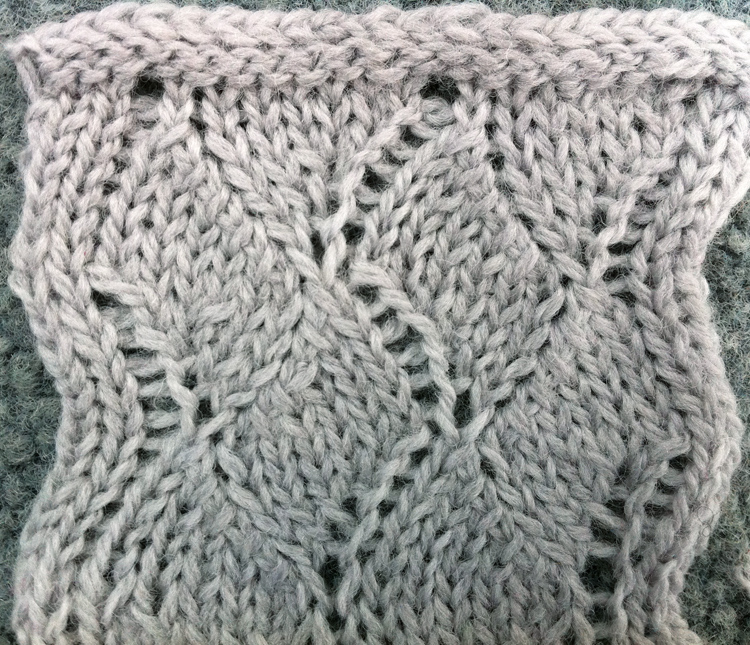
HK and MK variants of leaves may be found in a variety of sources. Some HK samples include a twin leaf verion. A very quick sketch of a possible adaptation for use with punchcard development as described above, using the 24 stitch repeat limitation, red = NOOW follows
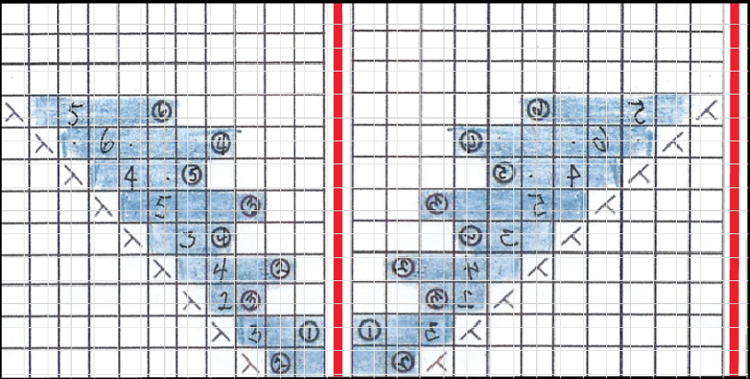
one trouble spot: Row2, where 2 holes line up one on each side of the “ladder”
Knitting with the iPad.
Monday, February 27th, 2012Revisiting Fleegle’s blog: recent posts include some yarn reviews, and knitting with the iPad!
Leaving it to chance
Sunday, February 26th, 2012Newsletter and comments.
Sunday, February 26th, 2012For those of you that have been following my blog for a while: thank you for the continued inquiries on a possible newsletter. I have no plans to publish one, I choose to post as time allows and on where my flights of knitting fancy take me, so leaps/breaks in threads are bound to occur. I do receive comments and read them. Since they do not generally add to post contents they are not published. If a personal response is sought, please use Contact link in my blog roll or provide a valid email with your comment that will not bounce my info@.com address.
Some collections 2012/ uk
Sunday, February 26th, 2012Back to lace
Saturday, February 25th, 2012Recently I came across a photo in a magazine with what I thought of at the time as an unusual knit leaf. One of my first instincts upon viewing such patters is often to explore whether I might be able to reproduce the knit on the machine more quickly, and whether in addition there may be a way to “automate the design” by coming up with a repeat that would work with use of the lace carriage. I will share some of many ways to explore such transitions in a series of posts. As written they will specifically apply to knitting on Brother/Knitking/Taitexma brand knitting machines.
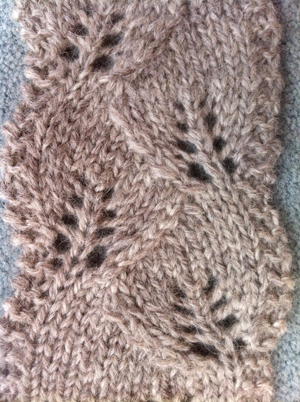
The original “culprit” pattern:
One way to interpret those triple stitches leaning to right and left in HK is to knit three together for right leaning, and slip, knit two together, PSSO for left leaning on RS (“right” /knit side). The same steps on the KM would involve moving around of those triple stitches to achieve the correct lean of the leaf edge on the knit side of the fabric. The number of rows for transfers to achieve a similar look make the fabric impractical to knit using a lace carriage on the KM, so back to hand knitting.
In yet another instance of “it’s a small world” since I first came up on the repeat and began looking for interpretations, I did find several hand knit patterns on ravelry and some magazines using the same or similar motif.
The pattern repeat in my first hand knit sample in a 4.5/inch gauge wool
In turn this led to my developing my own repeat design, which is now on 2 needles, becoming a scarf for my grand daughter, which can be shared in future.
I work predominantly on a Mac, OS Lion. Last year finally got turned on to using excel for knit design after finding excellent online tutorials such as those by Marnie MacLean and Fleegle’s blog. Over the past week I finally got around to playing with iWork, using Numbers instead of excel, and in conjunction with Pages have come up with final images such as the ones below. Am pretty much flying by the seat of my pants in this, so I can’t really share a step by step method, but have been pleased with the instinctive qualities of the Apple programs and the results.
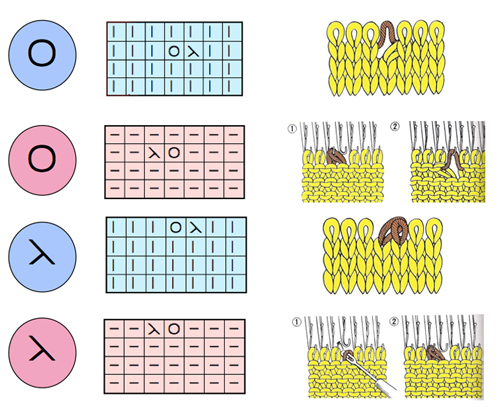
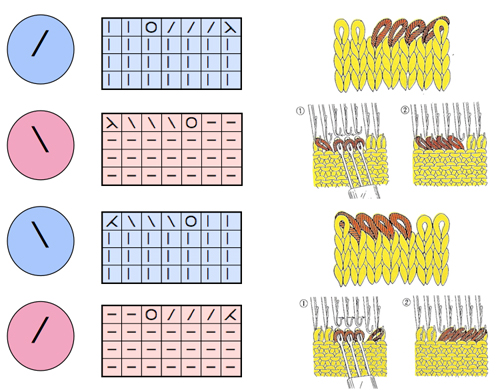
In subsequent graphs: blue represents knit as it appears and may be worked on the knit side, while pink represents how the knit appears and may be worked on the purl side, and as such on the KM to achieve the same design
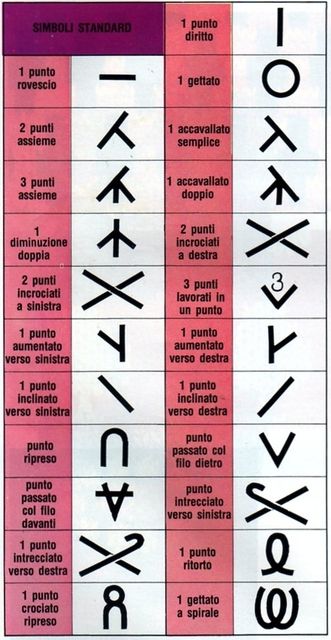
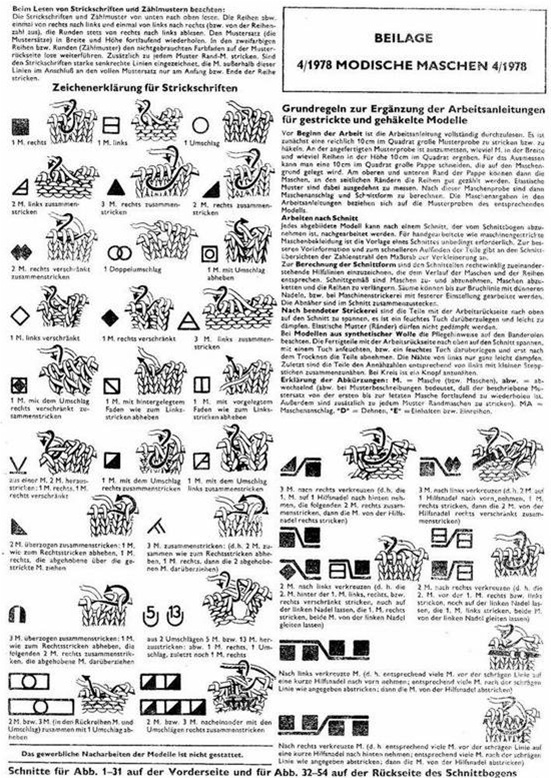
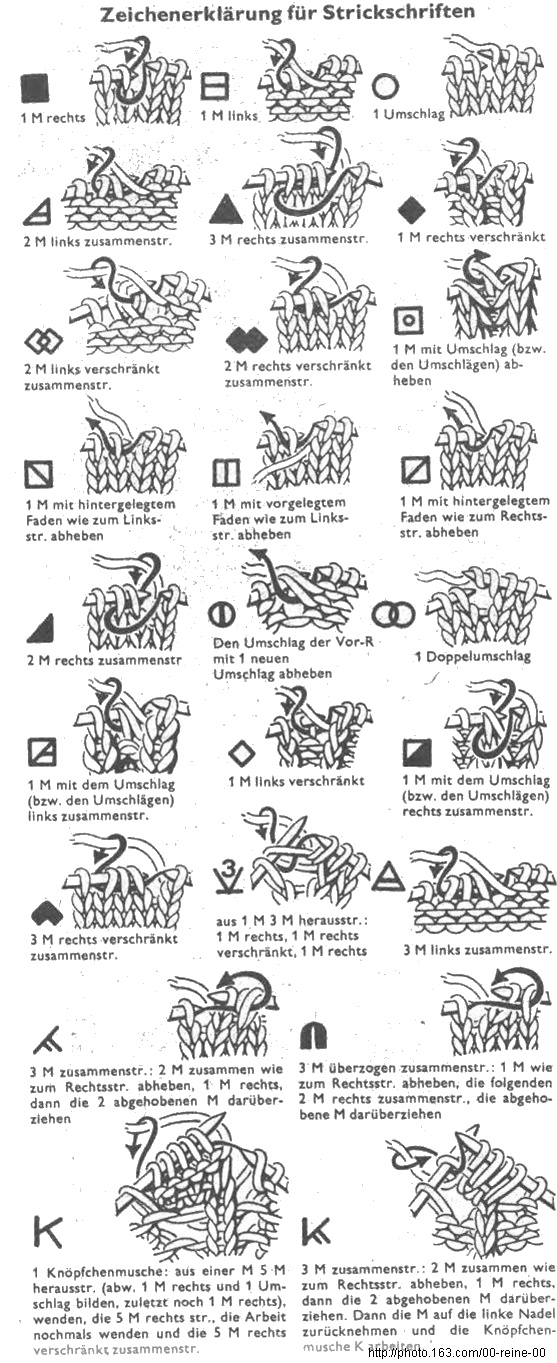
Common Lace transfers and symbols
now: starting to play with a hand knit repeat with the intent of translating it for use on the KM: triple stitches in one location in any single row are eliminated, as well as sets of double lace holes in any single row while retaining the diagonally slanting leaf motif
garter stich will be eliminated by adding a needle out of work in its place, creating a ladder space between repeats; repeat will be adjusted to work within restraints of a punchcard limitations in terms of stitch width and row height requirements, more on next post.
_____
Crochet wire scultpures
Wednesday, February 22nd, 2012Ruth Asawa is an interesting artist whose work includes some exceptional crochet wire scultptures.
“Portrait sweater knits”
Wednesday, February 22nd, 2012For a while now the video and directions on hacking a brother 930 knitting machine has been available online. One use for the patterning option is knitting bill cosby wearing a bill cosby sweater as seen here.
“Wisteria” 2
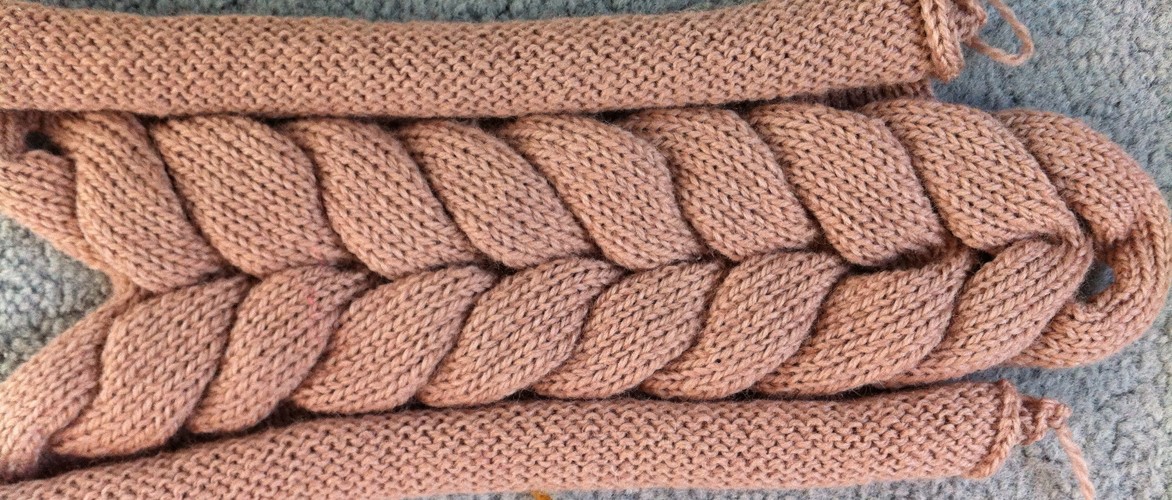
Monday, February 20th, 2012A follow up to the previous “horizontal cable” post: it has a relative that produces a flat or textured “lacey” fabric depending on number of rows knit in each segment.
an attempt at a graphic representation of the previous “wisteria/cable”
The relative: after some initial rows of knitting (whether waste yarn or edge of actual piece or swatch), beginning with knit carriage on right hand side, moving right to left, the knit is created by knitting on a multiple of chosen # of stitches plus needles out of work (OOW, A position). In the instance below a multiple of 9 + 8 is cast on, with OOW needle (represented by blue) between repeats. The ladders created where needles are in A also make it easier to visually identify stitch groups that need to be moved in/out of work
an attempt at a graphic representation of the corresponding knit
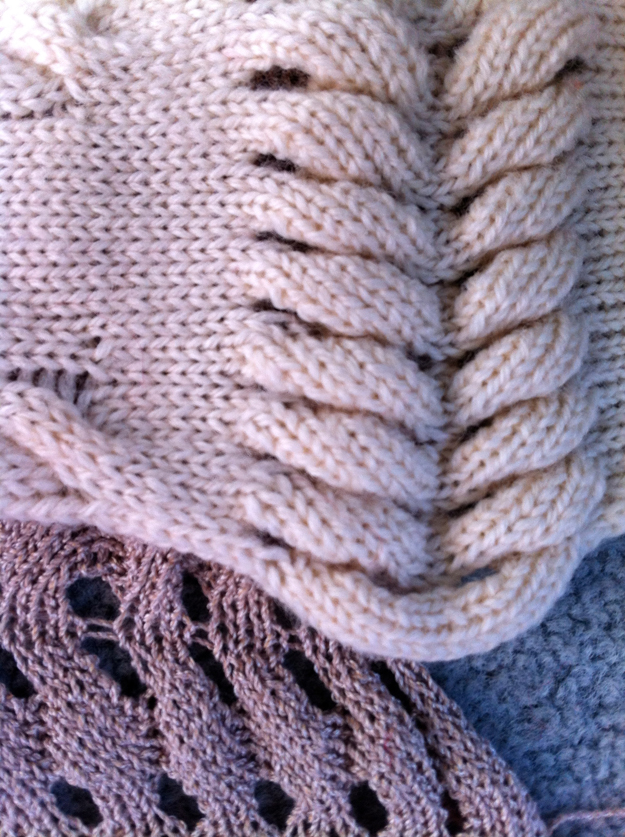
the swatch knit side, orientation as knit
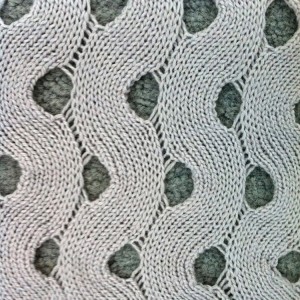
the swatch purl side, rotated 90 degrees as it would appear in a sideways knit
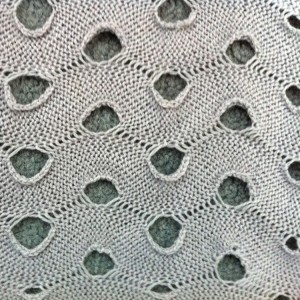
the knit tends to curl along edges to purl side as seen above, could be embellished with stitching for more contrast and color
To knit:
first pattern row:
COR knit 8 rows on first group of stitches on right (1)
push second group (2) into work and knit 8 rows
push third group (3) into work and knit one row
push group (1) on its right into hold, knit 7 rows across remaining 16 stitches
bring a new group on left into work, knit one row
bring group to its right out of work, repeat process across row
when second to last 2 groups on left (6 and 7) are reached, knit 8 rows on both, push second to last group into hold (6)
COL knit 8 rows on last group on left (7)
second pattern row:
COL, reverse process from left to right for the second pattern row
the row that picks up the adjacent group of stitches helps create a joined fabric, with movement resulting from the direction in which each “pattern row” is knit
varying the ladder space and number of rows knit will change the overall look of the fabric
turning fabric sideways after varying the size of the holes across the now horizontal rows could also affect overall shaping ie narrowing and widening of segments
going from larger holes on one side to narrower in the opposite will make the knit “ruffle” on the edge with larger holes, etc.
if one knits vertical segments that are 8-16 rows in turn, cutting the yarn at the end of each sequence, then there will be straight slits/ strips that may in turn be left as such when knitting is resumed, twisted in a variety of sequences with alternate groups as one would a cable, rotated on their own axis once for 180 exposing some of the back/opposite surface of the knit single or or multiple times as desired
strip of slits may in turn be “latched up” in chain, stitched, after knitting is completed
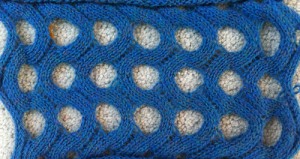
a sample with wider ladder spacing and slightly different sequence
Artists using such structures in their work include Ruth Lee and Diana Eng. The latter addresses the construction of her fibonacci series scarves in her blog in a post dated October 21, 2011.