Reducing figurative designs to repeats for knitting on a low needle counts results in loss of definition.
Filet crochet charts can serve as a starting point for repeats, but usually are planned on more than equivalent 24 stitch counts, so results of adapting them are often usable on electronic machine models only.
The knitting technique used to execute the design determines whether the lengthwise aspect ratio is affected or not.
1: the source image
2: processed using Mac Numbers
3: opened in Gimp
4: the grid color can be altered to view and match stitch counts
5: the color reversed image to visualize the possible appearance of doing so in the knit
6: a small border frame is added, bringing the figure color to the edges of the knit piece, and the figure is mirrored, helping to make a choice about its orientation on the the knit side 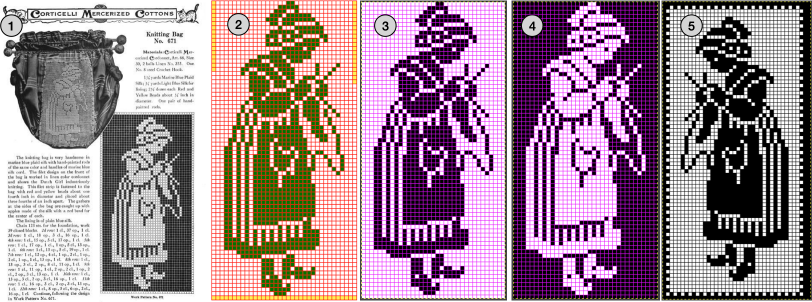 Depending on the model machine used, the motif may appear as drawn on the purl or on the knit side, mirroring it when direction matters may be done using machine settings or mirroring before download.
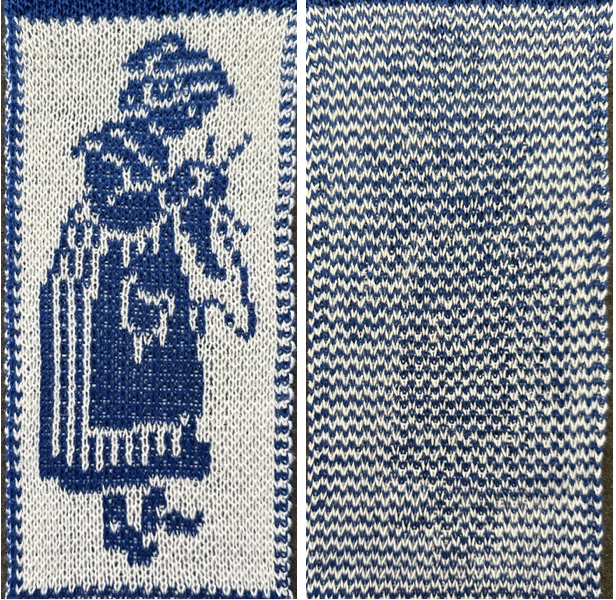
On my 930 mirroring was not necessary, the swatch was knit on 40 stitches, with the added frame.
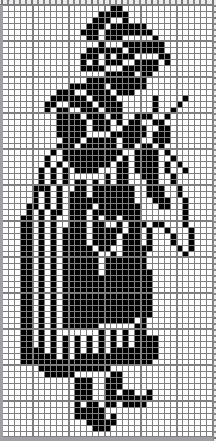
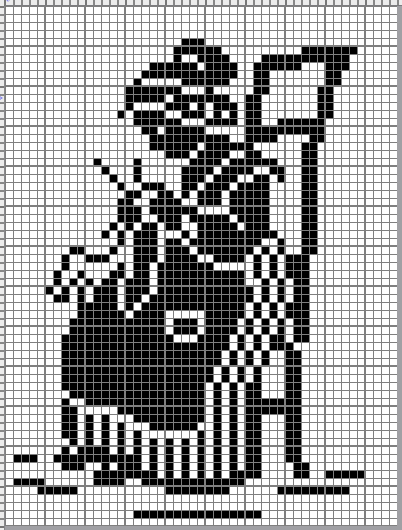
The figure alone, 35X72 pixels  shown on 6X6 grid blocks
 A DBJ swatch with birdseye backing
  A sitting companion, inspired by random Pinterest find, processed using ArahPaint, not knit tested, 49X65 pixels
  shown on a 5X5 pixel grid
  Graduating to pillow or blanket size, a bit of romance in advance of February, from a Priscilla Filet Crochet book, the original was in a nearly oval format.
A border was added to complete the original to full oval shape,
black pixels were added to complete the inner shape, and the BW image was extracted and saved.
Working in RGB mode, the border needs to be adjusted for symmetry, not fully complete here, and bucket pattern fill may be used to customize it or any frame 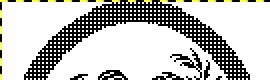
 the 117X154 modified oval chart and png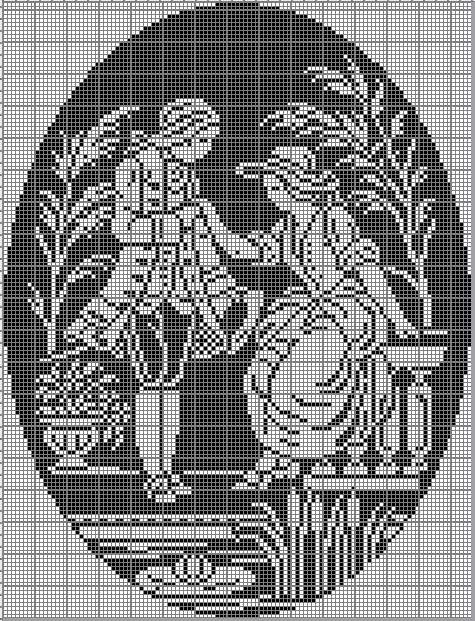
 color inverted 107X154 for DIY modifications to other shapes
  A 137X184 RGB version with editable border
  Mythological inspiration from a Priscilla source
A: the original
B: processed with GIMP
C: processed with Arah 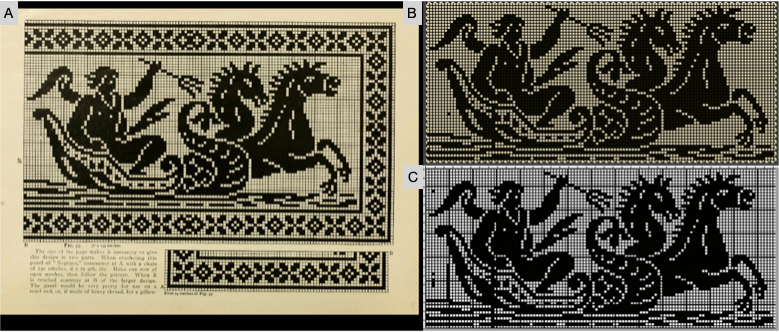 the final png chart, with some pixels removed
 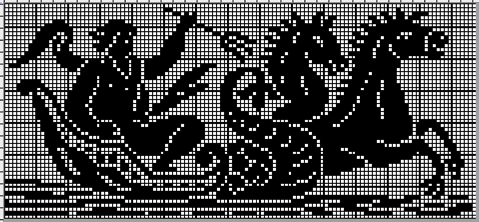 and the 118X54 png
  A 142X81 pixel version that includes a border
 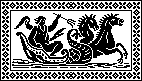 From previous posts:
74X54 Celtic design 
43X53 squirrel  This image is not from a filet crochet chart but from one of my Studio 560 mylar sheets dating back decades. It is used to illustrate the possibility of mirroring in different directions to produce far larger designs ie wall hanging or blankets.
Alone it could serve as a scarf, with the image rotated and perhaps even mirrored at the opposite end of the scarf to match directions when draped around the neck 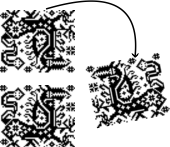 The 60X50 cell repeat
  It takes a few clicks of a mouse and a couple of program windows nowadays to make the addition of single cells at the top, bottom, or sides of such large designs that avoid tiling intersections with double cells if that is the goal.
It is also easy to manipulate the chosen designs to visualize the appearance of a final piece. Printing the pixelated results in a larger format can aid informed choices before any actual knitting.
Adding a single cell blank column on the right, and one with a few pixels on the bottom a blank row on the top, 61X52  in a 122X104 repeat that with coordinated borders could approach the use of most of the needle bed
 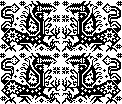 with the initial shape mirrored horizontally and then drawn in repeat a column with double pixels appears again at the center of the design
 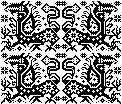 staying with that, but making shapes go around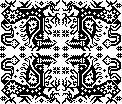
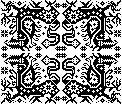
Category: Online Resources
Seasonal knits inspired by published repeats 1
In previous posts, ie Numbers and GIMP: online punchcard patterns to electronics 2, I shared some ways of converting online images from varied published sources.
This series was edited using primarily ArahPaint and some Gimp, both are available for free.
DAK users have the ability to achieve similar results in that universe, producing stp proprietary files. There is no export (or import) available to other formats ie png or bmp possible.
Fair isle is not in my preferred wheelhouse, especially in season specific designs, but that said, I have been sharing these repeats in the FB machine knitting forum and thought I might make them available to others here as well.
The pngs are editable for further DIY modifications.
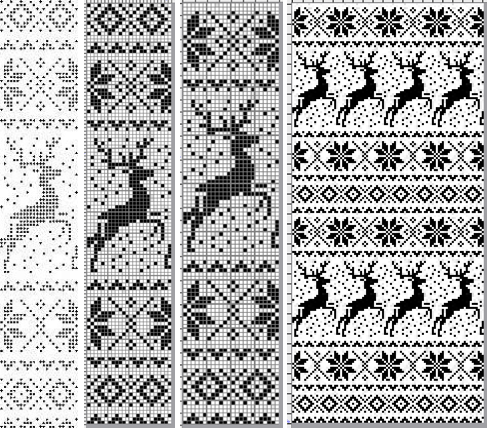
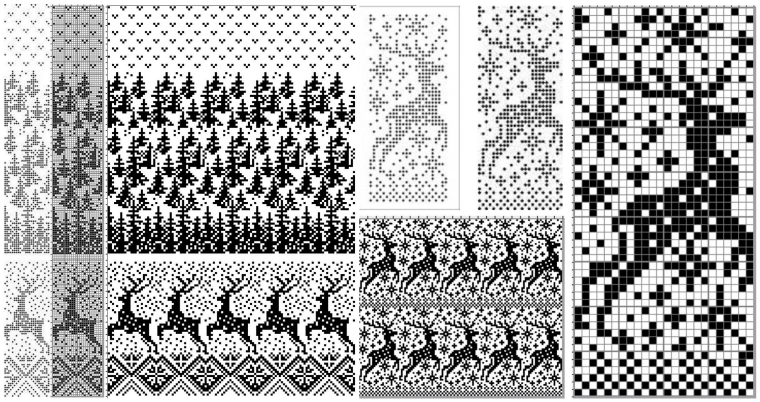 24X189
 24X94
24X94  24X85
24X85  cropping given repeats for desired tiling, # 1068
  the original 24X119 png
  cropped to 24X105
  My first encounter with “naughty reindeer” was during a Brother dealer-sponsored small machine knitting club meeting. A present update, using a Pinterest find as the source
 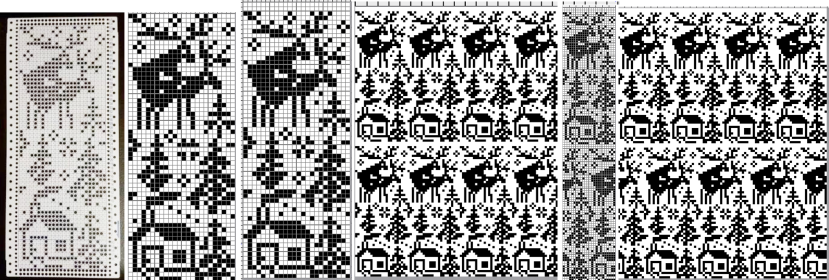 the original 24X60
  with 2 rows added to 24X62
 in brick repeat, 24X124
A 40 stitch Madag design 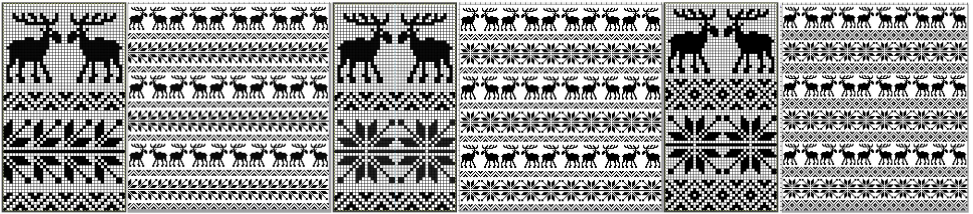 40X68_1
  40X68_2
  A 24 stitch version, with the moose, and without
 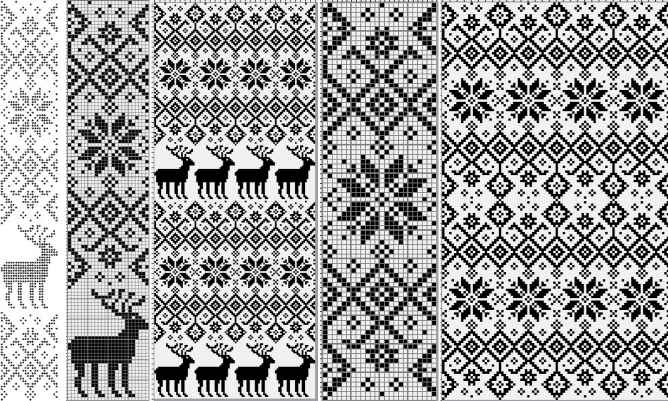 the original, 24X152
  cropped to 24X118
  with the moose edited out, 24X84
  Snowmen and trees
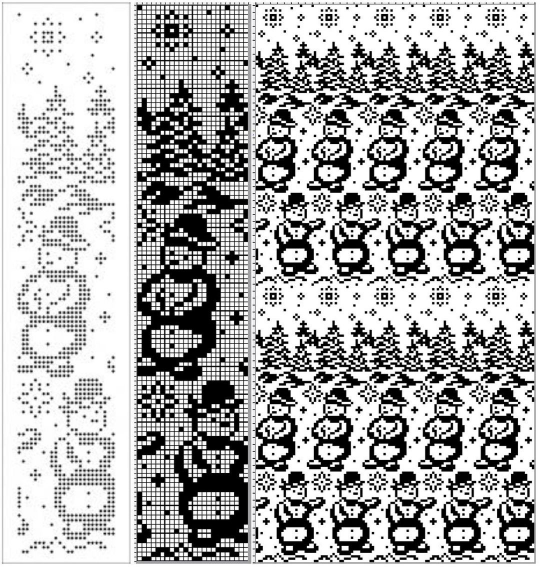 24X120
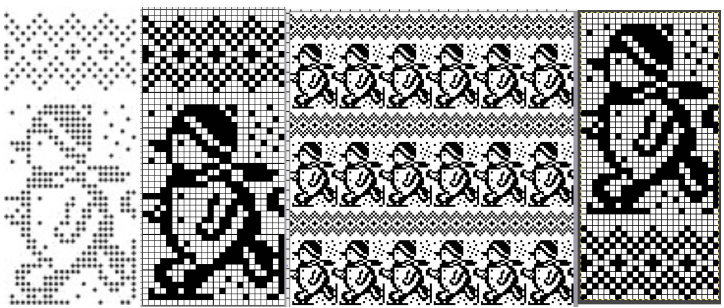 24X50_1
  24X50_2
  testing tiling prior to knitting, editing out unwanted symbols
 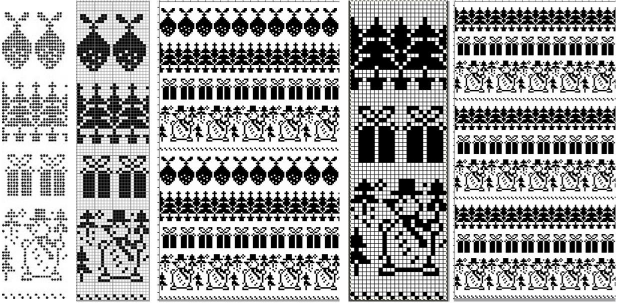 the original 24X99
  the edited 24X74
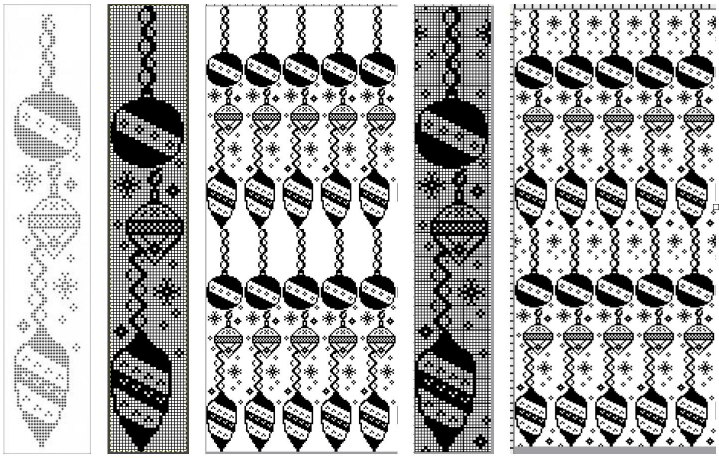 As a 24 stitch repeat, this is suitable only for single motifs, since repeating them horizontally would join the darker ball shapes. Adding a blank pixel column on the far right changes the horizontal alignment. A few pixels added at the top of the motif form an unbroken join vertically, the final 25X146 shown on the right
  This Santa was identified as being attributable to Knittery, a company long defunct that offered pre-punched cards for purchase. Images where the background is punched out make it possible to introduce striping it with the color changer or using the chart for duplicate stitch embroidery on a knit ground.
 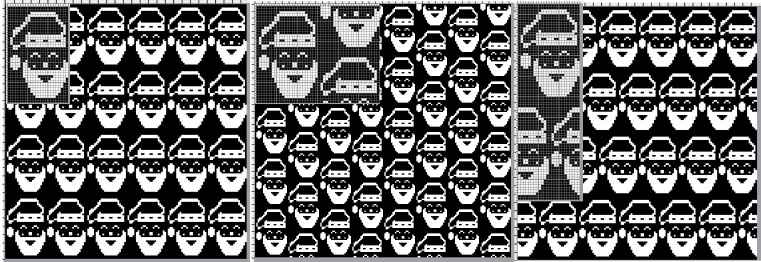 the original, 24X38
  in half drop, 48X38
  and in brick repeat, 24X76
the original, 24X185 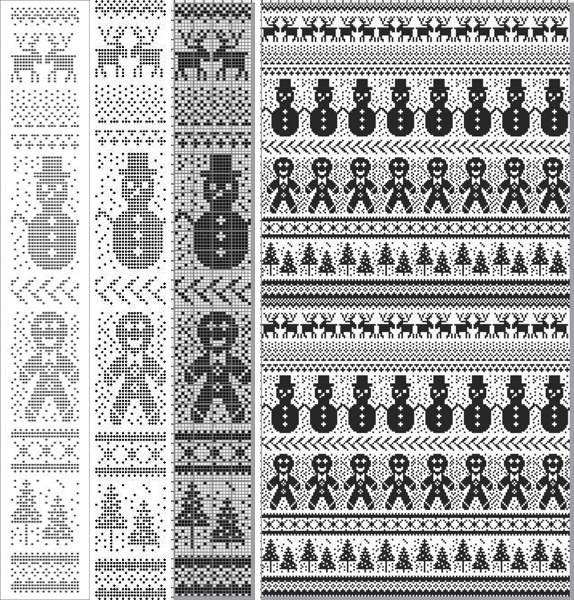
 with the elimination of some rows, first at the very top
 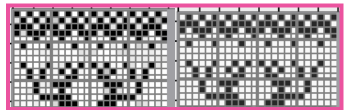 and then just above the snowman’s hat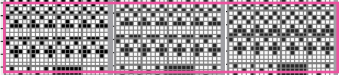
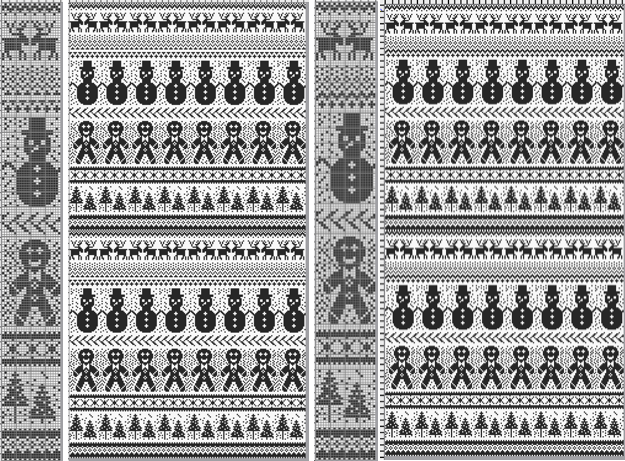 the final 24X182 png
  The question as to how to adjust repeats for use on 12 stitch knitting machines often comes up in forums.
Continuing in the seasonal vein, the easiest method is to begin with a 12-stitch repeat that occupies only half of the card vertically and twice in width. Here the original “half” is 12 stitches wide, 46 rows tall.
One method for the conversion is to work on a spreadsheet:
Begin with a table 24 cells wide, adding enough rows to the expected planned height to repeat the snowflake border, 46 cells in total
configure the cell borders for easy viewing, ie with a 3 pt red lines
hide 12 columns beginning with the second from the left
fill in black cells matching the original design or the DIY version
unhide all 12 columns for the final repeat 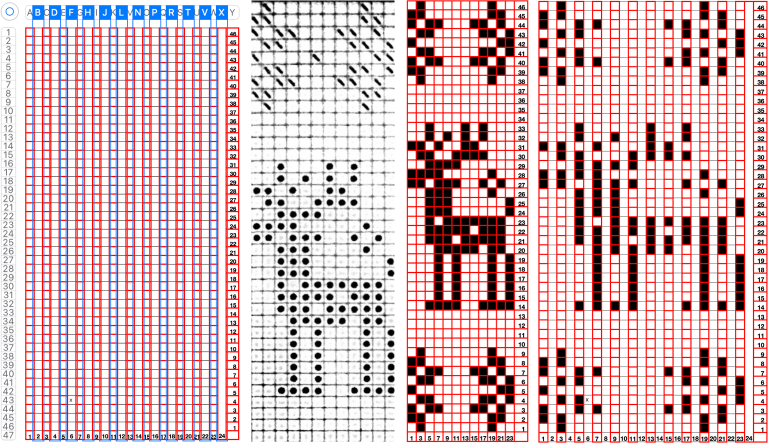 When converting the screen grab from a spreadsheet to png in Gimp, before scaling to final size, a first scaling may be required to make certain the result is divisible by the expected number of stitches and rows using the broken chain link, and then scaled again with closed chain link, the first png
  Working in Gimp or any paint program
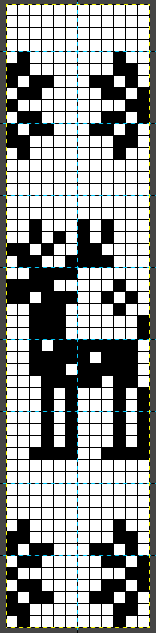
draw the “original” and save it, mine now has 2 added rows, one above and one below the deer, making it 12X48 pixels  scale it to twice the original width
  configure the grid properties for contrast/easy viewing
fill in every other column with white using a straight line white pencil. To do so, select a pixel with the mouse, hold the shift and command keys down to draw the lines, and release the mouse to stop. The first white pixel may be placed within an easy-to-follow section of black ones and then the mouse may be held and moved up and down to complete each column. Save the result.
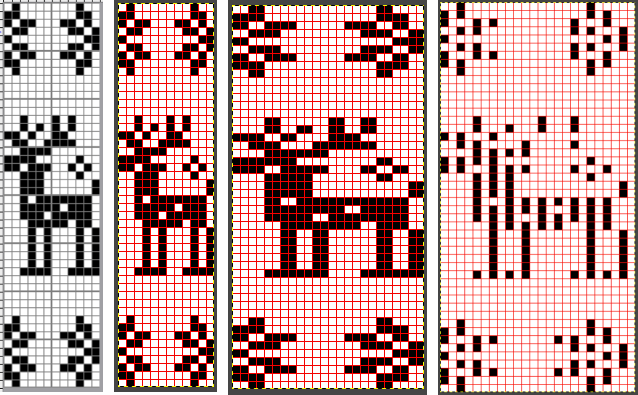 Proof that it is always a good idea to draw the initial image in repeat before committing to color separations or any downloads and actual knitting:
 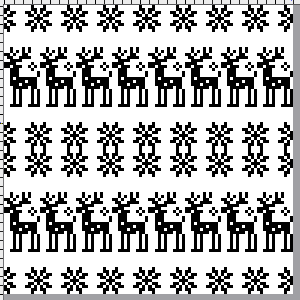 Two possible alternatives in adjusting the design to one’s preference are marked in 6X6 grids in ArahPaint to match markings on blank Brother factory blank cards:
the first removes a snowflake border and is reduced to 12X39 pixels,  the second adds 4 rows at the top of the second snowflake border, 12X52
  the number of rows between motif segments can be varied for planning the introduction of stripes in added colors
 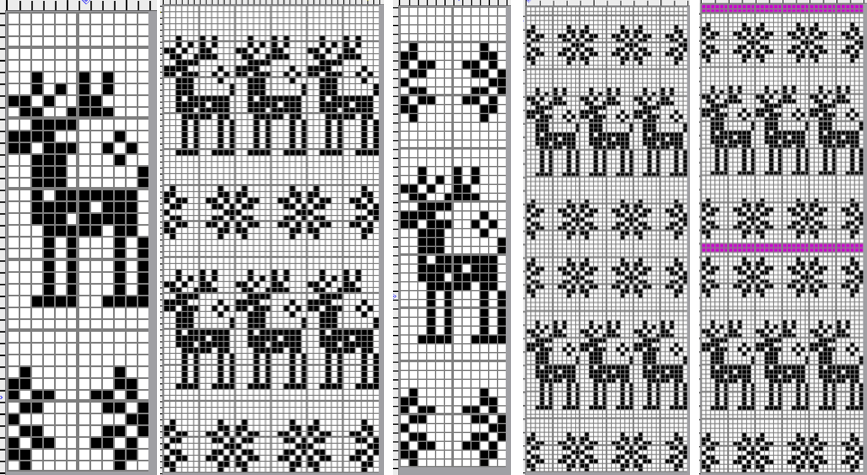 If only Gimp is available, I have not found a way to vary colors in grid borders in blocks other than to use guides, appearing as dotted blue lines.
  A break from reindeer, teddy bears, and hearts follows, perhaps for a baby gift or to save for Valentine’s Day. When there are clear horizontal borders added to motifs the half-drop repeats will produce mixed results.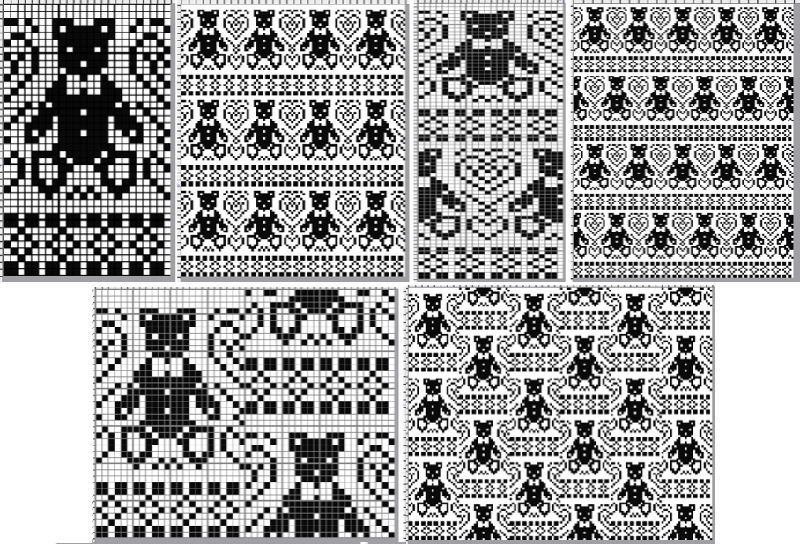
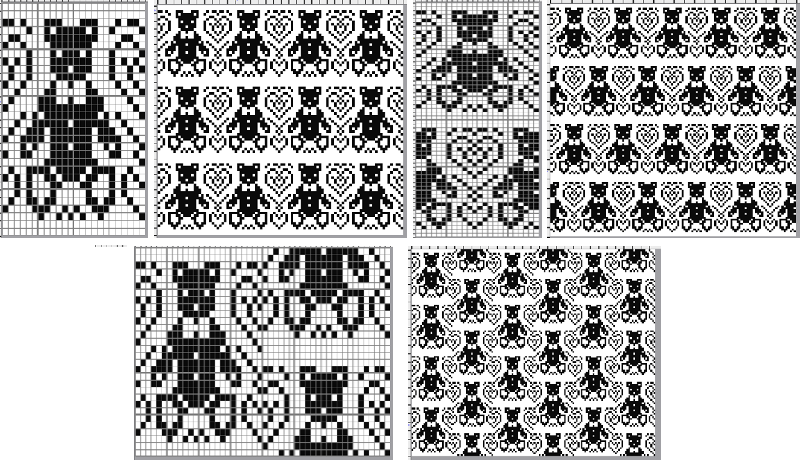
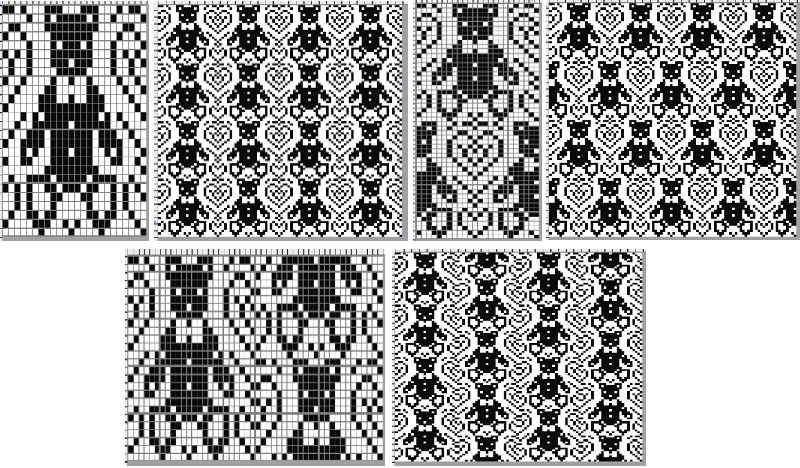 the pngs:
24X39 24X78
24X78  48X40
48X40  24X60
24X60 24X30
24X30
48X30 
24X26
 24X52
24X52 
48X26  Bell motif variations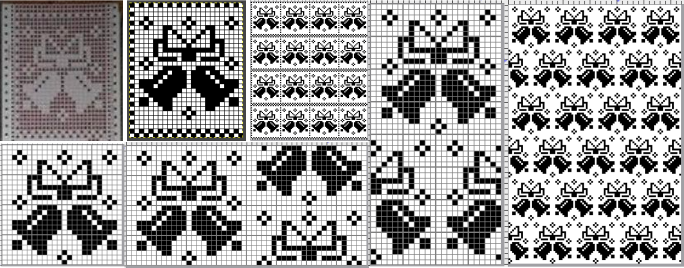
24X30 24X48
24X48  48X24
48X24  The last in this series, a nutcracker motif inspired by a larger scale cross stitch design, reduced by me to a workable 24 stitch MK design with varied borders and collaged small motifs in the background
 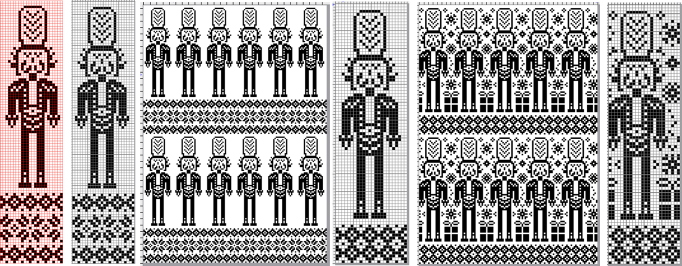 24X101
  24X87
24X87  24X87 with added background designs
  Considerations in choosing a design are guided by its end use, tiling the repeats leaves fewer surprises in any actual knitting.
This might appear in casual observation to be a “snowflake”.
The full 25X25 pixel version can be isolated, with matching fragments around the whole. Magenta lines indicate cropping points depending on end use if double stitches not immediately obvious or planned are to be eliminated. 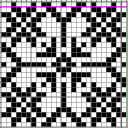
 A: the full design as a potential knit border
B: trimmed a one-pixel width column on the right to 24X25 while retaining matching top and bottom rows  C: trimmed the single top row as well to 24X24 for an all-over execution, drawn in repeat for an opportunity to evaluate whether the design as it now appears produces the initial imagined shapes and effect
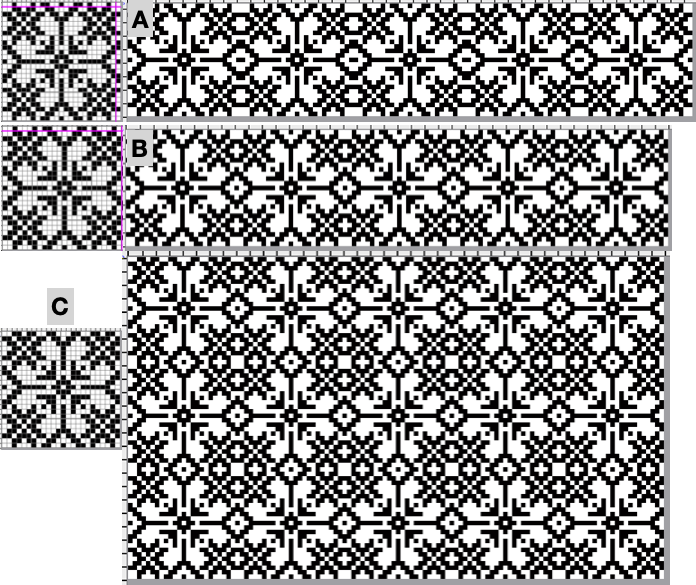 Then there is the optical effect change that happens with color invert, for which an easy test may be made during knitting by simply switching yarn color positions in the knit carriage sinker plate
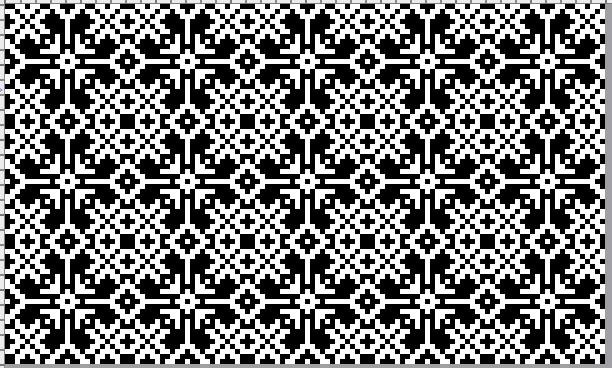
Swatches based on adapting random online published repeats
I still surf Pinterest daily and often encounter published punchcard repeats that catch my eye.
Many need some interpretation and editing for use in specific machine models.
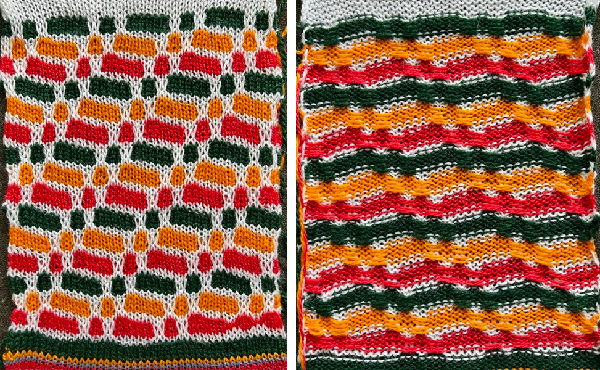
The first inspiration: 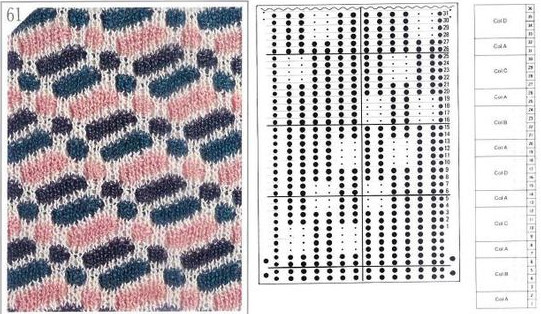 is knit using 4 colors, alternating 2 rows of a base color, then rotating color changes for 4 rows for each of 3 contrasting ones.
Counting up from the bottom of the illustration after the marks for the typical two all-punched rows, it would appear this is a Studio punchcard, but starting row 1 as visible outside the card reader can simply be changed for any other brand knitting machine.
The every other stitch configuration is for an every other needle repeat used in early machines such as the Juki.
A full reference volume 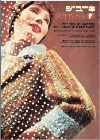 An illustration of the card use
 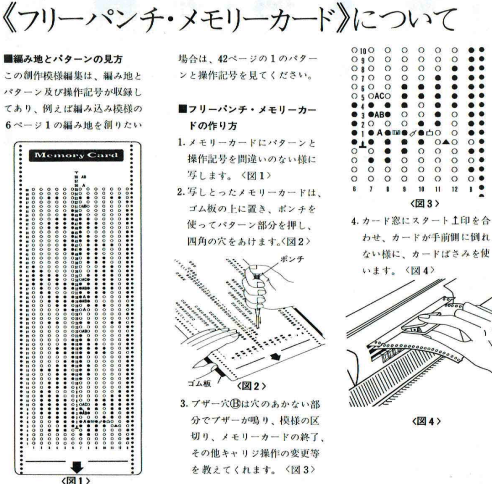 If using thicker yarns on a standard machine that grinds at the loosest tension, this configuration can retain the full design while knitting every other needle/EON.
The adaptation began using Mac Numbers, the repeat was isolated and traced, and the 12 blank columns were then hidden 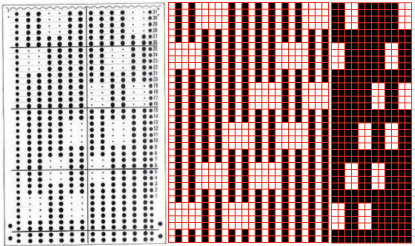 producing a result scaled in indexed B/W mode to 12X36 pixels. The tiled design, checking alignments.
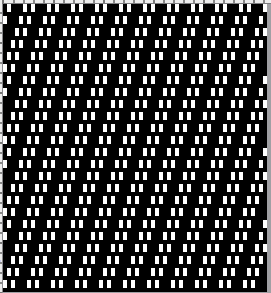 The proof of concept
  Periodically tuck stitch designs that appear to break the usual rules for the stitch are discussed.
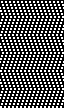
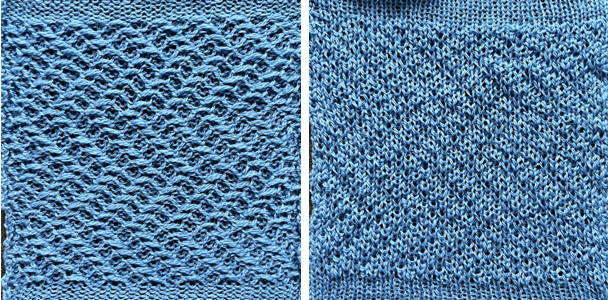
This design is intended for a push-button machine capable of 24 stitch repeats, uses symbols in the associated chart interpreted to mean tuck loops form for 2 rows and knit along with all other stitches every third row. 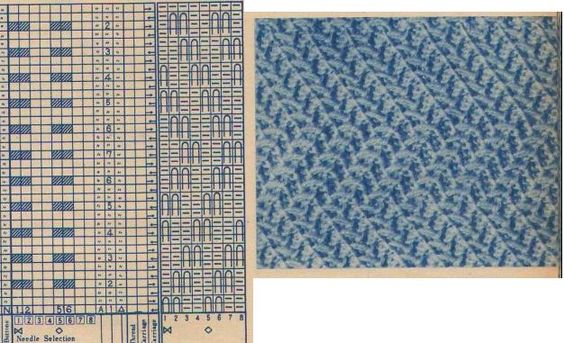 The working repeat is made up of 8 pixels in width, and 36 pixels in height.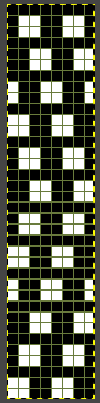

 This next design is likely published for use with the Studio color changer, which is marked with letters for each color,
 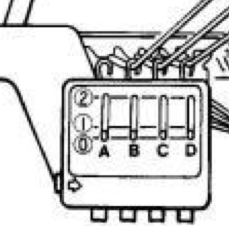 rather than with numbers as in Brother models.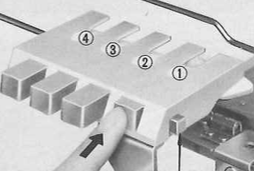
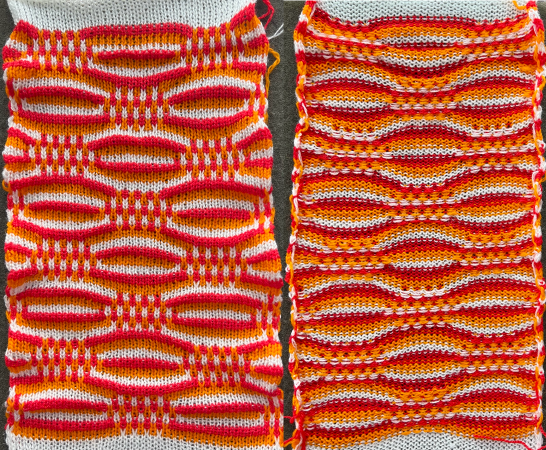
It is intended as a slip-stitch. The bottom swatch relies on color changes every 3 rows, which would need to be performed manually.
In the elongated version, colors are changed using the color changer, every 6 rows. 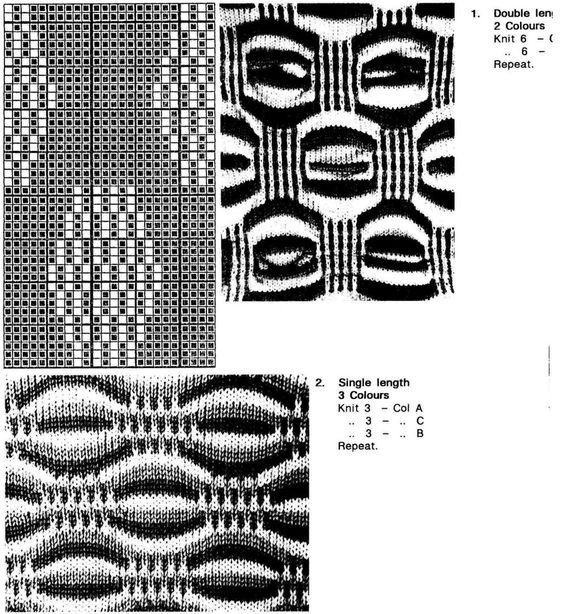 The design was first tested in thin yarns using the electronic 24X84 elongated PNG
  tested for alignment
 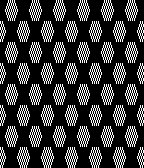 and displays interesting 3D variations, the purl side is remindful of shadow pleating
 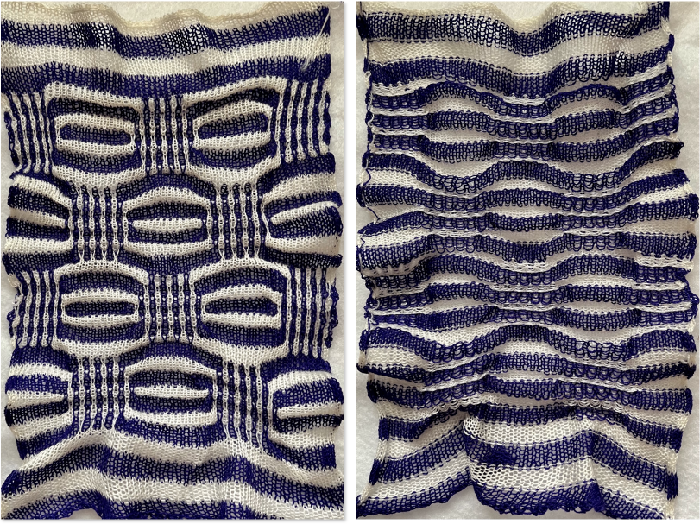 Changing colors every odd number of rows is a tad fiddly.
The use of the color changer is not an option.
With the three yarns fed through the yarn masts, it became hard to keep them from twisting around each other. Ultimately, that problem was solved by hand-feeding one of the three colors with the cone on the floor, in front of the machine, as one would place yarns for weaving.
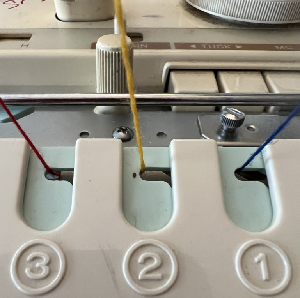
Brother knitters are familiar with yarn placements in the sinker plate.
Position A is for knitting when using only one color or for the ground color in fair isle patterning. There is a “gate”, which is closed, and the B color/contrast motif color is placed in that front position, knitting the yarn in needles preselected to needle position D on the next carriage pass.
It is tempting to leave the gate open when switching colors by hand frequently, and that may work for a while, providing tension is placed on the yarn manually to keep the yarn back. If at any point the yarn shifts forward (green arrow), with no needles in position D, stitches will be dropped.
Textured stitches can make for more complicated correction of errors or dropped stitches.
Taking the extra seconds to close the gate (red markings) after each color change avoids what became fondly known as “dropitis” in my classes. 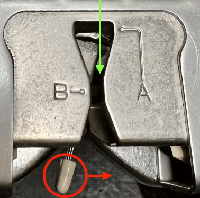 The proof of concept: two of the yarns used were acrylic, so steaming to reduce the curling of the swatch flattened the texture.
  At one point Studio published a newsletter with cover art composed of simple drawings, such as this, for #143, which spiked my curiosity,
 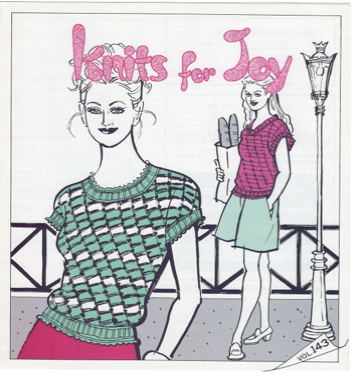 and led to these explorations:
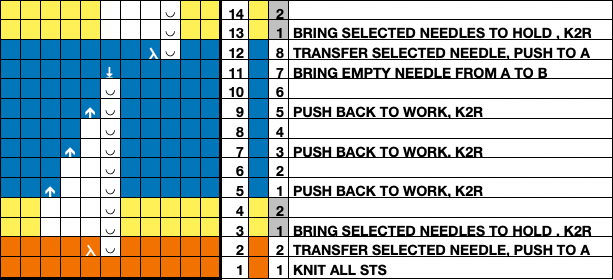
the pattern and symbols refer to tuck stitch, but technically the design is executed using short rows and transfer techniques.
The programmed repeat selects needles, making tracking actions easier.
End needle selection is canceled.
No cam buttons are in use.
The knit carriage is set to hold.
Stitches on the single needles selected on rows, 2, 12, 22, etc, are transferred onto the needle on their left. The empty needle is then pushed back to A position, out of work, creating a ladder.
The groups of 3 preselected needles are pushed out to hold, the D position, before continuing.
After every 2 rows knit, a stitch on the left is pushed back into work, until lastly, the empty needle is returned to the B position.
All needles will then knit for one row filling in the empty needle with a loop and a full knit stitch on the next pass where transfers begin again. 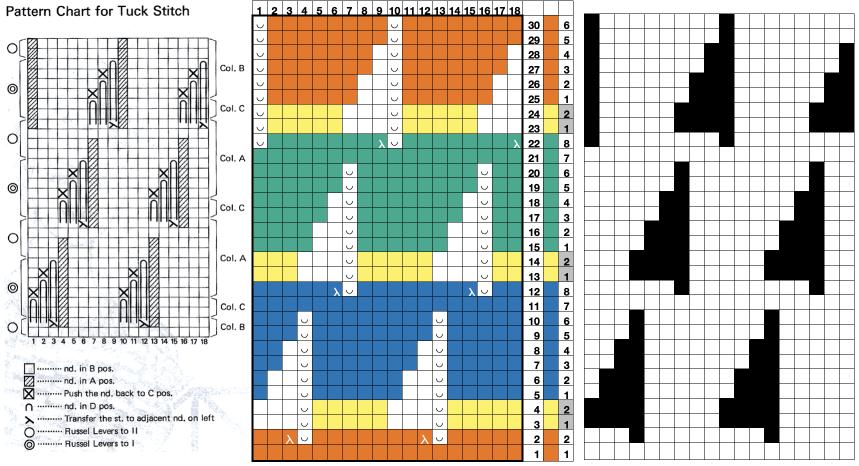 A brief summary of stitch manipulations
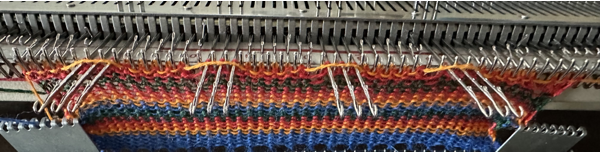
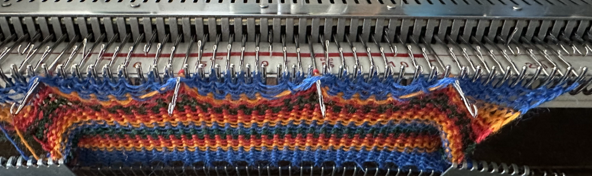
  Images of the work in progress, a small claw weight single claw hung on edge stitch helps keep side edges equal in length:
preselected needles initially manually brought to hold position after the first carriage pass to the right
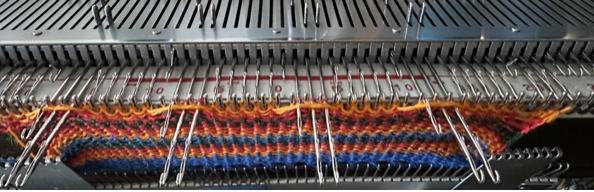
 after the second carriage pass to the left, with the first needle on the left in each group pushed back into work
  the second needle on the left in each group is returned to work
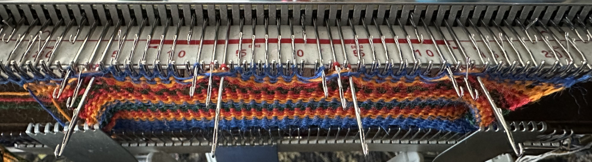 one needle in each group remaining in hold pushed back into work
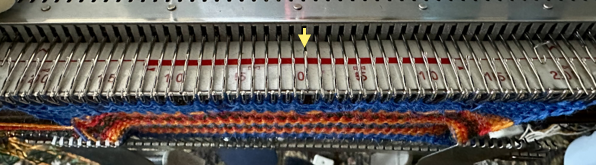
  at this point the empty needles have been brought to the B position,
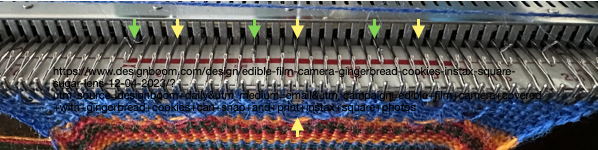
  single preselected needles have been transferred to the left, and a pass is made forming loops on the empty needles/ eyelets
  The original 18X30 repeat, some machine models and download software may require that it be mirrored horizontally,
  repeated to 44X30 with a planned distribution of plain stitches at sides, knit in 2/18 wool blends: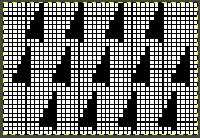

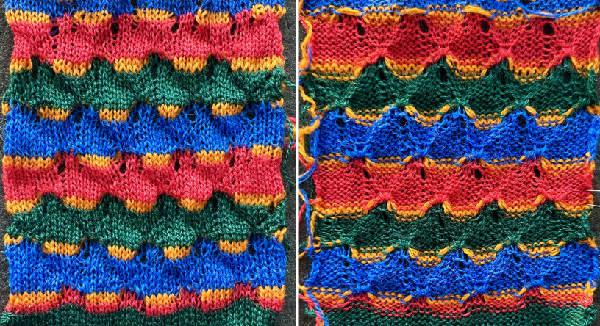 Converting random transfer lace designs poses different challenges, and since the time at which the reference post was published, there have been several Gimp updates.
Lace designs contain few black and white pixels and, at times are brand-specific. Multiple transfer lace in Studio models begins with 2 blank rows, while Brother begins with a design row, and ends with 2 blank rows. As given, the inspiration repeat is designed for Studio/Silver Reed.
When using any program, ie Gimp, ArahPaint, or even Dak, the original scanned or screengrabbed design needs to be aligned horizontally and vertically to window borders for accurate conversions.
Gimp:
Before any scaling of images, establish stitch and row counts. In this case, they are published as being 16 stitches X 96 rows.
The process for converting the same lace design using Gimp 2.10.34 on the Mac, beginning work in RGB mode:
1. drawing a straight line to the side of the cropped image reveals a slight lean to the right
2. using Image, Transform, and Arbitrary Rotation -0.30 improves the alignment 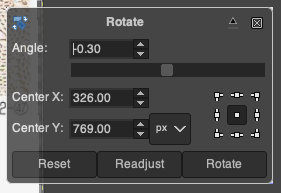 3. using the rectangle tool, crop to the borders of the published image.
In this instance, the cropped image measuring 199X938 pixels is at first scaled to multiples of 10 for both width and height, note the broken chain link
4. 160X960 pixels. 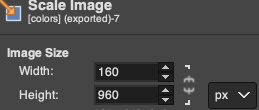 5. Image mode is changed to B/W indexed, and the image is scaled once more to 16X96, the size of the expected repeat, note the intact chain link
 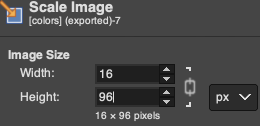 6. the final repeat, when studied, matches that from the results in the previous post
 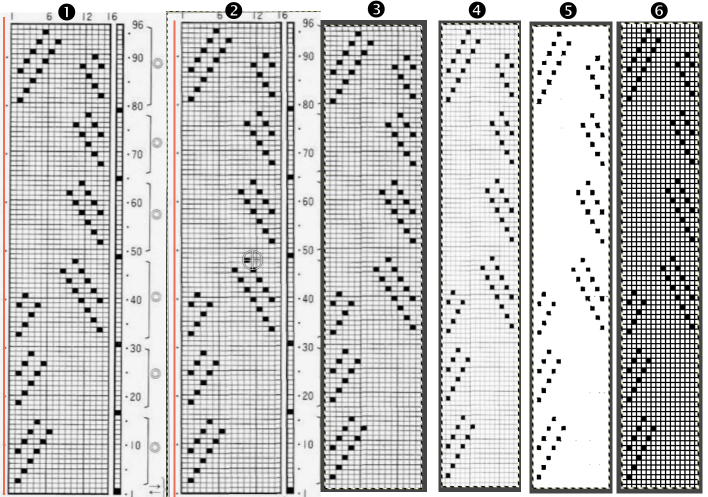 1: the result using ArahPaints tools, including its guess weave from grid, compared to
2: the Gimp final image and
3. borrowed from the previous post illustrating other considerations before actual knitting, 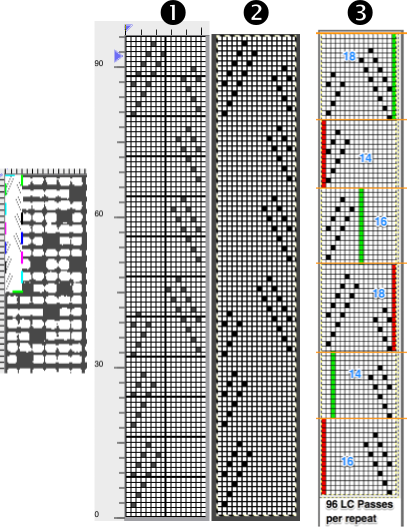
which include:
if using the repeat on Brother machines, the first 2 blank rows of the design are shifted to the top.
The 16-stitch design width makes it suitable only for electronic models.
The final PNG is actually downloaded as a fair isle pattern while maintaining the required needle selection for lace, and the knit carriage remains set to knit throughout while the lace carriage selects and transfers.
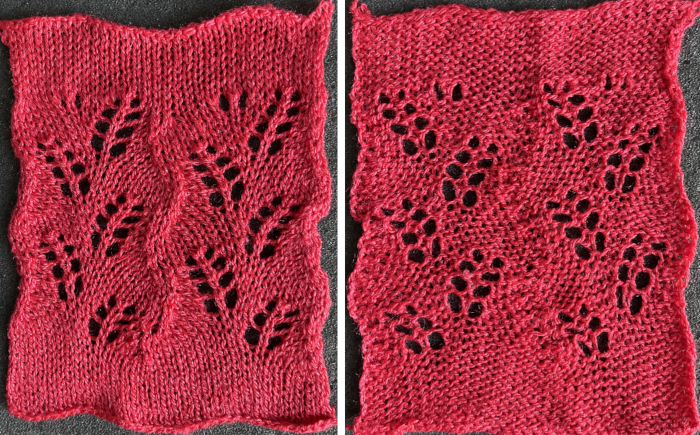
The machine, depending on the model, may by default mirror the result vertically, so the final PNG can be mirrored and saved as here, prior to knitting on the 930,  or the mirror function in the machine may be used after programming.
I prefer to save my files in the orientation required for the actual knitting as a means to avoid confusion or errors.
Working in Arahpaint, rotating an image turns it on its center point. To rotate a layer, selection, or image, from the Image menu, choose Rotate. 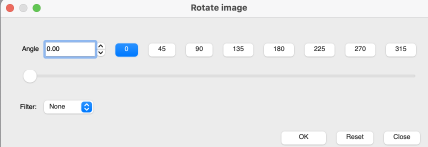 Selections can be made at offered angles, or specified degrees can be entered in the degree field, or select an area, move the pointer outside the bounding border, and then drag on any one of the small boxes at each corner while pressing the left mouse button.
 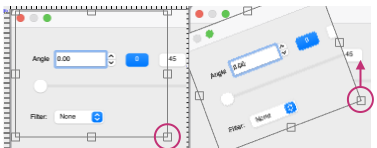 To align the image,
1. load the lace inspiration
2. choose Image, select Rotate Image, and draw a line that follows the orientation of the image. The color will be based automatically on the palette being used, and altering the pencil pixel size or color has no effect.
The program then rotates the image and will inform you of the rotation angle, and the drawn line becomes straight.
To confirm alignment, click the OK or Close button in the Rotate Image window.
3. use the rectangle tool to select the content for the full design repeat, and crop the aligned image to the selection. 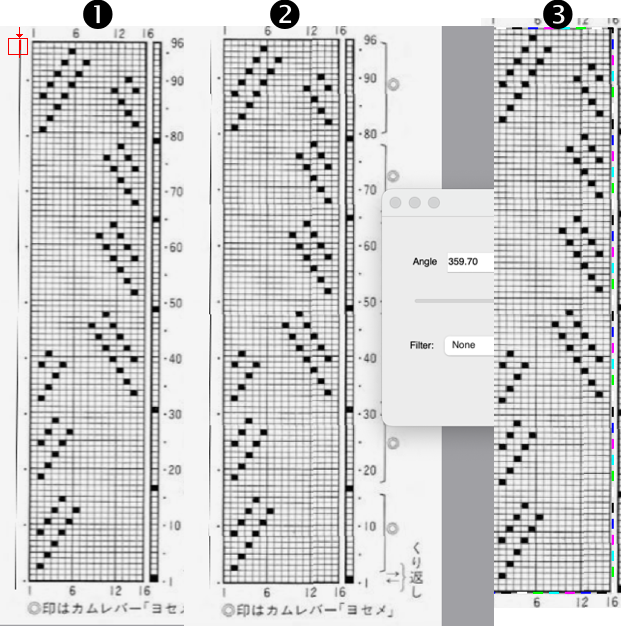 4.-9. continue with the steps using the tool Guess Weave from Grid, producing the same final PNG. In summary, they are:
4. crop the selected image to size
5. change the color palette to 8-bit, adjust background and foreground colors
6. reduce the number of colors to B/W, adjust the threshold, and set the number of colors to 2
7. the resulting image
8. use the guess weave from the grid tool, crop the bounded image to the selection, magnify the results to visually check the repeat, and save the PNG if satisfied
9. the final 16X96 pattern design repeat, matching the Gimp result. 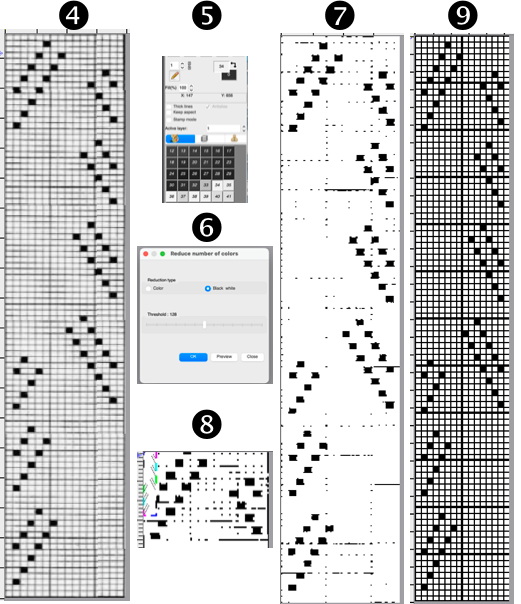 The associated swatch
  This Pinterest find is credited to Tatiana Demina, and is intended for use on Studio punchcard machine models.
 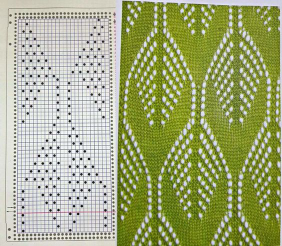 Studio machines are capable of transferring and knitting in single carriage passes. Studying the image of the card, it can be seen that there are no blank rows anywhere, and punched holes on alternate rows indicate transfers alternating first to the left, and then to the right.
The swatch was knit using the same technique described recently in the post Unconventional uses for punchcards 2: thread lace cards for “filet” mesh
The original 24X56 design 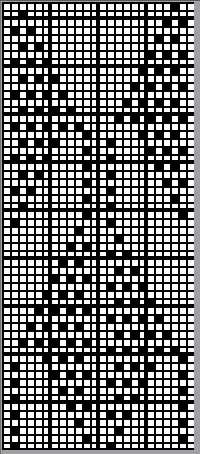
 was lengthened X2 to, shown here also doubled in width to 48X112
 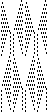 to match the direction of the transfers, the hint offered in the inspiration source can be followed down to indicate the first row of transfers need to be made to the right,
 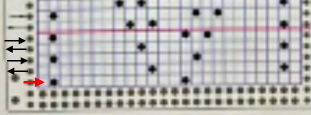 hence the knitting begins with the knit carriage on the left, the lace carriage on the right. As the LC moves to the left it preselects needles, and as it returns to the right it transfers them to the right.
The LC is removed from the knit bed.
The KC knits a single pass to the right and remains there.
The LC is returned to the knit bed on the left, preselects needles on its pass to the right, and transfers them to the left as it returns to that side, and is removed from the bed.
The KC knits one row to the left and stays there.
The LC is returned to the bed on the right and the process is repeated.
Preselection of needles is made by the LC toward the knit carriage, transfers are made away from it.
Whether the repeat needs to be mirrored again may depend on the machine model or the software used to download the file to it.
The direction of the first row of transfers provides the necessary clue, they need to be to the right. If to the left, mirror the pattern horizontally and begin again.
The swatch was knit in a wool-rayon blend, the results point to the difference in appearance and gauge with a change in color and type of yarn used when compared to the inspiration image 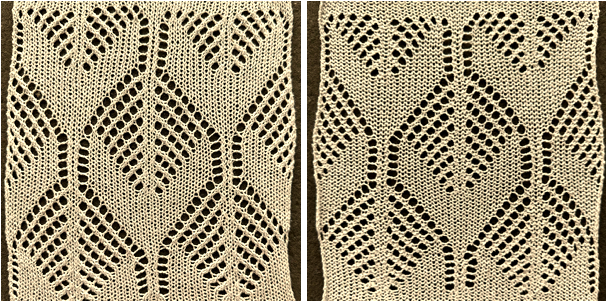 The context for this can be found in To mesh or not to mesh 8: more Numbers meet Gimp
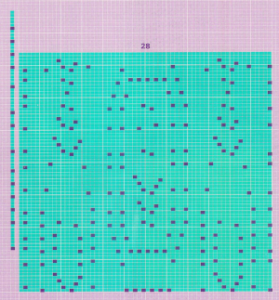 the 60X74 png
  and the proof of concept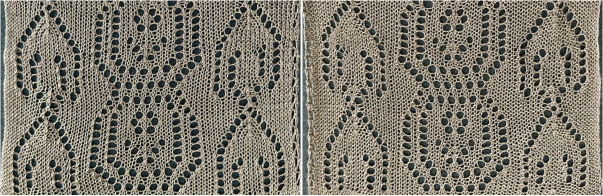
Traveling between brands, Duo and E6, settings and techniques
The old pattern books for specific machine brands picture fabrics in many exciting textures.
This post includes information gleaned/ collated from several decades-old references and is shared as a possible starting point in exploring translations between brands.
I welcome being contacted if any knitters more experienced than I notice any errors.
The Duomatic locks compared with those of the E6 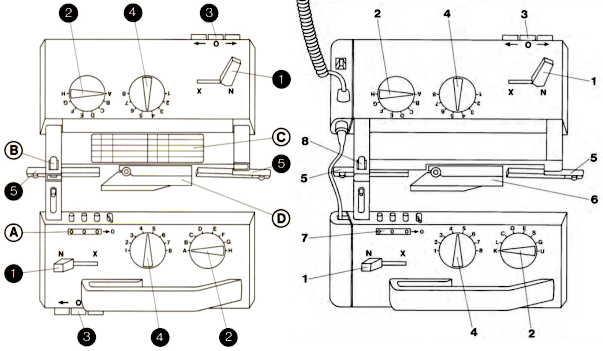 Arrow keys
Left <– reverses pusher position as the lock moves from right to left
Right –> reverses pusher positions as the lock moves from left to right
Both <–> reverse pusher positions every row
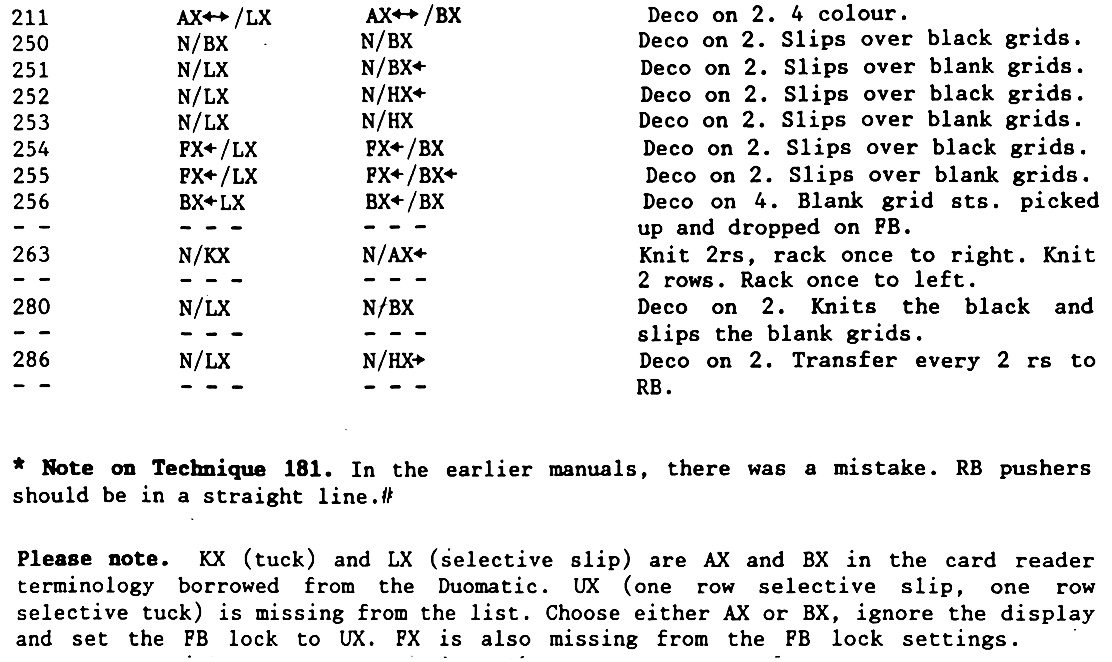
More on the lock settings, and planning follow-up swatches for some of the suggestions in the future, 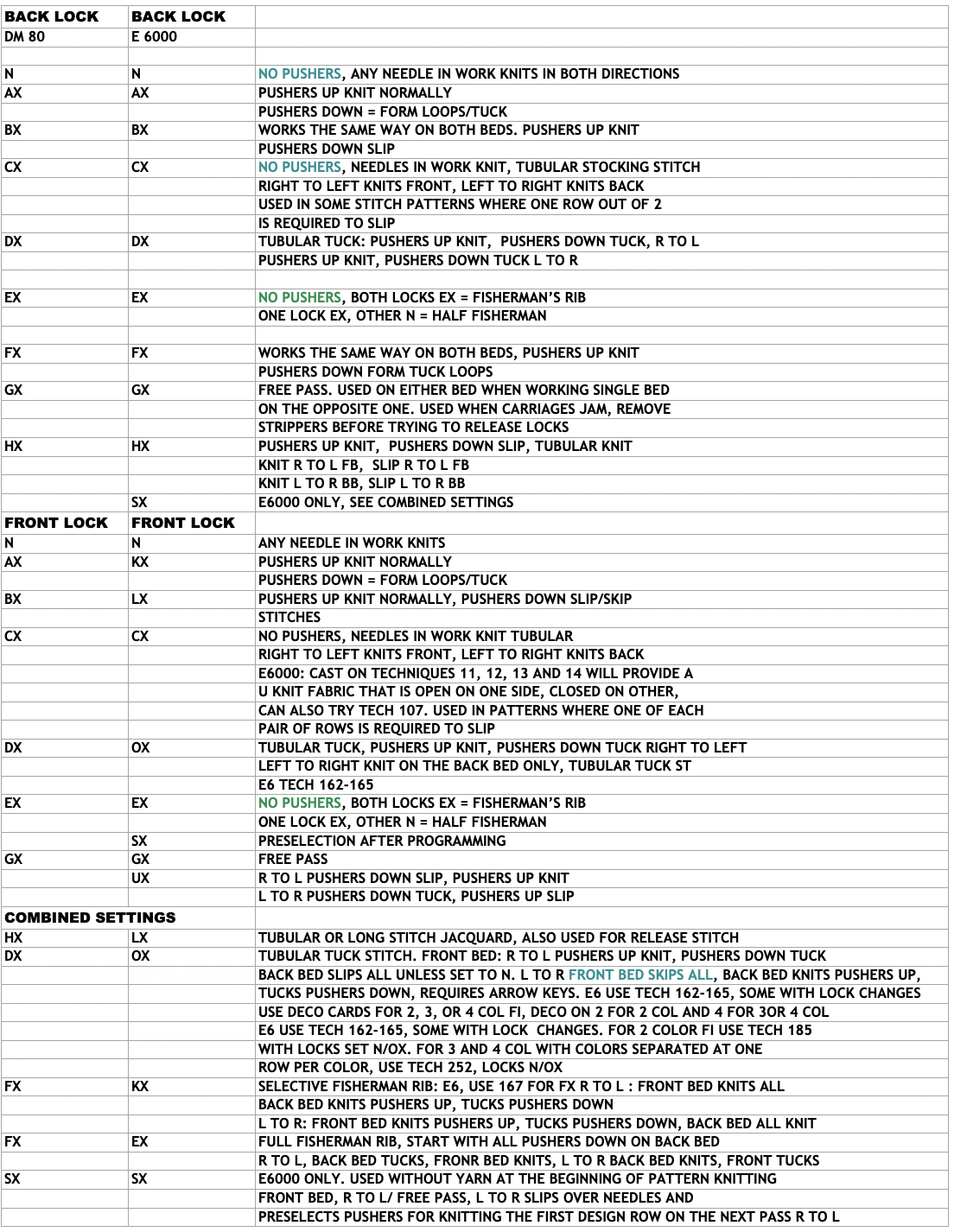 Traveling between Duomatic and E 6000 patterns is helped by tables showing the relationship between the Duomatic and E6 lock settings.
Duet Magazines #13 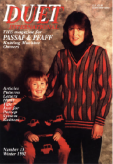 and #14
 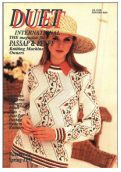 began a series attempting to match technique numbers in the Passap E 6000 to Duomatic techniques, which seemed to stop at that point. E6000 vs duo_ duet
The topic was popular at knitting machine seminars, and several other authors published their collections, offered at seminars such as Passap University and Passap Clubs. Many of the references in my collection are several decades old.
Color changes in text indicate changes in instructions, suitable for 3 and 4 colors, and with transfers from one bed to the other
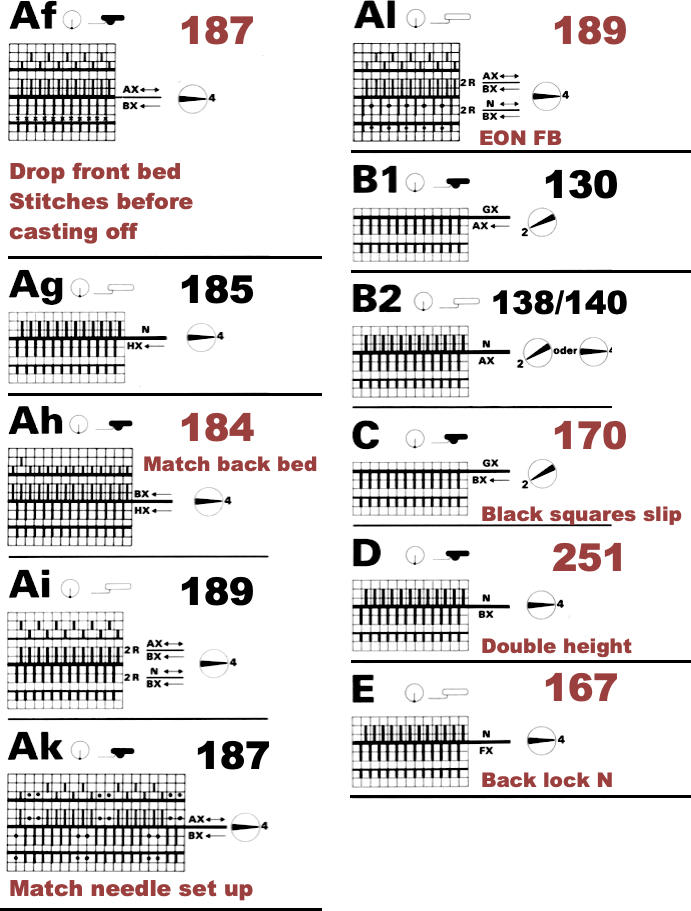
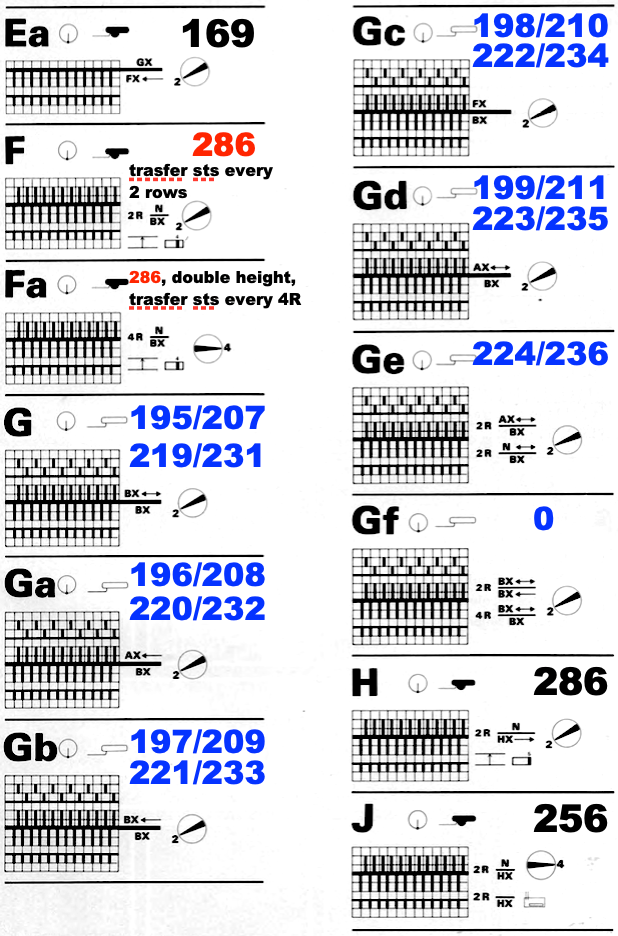
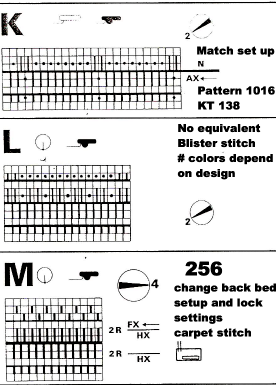 From the Duomatic purchase, collection
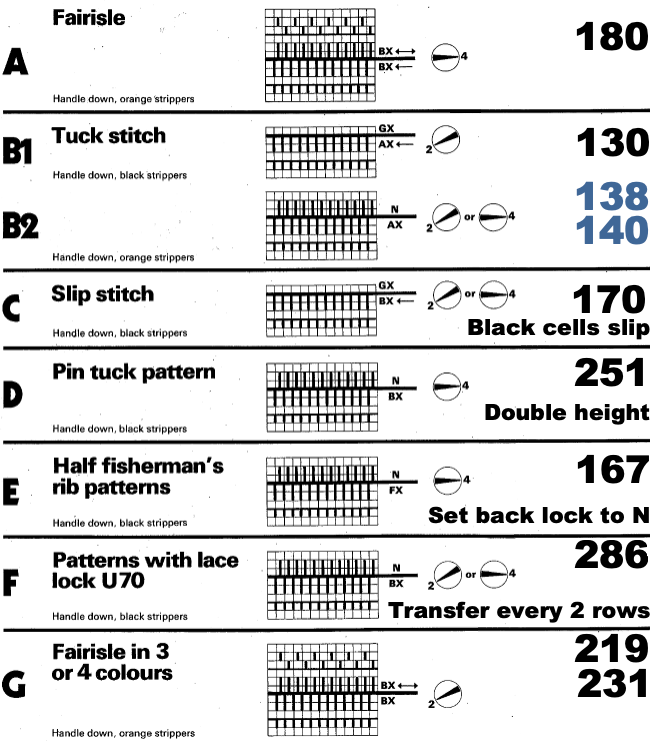 This is a copy of a Passap University handout, contributed by Eileen Metcalf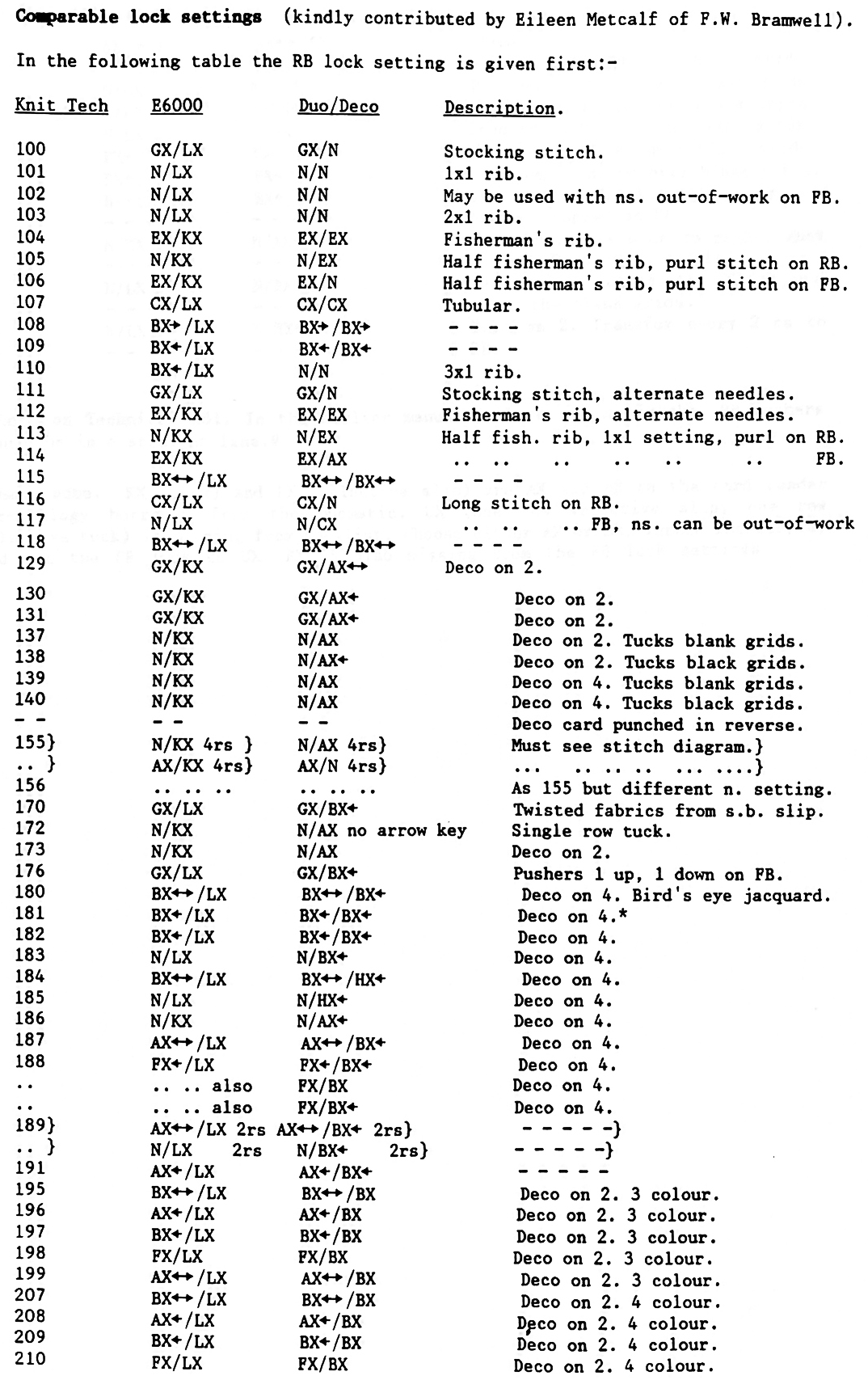
Recipes for rib jacquard fabrics: E6000, Brother
Anyone reading my blog is likely familiar with my selection of topics based on the latest rabbit hole to attract my attention and elicit a leap on my part, a derailment of sorts.
Supplements to the manual were published when the model first became available. Duet often offered very valuable tables, ie an electronic pattern matching chars in #6, pp 21 and 22
I still own an E6000, but it has been used infrequently in the past few years.
When my iMac was replaced with a new one with an M1 chip I purchased a PC to use for knitting downloads that were not possible on the Mac.
At present, I am working on establishing downloading to the Passap from the PC using Wincrea, the Croucher cable, and a USB to a serial connector, and am considering exploring some knits in the spirit of how and why the stitch formations happen, still comparing the results to those using Brother knitting machines.
At one point, I taught advanced knitting workshops to textile students and immersed myself in gathering pertinent information before doing so.
Every one of my Passap manual pages is pretty much marked in a manner such as this. At the time, the added notes made perfect sense.
A couple of decades later, my scribbles require deciphering, and I find myself wishing for what might have been an expanded notebook with notes that would make better sense now.
A place to start: the 2-color double bed techniques, mad hatter scrawls version: 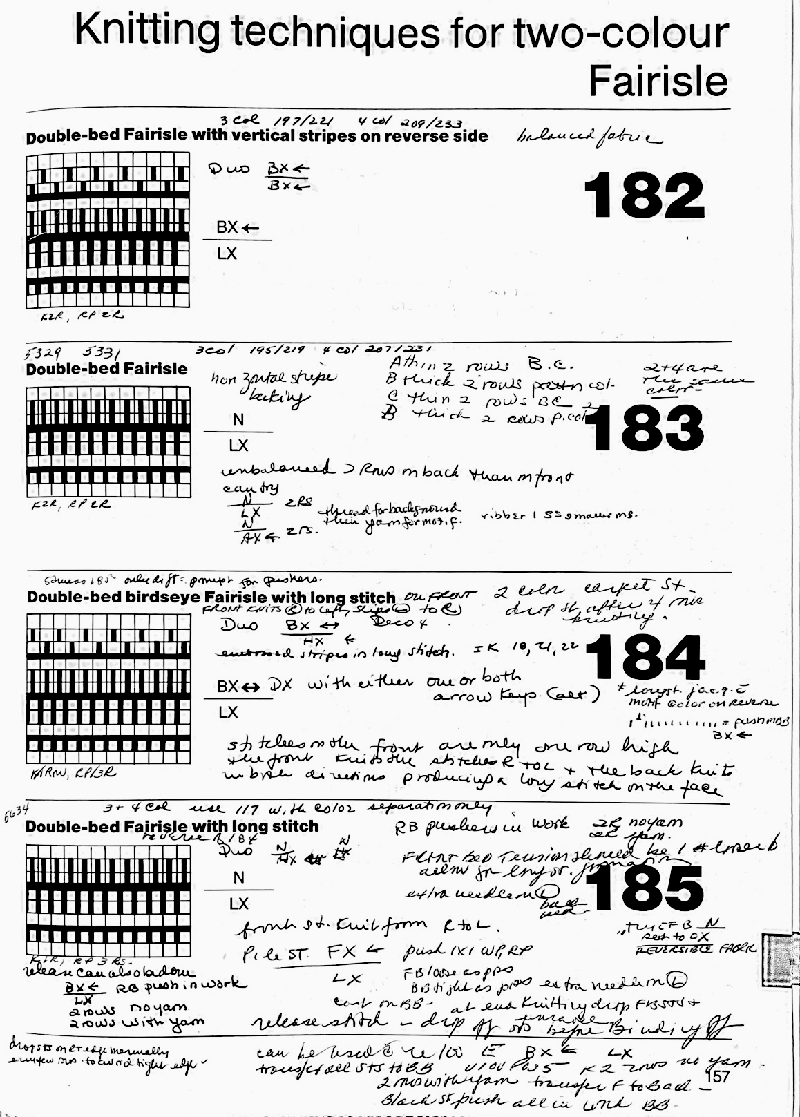
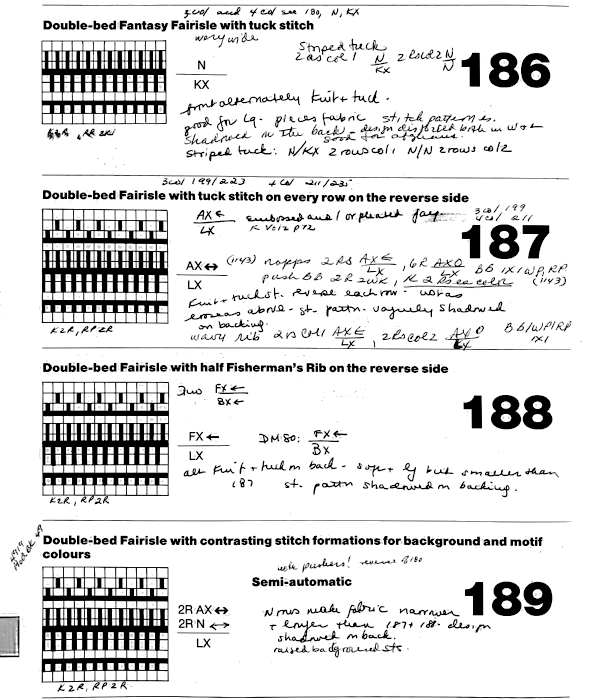
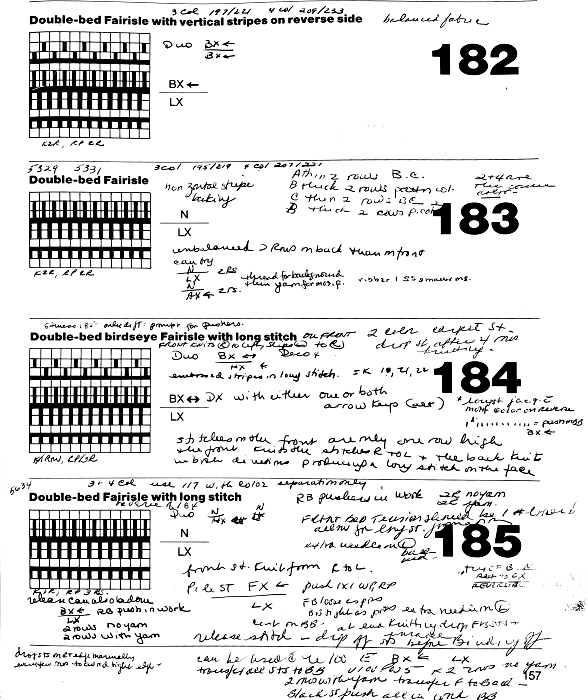
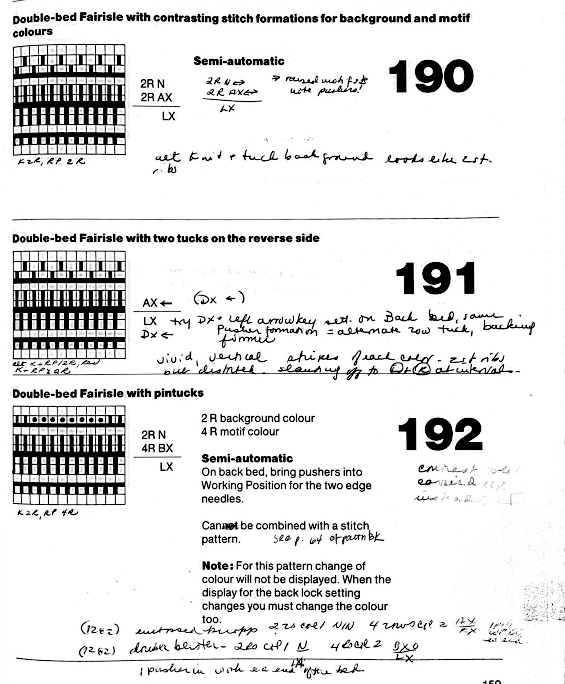
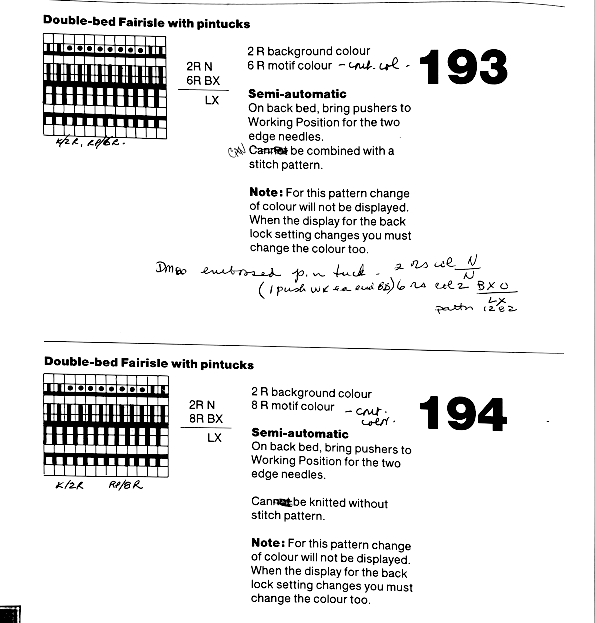
A far more organized source of information: http://www.needlesofsteel.org.uk/downloads/Passap%20DBJ%20Techniques.pdf?
A sample segment from its first page 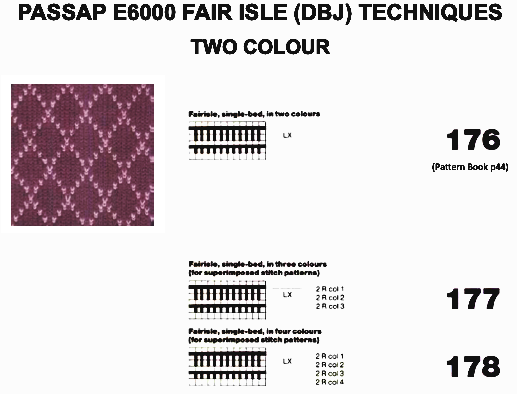 A brief summary of 2-color DBJ techniques that can be executed with no changes to the back lock stitch dial settings on either model.
Downloading full manuals for E6 or Duo will provide full-scale images of techniques and settings.
180: standard birdseye
181: FI with background color only on the reverse side
182: striper backing, Duo AC but pushers one up, one down on the back bed
183: Duo AX <– or N, but the front lock on BX <-
184: birdseye FI with long stitch
185: FI with long stitch/ half Milano, for drop stitch cast on BB
186: fantasy FI stiped tuck stitch
187: FI with alternating tuck stitch on every row on the purl side
187: AE set up for release stitch, drop stitches on the front bed
188: half fisherman rib on the purl side
191: two rows of alternating tuck on the purl side
set back lock to AX with left arrow key, can try DX<–
It is easy to accumulate pattern books from brands other than the machine brands in our stash.
Arahpaint’s guess weave from grid makes converting published repeats to pngs quick and very often with little or no cleanup. From the Deco pattern book, 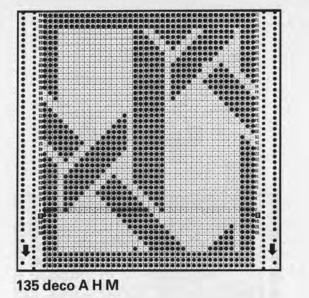 trimmed to 400X400
 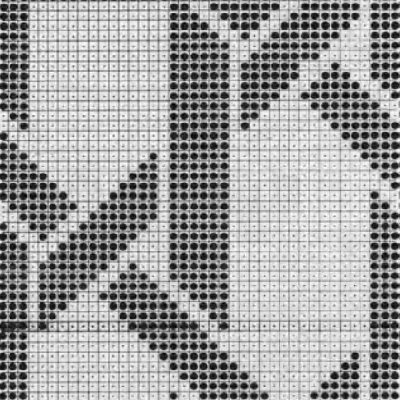 cleaner results were obtained using the color inverted image, in turn cropped to selection,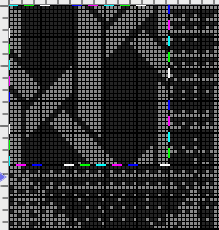
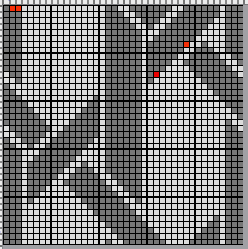
 color inverted again, drawn in repeat to identify any missing pixels (red)
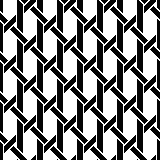
  palette to B/W
  the design drawn in repeat again to check alignments
 Some Passap designs as ready to knit pngs may be found in this download from Knitstudium
References to Passap machines in my blog post so far:
Passap Duomatic and Deco pattern musings
Two color dbj, non-repetitive images, electronic km for when using designs copied directly from patterns published for use on Japanese knitting machine models
Ribber pitch, a bit on racking 1: chevrons/ horizontal herringbone
Racking 2: vertical chevrons/ herringbone +Brother/Passap: traveling between brands
Another racking tale: Passap/Brother 5
A racking tale: Passap/Brother 3
Racked patterns 5: Passap/Brother 2
Fisherman-English rib 1: checks patterns_ Brother, Passap
Tubular machine knit fabrics: fair isle, Brother/Passap
Pile knitting on Passap and Brother KMs 3
Pile knitting on Passap and Brother KMs 2
Pile knitting on Passap, Brother, and Studio KMs 1
Drop stitch lace, 2 colors per row, Passap KM
Back to leaf lace, add rib, and take it to the Passap
Japanese punchcard motifs used in Passap E 6000 machines
Translating Passap model book pattern/use on Brother 1
Knit bubbles and “stitch ditchers/dumpers”
More Truchet inspired tiles, a brief look at gradient filter use
The latest ArahPaint user manual download, updated on February 9, 2023, includes added directions for drawing in repeat including a truchet/Smith tile variant.
This post will not provide specific how-tos, the pngs can be downloaded and used to perhaps test Arah’s features or to aid in finding a personal, preferred method for manipulating DIY designs.
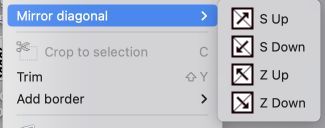
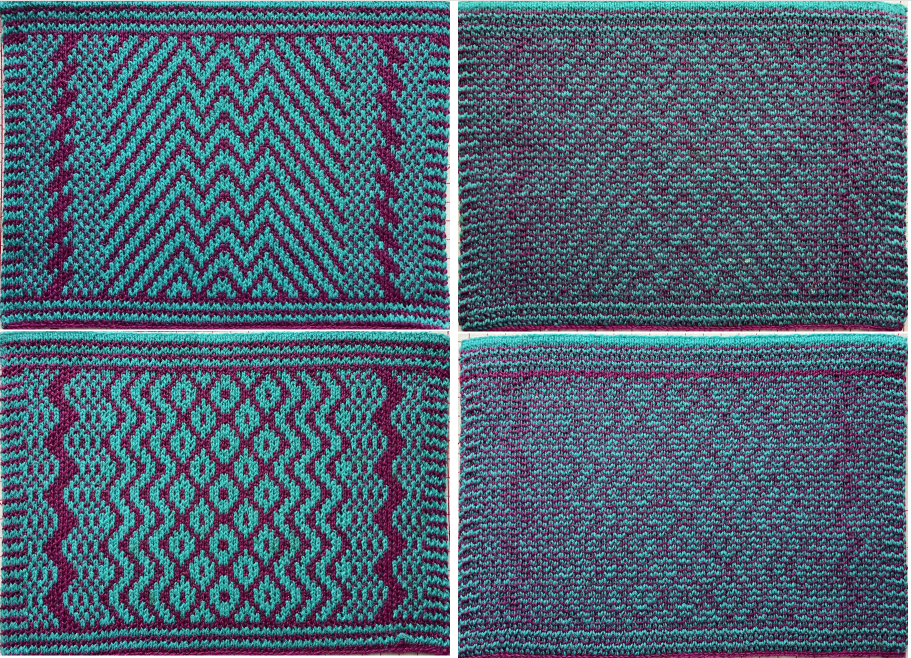
There are additional Arahpaint options for altering designs in width and height which may be used progressively on the same image. Some in the group of edits and rotations are evocative of the Passap console’s Alter programming loop. 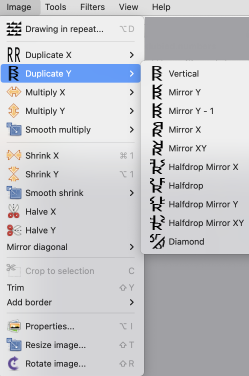 Lower in the same menu, diagonal mirroring opens yet another series of possibilities.
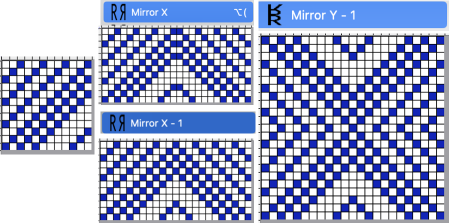
  These samples were produced in a Passap workshop, using the console Alter, add commands. Note that mirrored areas have identical pairs of side-by-side pixels at their meeting points,
  while ArahPaint offers an opportunity to change that, a thing to keep in mind when returning to simpler motifs such as those used for tuck stitch. Performing the rotations, however, will render the result with an odd number of pixels in width, often making them less likely to be usable in punchcard models
  My area of interest has been primarily and still is in creating textures beginning with small repeats that may grow in complexity and size to make the structures programmable and thus easier to track and execute.
Presently I rarely engage in multiple color motif work ie fair isle or other large-scale textile pattern applications but my curiosity in applied techniques has led me down this potential giant rabbit hole.
The speed and ease of drawing variations for repeats using ArahPaint make the process addictive.
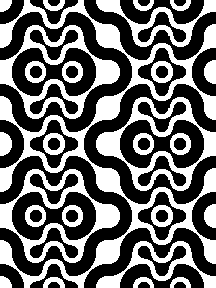
The source of inspiration for this design series is “The curse of truchet tiles”.
When recognizable circles are a goal, these tiled motifs often begin with starting sizes as wide as the 24-stitch standard punchcard repeat limitation, and the manipulated larger motifs are suitable only for electronic machine models capable of accepting software downloads. 


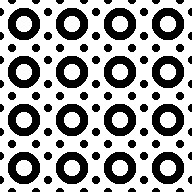 Adding lines and extra dots of circles


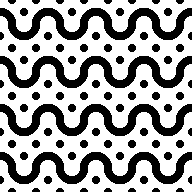
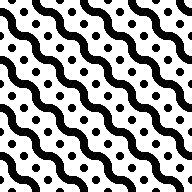
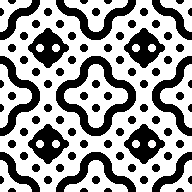 Isolating fractions and individually rotating segments to draw again rendering larger repeats


 More info on knitting DBJ using more than 2 colors per row:
DBJ: more than 2 colors per row 3 3/22
Img2track_multiple colors per row dbj, each color knitting only once 1/21
DBJ: more than 2 colors per row 2 12/19
DBJ: more than 2 colors per row 1 12/19
Adding one more color to the last repeat whole planning a knitting a test at a max of 3 colors per row knittable in a single track

 The img2track window
 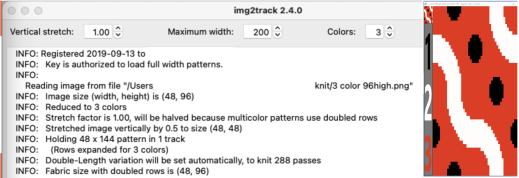 Positions of the respective yarns in the color changer as suggested by the program result in accuracy prompts by the machine on which of the respective colors should be in use at any one time.
  Planning gauge-dependent pieces using large repeats requires large test swatches, generally a minimum of 100 stitches by 100 rows.
Adding and varying the colors in the design draft to match the yarns to be used in the repeat helps to visualize the possible result, and allows for using the sequence suggested by the download program to help track the proper color changes.
The test here is 60 stitches wide, knit one full repeat in height, measuring 7.5 inches in width by 11.75 inches in height after resting. On rows where the colors for the dots and squiggles may knit in small parts or not at all, there will be a preselection of large groups of needles such as seen here. 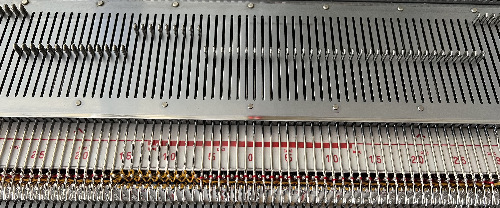 Birdseye setting is used to decrease motif lengthening. The img2track user manual describes the steps necessary for downloading to different model knitting machines and possibly using more than single tracks.
 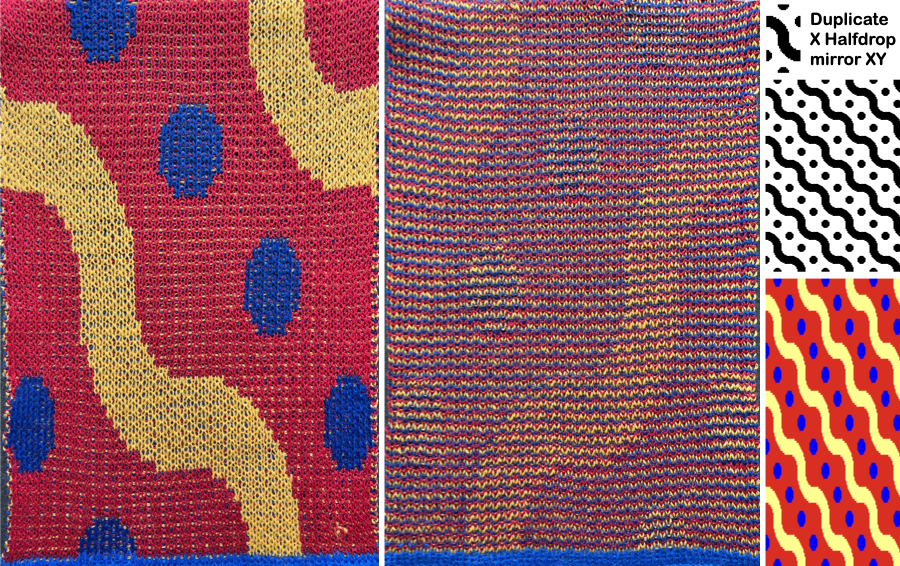 A series inspired by another of the tiles in the linked publication
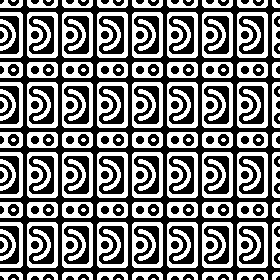
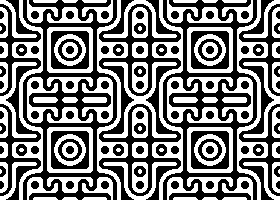 Similar to one of the source repeats, increasing the balance between light and dark
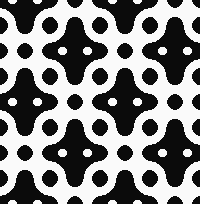 Open areas or specific rotations in the visual space may be created by eliminating or rotating individual segments.
To change the mirroring type, place a mouse pointer over the arrow that you want to change, and press the left mouse button. The arrow will jump to the next mirror type. With only 5 mirror types, you will get what you want in a maximum of 4 clicks. If you press the right mouse button, it will put the arrow to the default orientation. 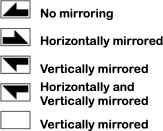 The result of course is dependent on the original file choice.
 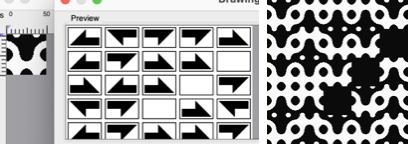 Combining duplicating repeat variations with drawing in repeat helps one develop a DIY library of favored tilings. Begin with a possible background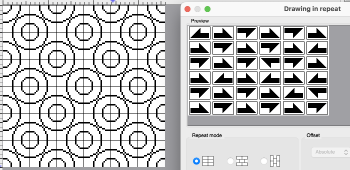
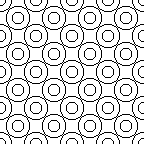 Tools/ Find Repeat
  Aiming for knot variations, a cross-over to add to segments of the ground, manipulating individual tiles, adding copy and paste


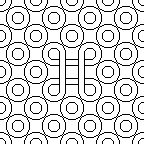

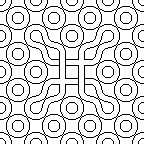 More play with manual duplication of tiles as opposed to drawing in repeat
 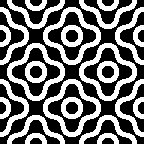 Combining different scale repeat segments, starting with 54X36 pixels
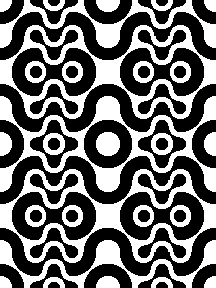
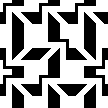
 And it’s not all about just circles, a 36X36 pixel design to play with
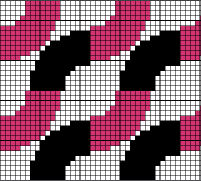
 A reminder, if the plan is to add color in continuous lines, it is best to place the colors after the full design repeat has been developed rather than on the individual starting tile segments, For some, this would be considered a design feature.
  A very different look may be achieved using any of the available filters. A square image of any size may be filled with a color gradient while keeping in mind the fact that knitting is very low resolution and the maximum number of available needles for patterning is 200 or under.
Beginning with a 20-stitch file.  Below the software tool options on the right, click on the tool in the area marked with the red shape
  to produce a design that may then in turn be drawn in repeat
 No edges were cleaned up in this view. The design meets the maximum 200 pixels/needles size
 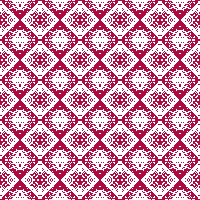 Going larger, an 80-pixel start to end with a 160-pixel blanket or tapestry suitable image with some wiggle room for adding a frame/border.

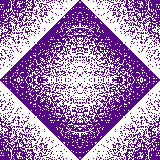
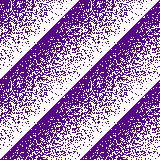
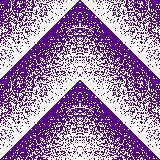 The concept may be used in various densities for use in an accessory such as a scarf,
 spaced and colored to your liking,
 or even sweater bodies and sleeves planned specifically based on stitch and row counts for each of the pieces involved.
 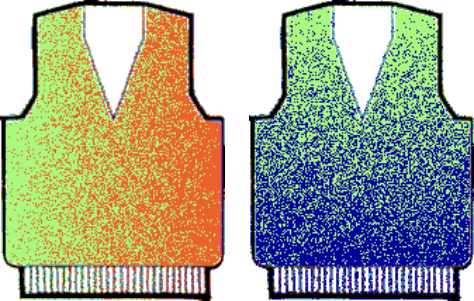 Filters may also be applied in developing other stitch structures in addition to working with color motif designs. That topic merits its own post.
A “fast pattern” user guide shared by the ArahPaint 6 developer October 2023 which demonstrates how to use filters with associated designs https://www.arahne.eu/pdf/fastpattern-EN.pdf
Truchet tiling design inspiration 1
For many years my knitting of accessories and wearable pieces was my source of income, guided by what pricing the local market would bear, the limitations of mylar sheets or that of an early Passap interface to program repeats, and the amount of time required to complete each piece.
There is practicality and ease in playing with colors using small motifs single-bed, and varying materials and yarn plies allowed me to aim for limited edition designs without looking at identical finished products more than once or occasionally a few times.
At first, Ayab and then img2track changed the playing field in terms of downloading and programming designs.
Eventually, my knitting moved from production pieces for sale to creating samples for my blog almost exclusively.
I have had a long and continued interest in math-based designs, and knit a line of accessories using automata-inspired repeats, often limiting the repeats in size to ones that would align vertically without having to program multiple DBJ segments, reducing the possibility of programming errors in scarves that would often require around 1200 knit rows in length.
A 930 followed the 910, this, knit in July 2021, was my first try at using img2track to download multiple tracks.  There are many ways to yield math-based patterns, and nowadays online generators and reference sites abound, making it possible for nongeeks to use the resulting files to create knit suitable designs.
Some recent Truchet tile images shared on Instagram brought me back to exploring math-based images and what by default needs to be executed as larger-scale design motifs in knitting.
Sebastian Truchet was a Carmelite priest whose “Memoir sur les Combinasions” was published in 1704. It is a wealth of patterns built up from a simple motif, which you can see here
http://gallica.bnf.fr/ark:/12148/bpt6k3486m.image.f526.langFR and in which he discussed squares, half black, half white, split into triangles, with four possible orientations for each tile. He was also the inventor of the point system for indicating the sizes of typeface fonts.
His method of tiling by the combination of manipulating four-letter codes, A, B, C, and D, in rotations using triangular shapes inspired new variations in tilings.
Cyril Stanley Smith introduced two alternatives to the basic Truchet tile in 1987. One uses only diagonal lines to create maze-like designs where the coloring is removed and only the boundaries remain. The other, resulting in the designs produced in this post, uses quarter circles that may be filled or used as outlines and rotated to form the final shapes. 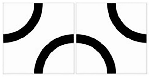
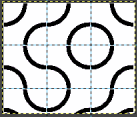
 Distinctions in naming the tiles are not often made. “Truchet” is the commonly used generic term.
Some articles on the tilings:
Generalizations of truchet tiles, Multiscale Truchet Patterns, The Tiling Patterns of Sebastien Truchet and the Topology of Structural Hierarchy, and More on tiles, fun with portraits.
Basic elements include contrasting triangles, quarter circles, and diagonal lines.
One may find code for programming DIY in various GitHub links. Python is far beyond my interest or skill, there are many ways to achieve the designs.
Spreadsheets are also programmable, but require the development of formulas.
Developing patterns from online sources, beginning with the Smith variation using quarter circles: the Wolfram site is a computing and math one well worth exploring, the files there are Computable Document Files, a document standard developed by Wolfram Research. They can be saved and opened using the Wolfram CDF Player, which is a standalone application and a Web browser plug-in provided for free.
To preview search results in a browser: https://demonstrations.wolfram.com/TruchetTiles/.
Ad blockers may interfere with proper previews in Safari but appears to not be an issue using Chrome as the browser.
Files cannot be saved from the preview results other than as screengrabs.
What is cdf
For permanent access to preferred CDFs:
CDF Wolfram player download is available for Mac and Windows, you will be asked to provide an email address.
After the player is installed and opened, click on the central option,  and search for your area of interest.
  Any demonstration may be saved for future use, most are customizable to varying degrees.
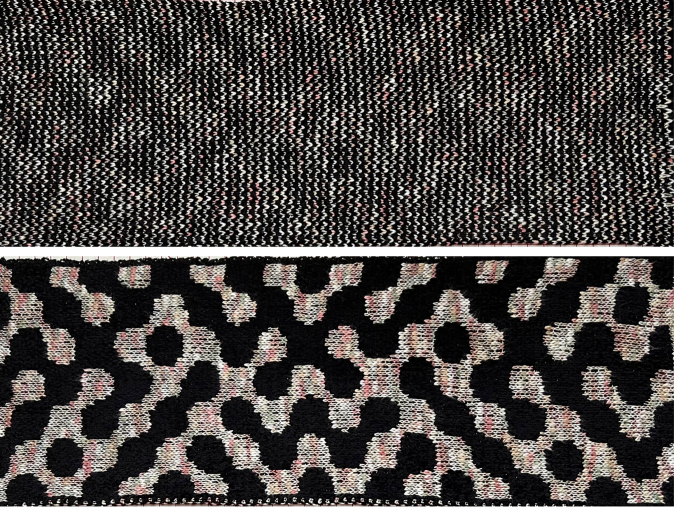
In my first effort, I used colors and left the black outlines. The second, simpler method of editing follows below it. 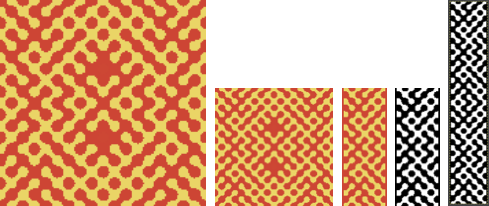 The swatch png, 58X150, includes 2 stitch vertical borders in the dark color. The machine was set to the built-in KRC color separation for DBJ. Some of the circular shapes have been already edited, but if I were to reuse the repeat, I would clean up more of the design shape edges
160 design rows were knit, measuring 7.5 inches by 20.5.
The dark color is a chenille from an unmarked cone with uncertain yardage. The space-dyed is an 8/2 rayon slub.
Tension was set at 5/5, the knit carriage on KCI, and the ribber using lili buttons for birdseye backing. KCII may be used as well if preferred, the side vertical edges will have a slightly different appearance. 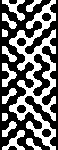
 Developing an added repeat:
the working file in the cdf is a default 600 by 600 pixels. If the goal is to save a black-and-white downloadable png, the present plan is to fill in portions of the design with black while leaving others in white.
Checking tiling insures continuous designs at any point in the process.
It is possible to directly scale size in the cdf, but the shape outlines become broken in the automatic % reduction, so the filling-in process I suggest fails to be contained. 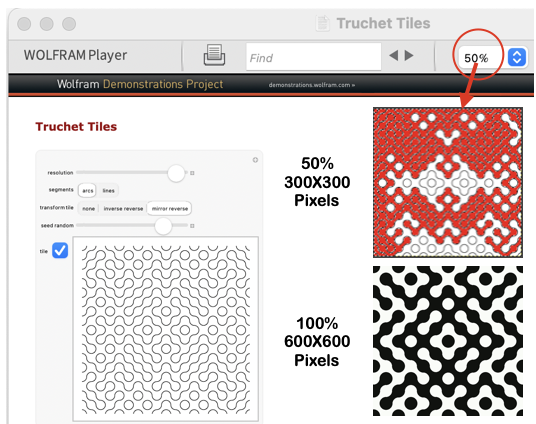 In this exercise, none of the other available parameters were changed. When the player is launched, click on the tile, it will be surrounded by an orange line,
 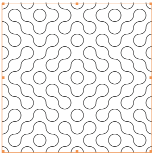 copy the image, and it can then be pasted directly into Gimp.
 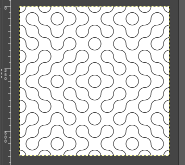 Change the Image Mode to BW Indexed before proceeding further.
Using the fuzzy select tool  click on any area in the design, it will be surrounded by dotted lines
 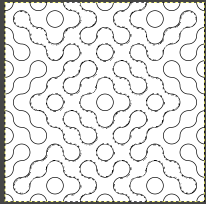 select bucket fill, to fill the selected area with black.
Edit, undo will revert to the previous steps in sequence at any point.
If satisfied, select the rectangle tool.
Clicking on the selected area 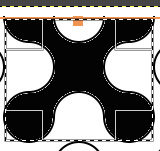 will allow its use for copying and pasting the outlined segment on a new canvas or cropping the area to the selection for saving while clicking anywhere in the Gimp work window fixes the results. The dotted lines disappear. Repeat the process on the remaining image.
 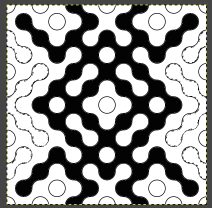 The processed file will measure 600X600 pixels.
Anyone working with large-scale images and reducing file size to make them available for knitting as single panels on a standard machine is familiar with the loss of detail and the need for cleanup of edges as incremental decreases in file size are attempted.
Magnifying any of these will help evaluate forms and scaling decisions for final repeats to be used in knit test swatches.
Downloading or copying and pasting them from here for personal use may change the image mode to RGB in the process, check mode and convert them to indexed BW if needed before any further use.
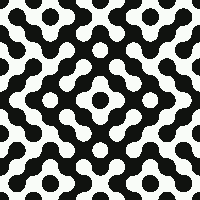
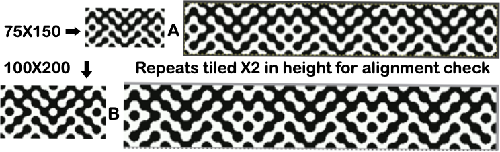
300X300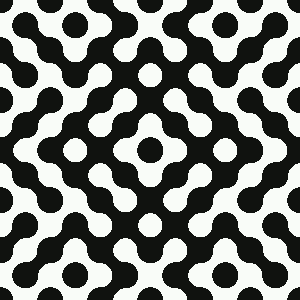 200X200 pixels
  150X150 pixels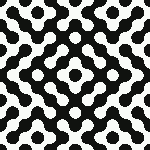
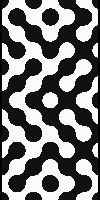
 The proof of concept was knit using the 100X200 repeat without any pixel cleanup.
  The blue yarn is a 2/20 wool, and the white is a 2/28 Italian yarn of unspecified fiber content from my stash. Both beds were set at 2/2. The KRC setting separated the colors so each color in each row knits only once, but it takes 2 passes to complete one row, so 100 design rows translate to 200 rows of knitting. In this instance, img2track used on the 930 broke up the design into 2 tracks, a 66-row first track, followed by a 134-row one.
Each track needed to be programmed sequentially.
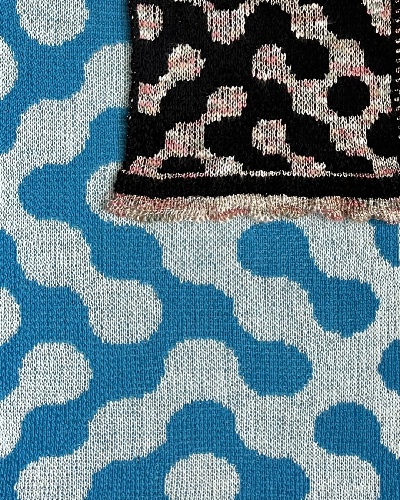
The ribber was set for birdseye backing, which in this case results in an interesting shadowing of the pattern 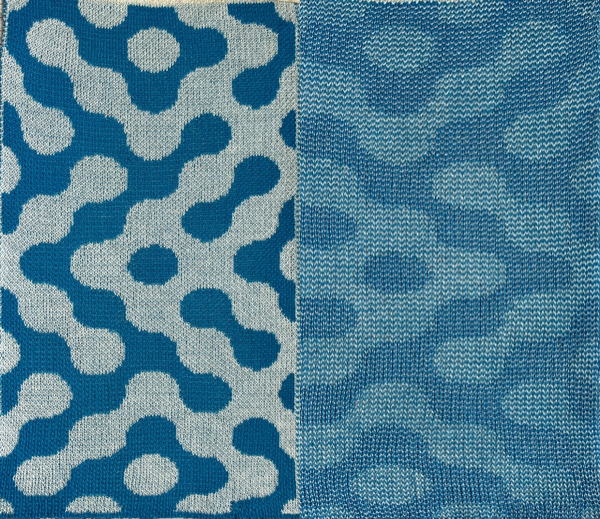 Comparing the two swatches:
  Variations in tiles made by changing variable view options
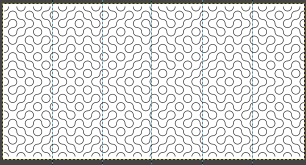
  will still align when combined, easily producing a range of new designs at merging points. Use guides to help narrow down segments of interest, here they are placed at even 100-pixel intervals on two adjoining 600-pixel images.
  To remove a single guide after placing it, go to Edit, Undo Add the Horizontal or Vertical Guide. To remove all guides, go to View, and uncheck Show Guides.
And for those not averse to developing any larger motifs from scratch, the limitations of any geometric shape, when reduced to low-resolution knitting, mean the search must begin for what one determines to be a pleasing circular form. 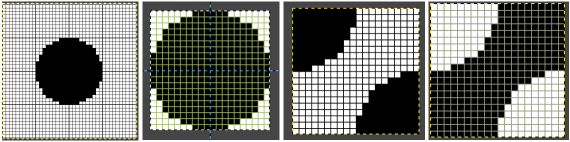 My original circle was placed on a 40X40 grid with outlines every 10 cells, the central circular 20X20 repeat was isolated and split into quarters, in turn generating these 2 tiles out of the 8 total required, also 20X20, with the second the color-reversed image of the first.
 A similar approach can be used in color to visualize the initial 8 tile repeats and their rotations in order to form new shapes. This technique may be useful in planning floor tile patterns but is cumbersome for developing knit designs.
 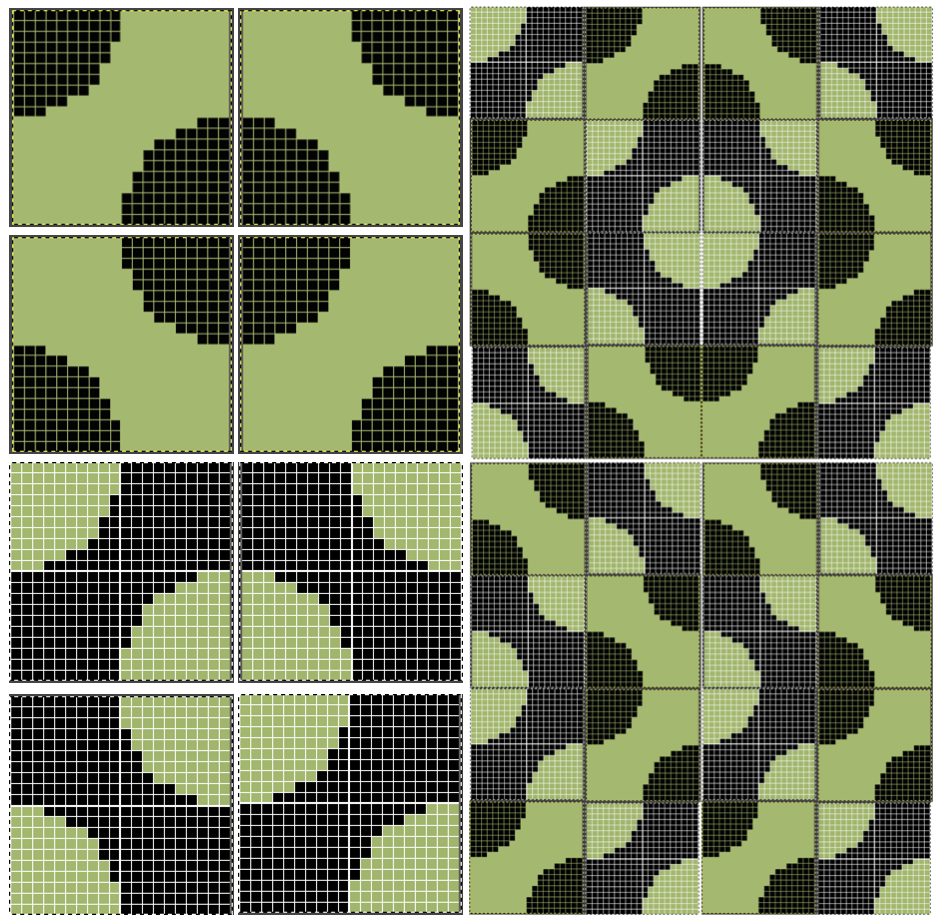 Facilitating and speeding up the process: in my post on using ArahPaint and Gimp in knit design, I briefly touched on the Drawing-in-repeat feature in Arah to produce random tiling.
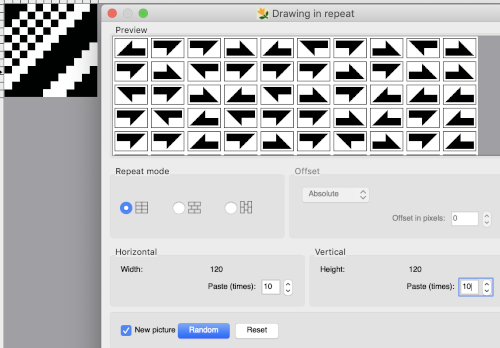 Thanks to the developer there now is a video, viewable on Instagram and Facebook, on how to use the feature for this type of tile, which allows for very quick DIY versions that can be trimmed as needed for knitting. This is my very first try, a how-to will follow in the next post.
 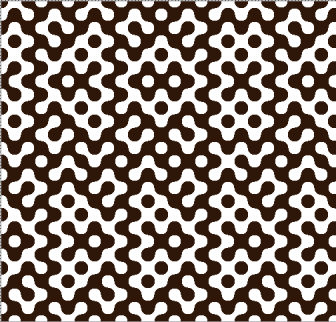 And the second, composed of triangular forms
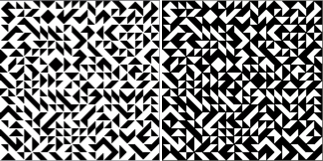 For spreadsheet users, this one generates the various tiles in Google Sheets and a related article.
Color separations for larger scale mosaics and mazes
There are generators online for many generators to aid with knitting design. In 2015 I published a post on working with generated mazes: Gimp charting 1
The mosaic and maze graphics prior to their color separations are not suitable for fantasy fair isle double bed knitting as a shortcut. There are simply too many vertical white pixel rows begging for carriage jams no matter the machine used. The same long lines of black or white cells make them unsuitable for traditional fair isle knitting as well.
Visual clues are helpful as steps get navigated. In small-scale repeats, a different option from the method that follows is to begin with a file previously used and separated, magnified to 1800X.
1. using the rectangle select tool, begin on row 1, extending handle outside the image, I work from left to right
2. hold down the shift key, and continue selecting every other row. As each row is selected, it is outlined with dots. The handles to the right and left of that row serve as guides as to the last row worked, moving up as separation progresses. Clicking on the rectangle select tool at any point fixes the layer, and the dotted lines will disappear. 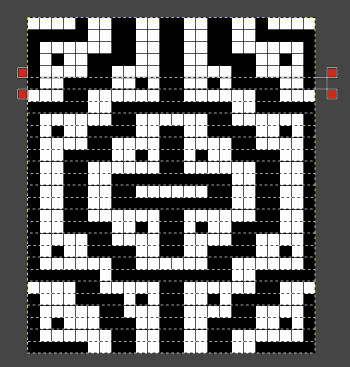 The process could be performed in steps, with guides placed prior to color inverting the previous steps in the sequence and moving onto the next.
  The guides remain until they are removed by clicking on the check mark beside show guides,
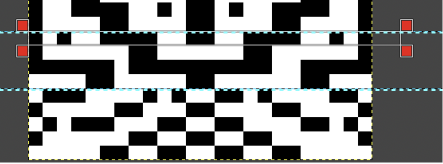
  or with the / / command.
In large designs, I would guess this may be more easily error-prone than when using layers.
3. after each pertinent row has been selected, choose the color invert option, and save the resulting file. The first step is completed in the separation.
The file then needs in turn to be color-inverted and lengthened X2 prior to knitting. The result matches the separation in the previous post. 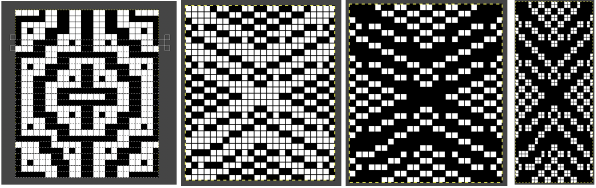 Holding down the shift key when using the pencil tool on any image produces very different results.
 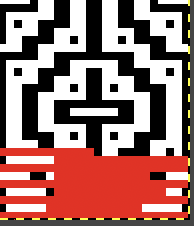 My samples continue to be knit on the 930 using img2track, a download program I find reliable and easy to use. The only errors in programming I have encountered were due to operator errors, not software ones.
Since 2015 working with larger images has become far less daunting as my methods for color separations of mazes and mosaics have evolved.
Laura Kroegler’s online Mosaic Pattern Generator is still available. Returning to it, and using these parameters  the pngs were downloaded both in red and then again in black and white.
 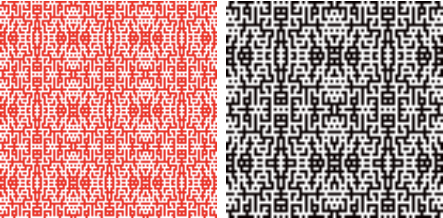 A 38X38 stitch repeat was isolated, and using Layer/Transparency/Color to Alpha a knittable mosaic design was obtained which, when knit, would require elongation X2 for color changing every 2 rows
 The last file, doubled in length to 76 rows in height, requires no further processing
  The separations are achieved now in just minutes.
The proof of concept swatch: when using repeats that are so much wider, one must commit to far larger swatches to test them. In addition, the placement in the final piece may matter with shifting the pattern to highlight a preferred center, here the machine was allowed to place the design as a simple overall one on 78 stitches by 116 rows. 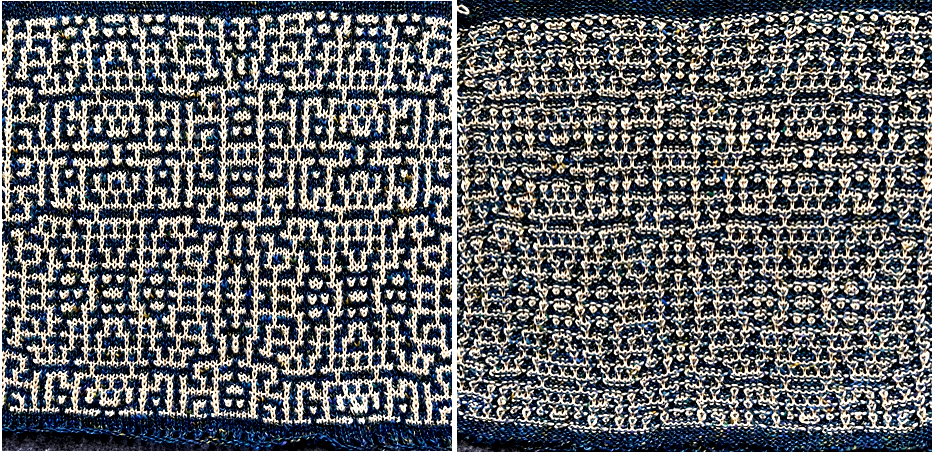 There are droves of inspiring large-scale mosaic crochet images published nowadays, which led me to wonder about DIY similar large graphic mosaics in machine knitting.
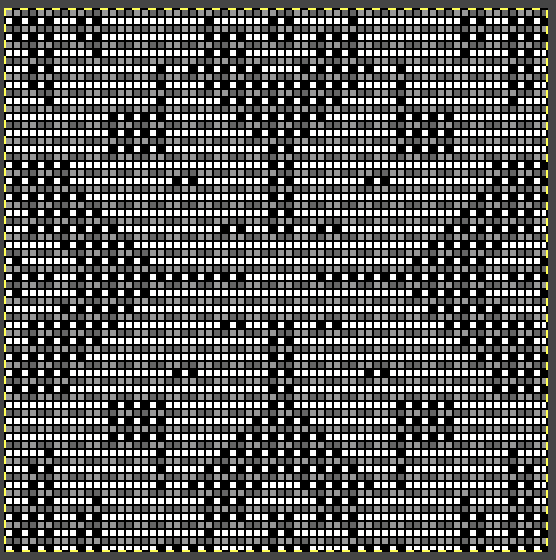
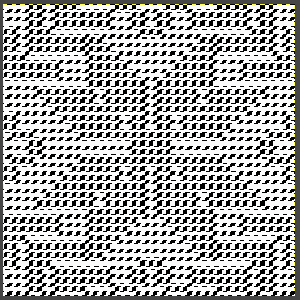
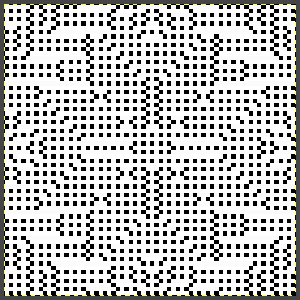
I performed the first color separation with shortcuts, used mirroring the cleaned-up repeat, did not verify each step with tiling, and committed to knitting a test swatch. A 68X136 repeat X2 in width and at least with 40 more rows in height, produced a 16X24 inch test swatch, wherein a couple of missing pixels became noticeable.
The swatch was also knit using slip in both directions on the main bed, which produces a narrow, short fabric as opposed to wide and also short when using the tuck setting. 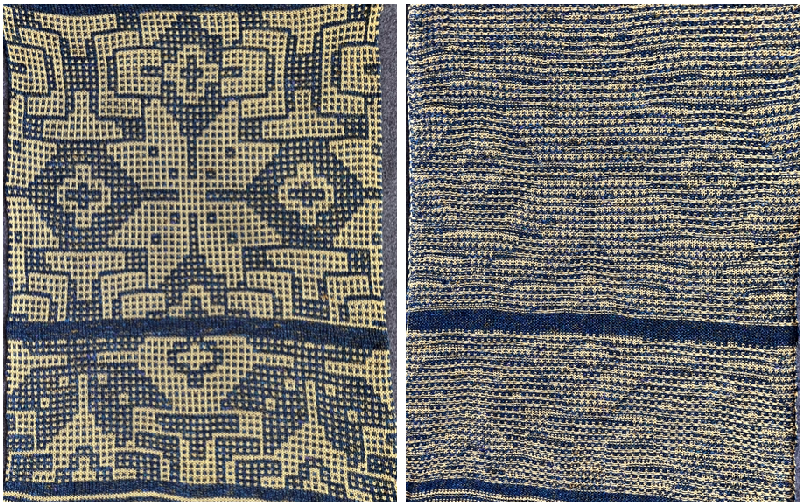 Back to the drawing board.
The initial approach is similar to that used in creating mock filet crochet shapes on the machine.
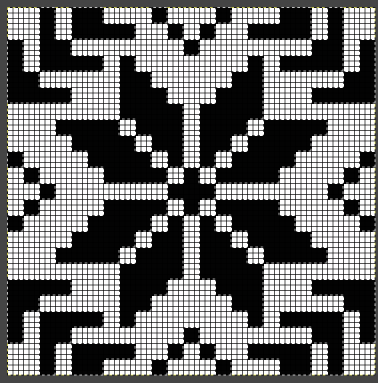
With present tools the results process is easy and quick: to begin with, choose any symmetrical design where the shaping of the motif occurs in single rows, this one measures 23X23 
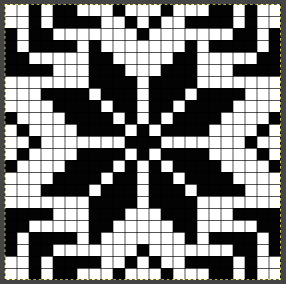 scale the file X3 in both directions to 69X69
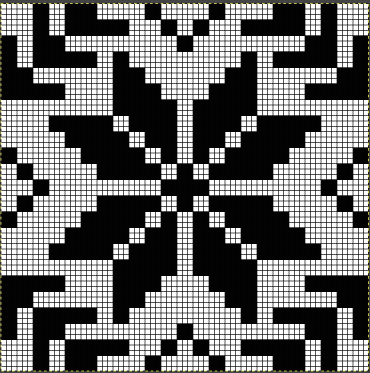 save this brush to use later for bucket-fill in the design.
  Choose fuzzy select by color/black, each shape will be surrounded by a dotted line
  bucket fill the selections with the saved pattern
  click on rectangle select to fix the layer, work on and clean up the repeat, and check a magnified version for any missing or misplaced pixels.
  Save the png. for reference before continuing to work.
  Make one of 2 choices. If the goal is to place a motif, and to add borders or horizontal additional design stripes, create a new canvas, larger in size than the above, fill it with the same pattern, and then Colors/Invert. Click on the rectangle tool to fix the layer.
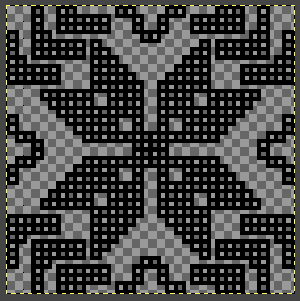
 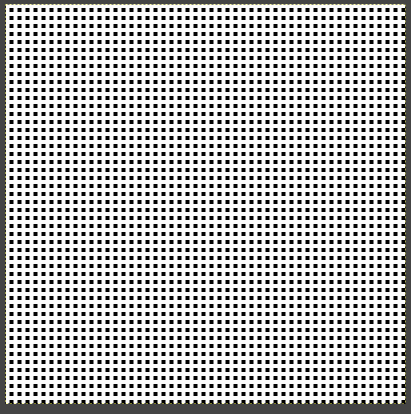 Change the white color to alpha in the previously processed snowflake, click on the rectangle tool again
  copy and paste the file onto the color-reversed grid, and click on the rectangle tool. Check the pasted image visually, and continue adding any other designs.
 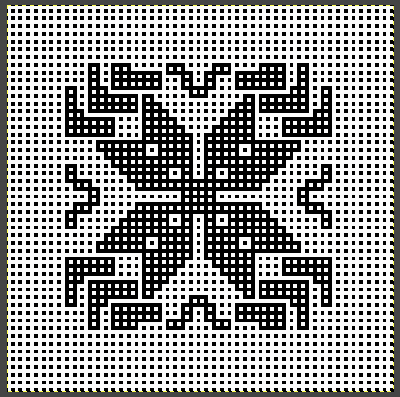 If the goal is to produce an all-over design, crop the shape on the dotted ground, and save it as a 69X69 repeat. Pasting the original on an equal size color reversed dotted ground does not work.
 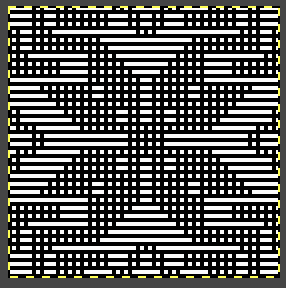 Tiling the result of the cropped repeat will show the need for cropping it by one row at the top and one column to the right.
 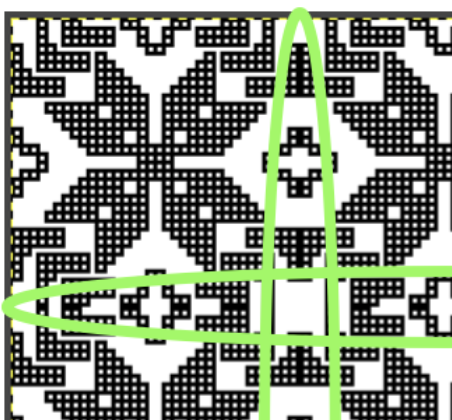 The resulting repeat, 68X68
  tiled X3 in each direction for a visual check.
 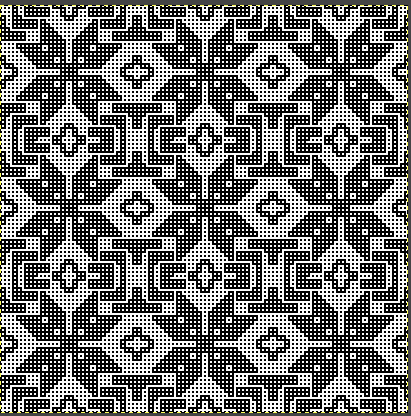 Using the process previously described
1. open the 68-stitch file in Gimp, and magnify it to at least 800X for a visible grid
2. open file/new, equal size and magnification
3. copy and paste 1 on 2, click on the rectangle select tool
Colors/invert, click again on the rectangle tool or anywhere in the work window 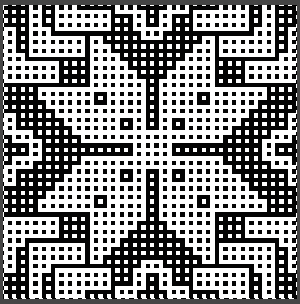 4: magnify further if needed. Using the pencil tool fill in every other row beginning with row 2 in a contrasting palette color, and click on the rectangle tool
  5. Layer, transparency, color to alpha, as described in the last post, click on rectangle tool
  6. Copy and paste this result onto the 68-stitch file in the first window, there will be lots of dotted lines onscreen
  Click on the rectangle select tool to paste the image in place.
 Since those large areas of white will be knitted in a tuck or slip fabric, the above result needs to be color inverted. If used as is, set the machine’s built-in double-length function.
 Doubling the length of the file prior to the download to km
  Part of the view on the img2track screen for the 68X136 file ready for download.
 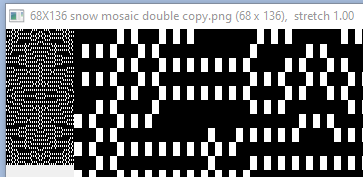 Committing to proving the concept:
  Using the same approach of tripling the original, here the repeat
 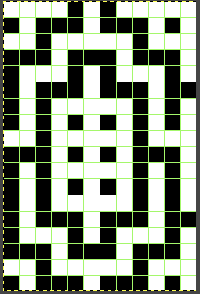 was used in an attempt to render a larger-scale mosaic. The process becomes fiddly because using the fuzzy select tool and then the bucket-fill-in pattern does not work cleanly on areas that are only 3 pixels wide.
That said, it is possible obstinately, in stages, to get from this, 36X54 
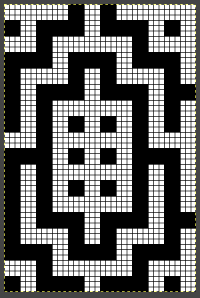 To a 36 by 56 mosaic

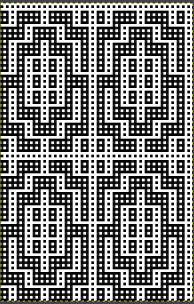 A last edit
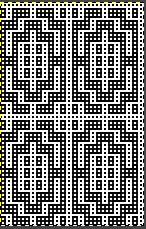 Perhaps falling in the category of “don’t have to simply because I can”.
Images at this stage of the process may be knit double-bed as a “fantasy fair isle” with no further separation.
On an electronic machine, download the repeat, program it for the number of needles in use on the top bed, and select the KRC separation button.
The first preselection row will need to be from left to right.
The main bed is set to tuck in both directions, the ribber to N in both directions.
There will be lots of non-selected needles tucking on rows with large numbers of side-by-side white cells. Because the fabric is being knit using every needle on both beds, each main bed tuck loop will have a knit stitch on the opposite bed anchoring it down. Those rows will appear more compressed, producing narrower horizontal lines 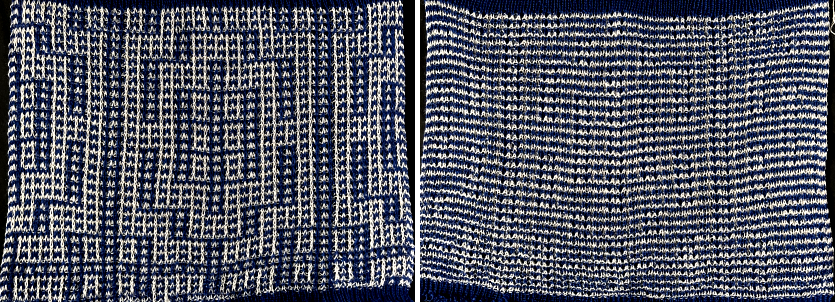 The yarns used were very thin single strands of 2/28 at tension 4/3. The result is a very lightweight and loose knit with lots of drape. The 72 stitches by 140 rows swatch measured 16 inches in width by 10 rows in height. Perhaps a good method for summer shawls, worth exploring in thicker yarns for blankets. A closer look at the structure:
 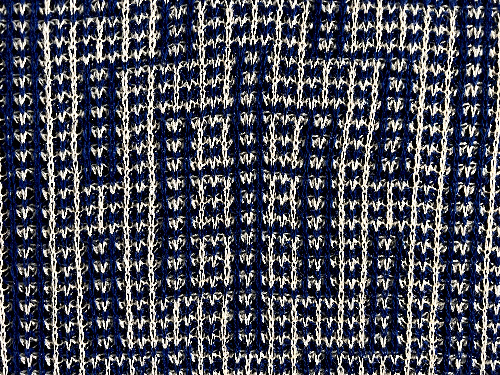 A larger BW design was processed using no modification of the original 75X71 motif. When using Gimp/File/Save, the result is a .xcf document similar to PSD files in Photoshop. It will store layers, transparency settings, and more information associated with and parts of the same project.
 Note to self: before deleting the .xcf make certain that at least the final png has been saved.
If one is familiar with image processing and fond of the maze appearance in designs, there is a font to try: Mazeletter
The downloadable associated documentation and source for inspiration: http://mazeletter.xyz/Mazeletter.pdf.
A very quick random type sample rendered with no advance planning: 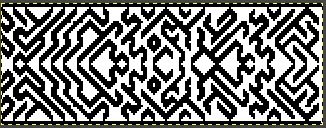
Another, mosaic4way, is potentially usable for single bed fair isle or dbj.  The drawback has been that my sample pngs for both were created in RGB mode, and conversion to BW or scaling loses details.
It is possible to begin on an all-white canvas, set the mode to indexed to start with, type text, merge layer down, crop to content, and have workable indexed black and white knittable results, but the degree of success appears to depend on the font size used.
Another thing to investigate 😉
Working with diagonal patterning in machine knitting
After a slow down in my blog posts for a variety of reasons I find myself playing catch up with the eternal list of knit fabrics that I wish to explore out of my own curiosity and the attempt to answer questions from knitters who contacted me directly via the blog or have asked them in the online forums in which I am a member.
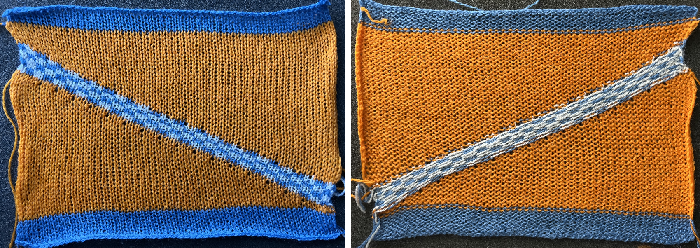
Stephen West is a prolific designer of colorful hand knits in a variety of techniques and complexity. This honey-striped scarf is an example. 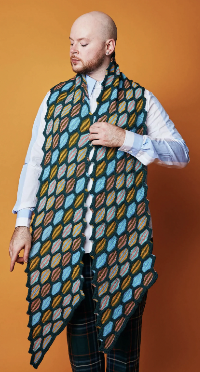 Slip-stitch patterning is a likely way of knitting a similar effect combined with
the use of the concept familiar to many when making bias cast-on rags.
A fixed number of stitches is cast on and positioned as far to one side of the machine as possible. They are then decreased on a fixed side and increased on the opposite one.
The strip moves across the needle bed, when far enough on the side opposite to the starting one, it is returned to the original needle bed position and the process is repeated until the desired length is reached.
If the moves to and from are performed on solid color rows matching needle selections may not be an issue. If the repeats in other cam settings are to match, then proper needle placement can be assisted by marking the metal bed, the factory-supplied needle tape, or a custom-printed one, and hand-selection for the first design row may be required and planned.
This chart attempts to visualize the proposed movement using colored stripes. Stitches are bound off on one side and cast-on on the other to maintain a fixed width with shaped edges. 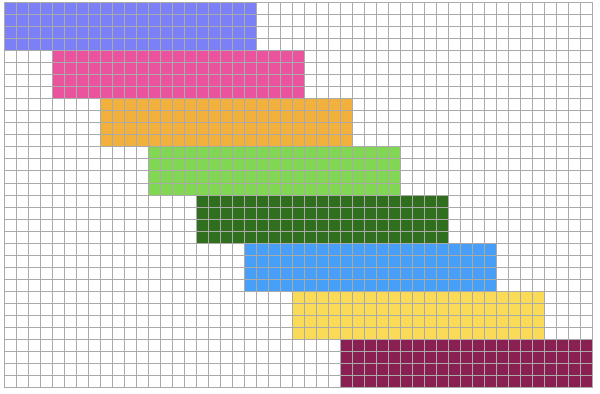 If the goal is to maintain straight bias edges, the design repeat would need to be rendered wider in order to compensate for the shifts on the needle bed in turn modifying increases and decreases at a different rate The black cells represent the adjusted stitch counts needed for each pattern band.
 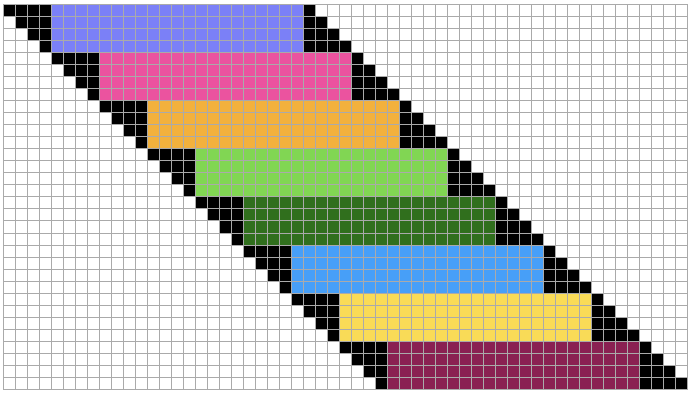 When an item such as a scarf is worn, both options will appear as diagonals.
 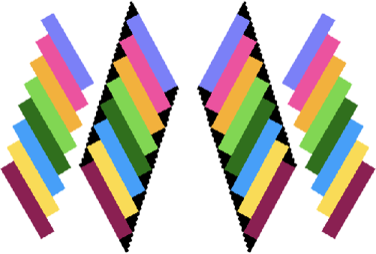 If any picture knitting is included and the direction of it matters when the piece is worn, appreciated particularly in representational fair isle, such accessories are best knit as 2 pieces knit from the bottom up, and grafted together at their center after the fact.
Increases and decreases are calculated based on the knit gauge carefully for garments. The approach to accessories may be more casual.
Stripes heights are varied to accommodate any specific design motifs or cam settings and in turn, are added to the base visualization charts.
Here an attempt at 45-degree striping is made by beginning on a 3-stitch tab. Increasing on the carriage side creates loops, while those opposite the carriage form knots.
Increases and decreases are indicated by arrows.
Increases are made on alternating sides, opposite the carriage, to produce matching edges.
The red cells in the chart represent the carriage side prior to each pass.
Table cells have been rendered rectangular in a 4 to 3 ratio, estimating the difference in gauge between stitches and rows.
Striping for an even number of rows matters if color changes are made on a fixed side ie if a color changer is in use. 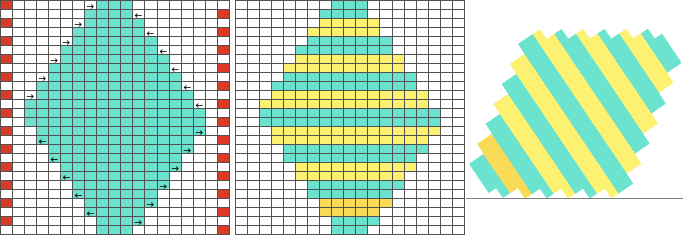 Yarn ends at color changes may be cut or the yarn can be carried up the side depending on preference and the number of rows involved. If carried up for long stretches, the alternate color yarn not in use may be secured by e wrapping it on the end needle periodically. Care needs to be taken that the float up the side is not so short as to have an effect on the swatch length and having an effort to remedy that will leave yarn ends too short to be secured.
The result is not going to produce a proper square, garter stitch is the only knit stitch that results in approximately true square shapes.
If the center of the machine is always used for swatches, keep an eye on the stitch formation. If loops are formed repeatedly on specific needles akin to tuck stitches or problem areas such as those in the center of this swatch are encountered, they can be caused by damaged needles or sticky latches that may result from frequent use. 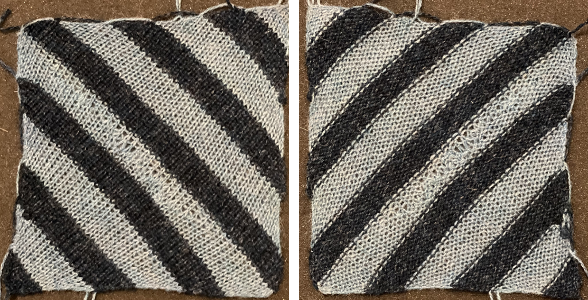 Diagonal lines in knits that maintain straight sides are also achieved using short row/holding intarsia techniques. Segments are planned in specific orders
 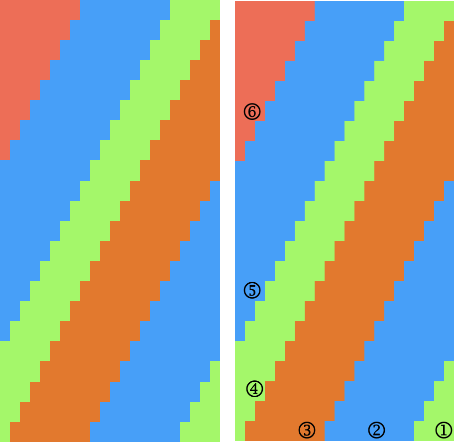 which can be varied to form added shapes.
 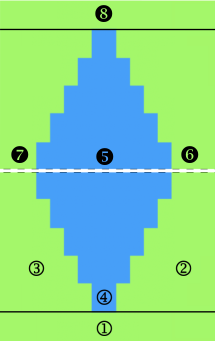 Chevrons would be more easily created by knitting separate strips and seaming as you knit or after the fact.
 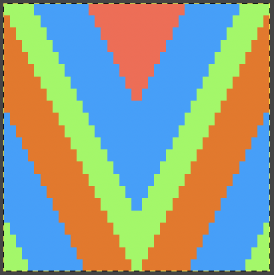 The addition of small-repeat fair isle patterns is also possible. Keep in mind when bringing needles back into work to reverse shaping, needle preselection for accurate patterning in Brother machines needs to be maintained by hand selection.
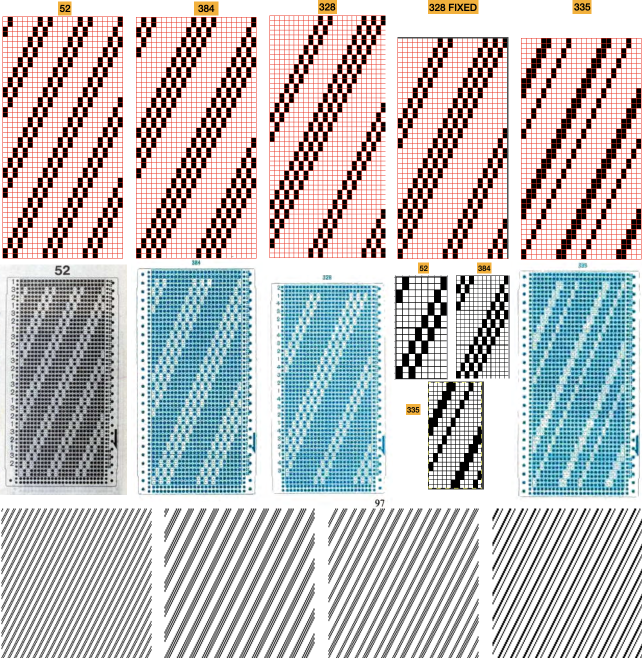
  Some of the published punchcard patterns can serve as a source for diagonal lines that may be tiled and programmed for the full design in addition to being used for their original intent. Numbers 52, 384, and 328 (published with error), are suitable for tuck, slip, and FI with moderately wide floats, while 335 would fail as a tuck stitch.
Tiling as in any patterning will reveal errors, such as here for 328. 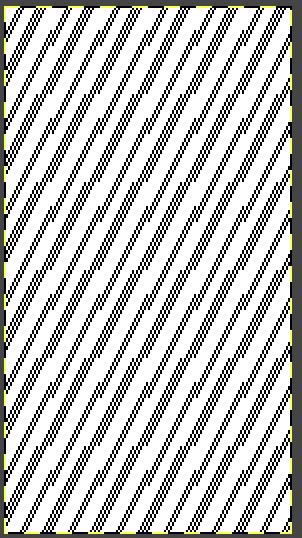 The latter was edited to a 22-stitch wide repeat, becoming suitable for only electronic machine models.
The charts with the red grid on the top row were rendered as tables in Numbers. Since their end use is different, they are the color-reversed version of the cards, whose screengrabs were in turn processed in Gimp to create knittable pngs.
The smallest repeats suitable for electronics are given in the center row of images, the amended 328 cannot be reduced in size. The last row illustrates tiling for all files as BW images that may be opened and amended to suit the size of the pieces planned.
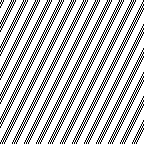
 Files in png formats for the group: if pngs generated by me in BW indexed mode are downloaded and opened in editors such as Gimp, they will open in RGB mode. To make them suitable for download programs, convert them to indexed BW mode again and save the result. There should be no loss of data.
384, 12X24 12X48
12X48  144X144
 328, 22X44
176X176
335, 12X24
24X48  144X144
  52, 8X16
24X48  192X192
  The black lines formed by units 2 rows in height can be followed or erased to establish short rows shaping a stitch at a time every two rows, in a view of at least 2X2 full repeats to check color placement as seen here.
 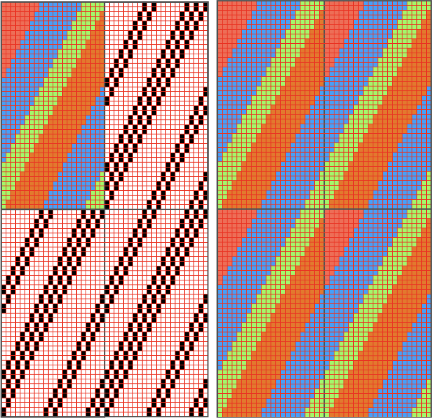 The method was used to isolate the previous ungridded color illustrations. Another instance of a published Toyota 901#11diagonal tuck card, in this case, incorporates a combination of 2 and 4-row tuck patterning. The repeat is 24X48
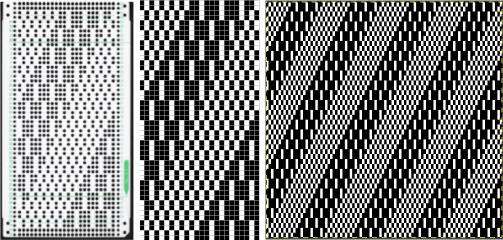 The previews may be used to replace color selections with those matching yarn colors used in the project to develop some idea as to how color shifts might affect the final piece.
EON diagonal patterning surrounding blocks containing other shapes may be maintained with slight variations in the size of the shapes used to fill those blocks 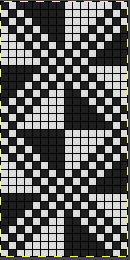

 References published for weaving can be a source of charts usable for this type of design.
The repeats are given in terms of width (shafts) and height (picks). For proper alignments, the provided charts need to be reproduced in full, or in DIY adaptations careful editing with erasures or additions can still maintain the proper tiling.
A page from an 1898 pub 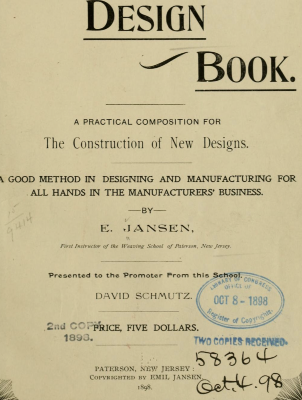
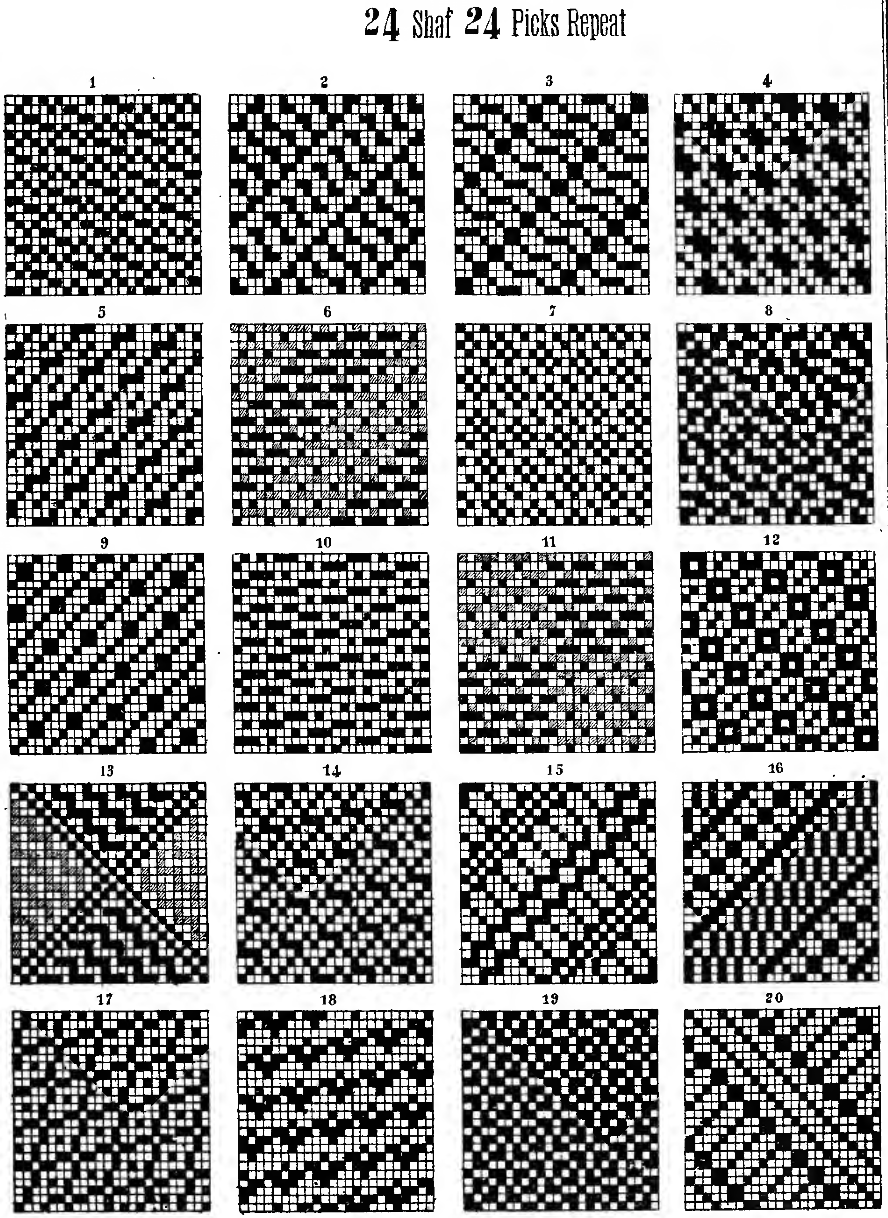 Playing with using #20 and #16 mirrored, isolating, erasing, or combining elements of each while keeping fixed some of the details that move diagonally to touch sides of the repeats, with the process illustrated in color.
Consider the width of the floats if planning for fair isle patterning.
Check the original for any errors, marked in the color chart in black. They are often not noticeable until the design is drawn in repeat. 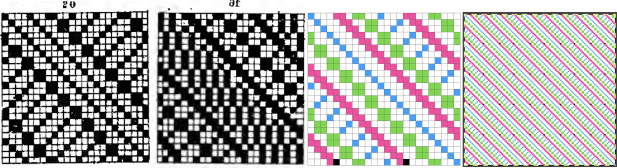
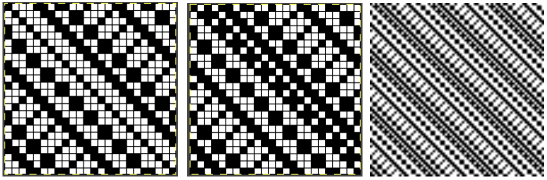 The editable png for the center 24X24 design is tiled on the far right above. It is also suitable for punchcards
Handweaving drafts such as those found at handweaving. net provide endless inspiration for designs, including diagonals.
8X8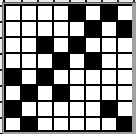

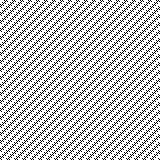 12X12
12X12
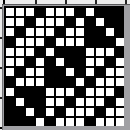
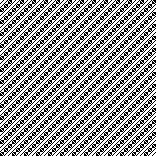
 drawn in repeat X7
 12X12
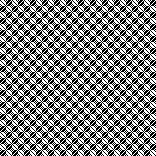
12X12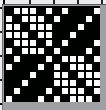
 drawn in repeat X7
 15X15
15X15

 color reversed
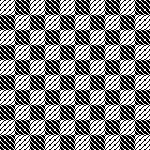
  using color invert and quarter rotations to 30X30
 16X16
16X16

 16X16
16X16
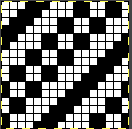

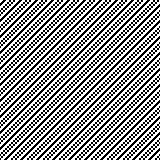 16X24
16X24
 drawn in repeat to 160X168
 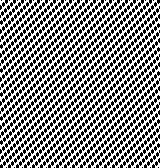 20X20
20X20
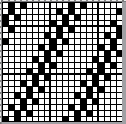

 32X32 with rotated segments
 playing with rectangles, squares, and fill-ins24X24

 Chevrons can be developed from partial repeats. This is from Toyota 950#12, 24X20
 drawn in repeat to 144X140
 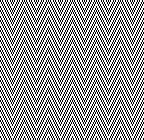 Whether in use for a punchcard model or an electronic one, the convention if the end goal is a tuck stitch fabric, is to color reverse the design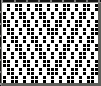
 Taking diagonal patterning to the double bed for creating pintuck effects using the slip-stitch setting, this 24X48 repeat explores some of the potential spacings and the resulting ridges.
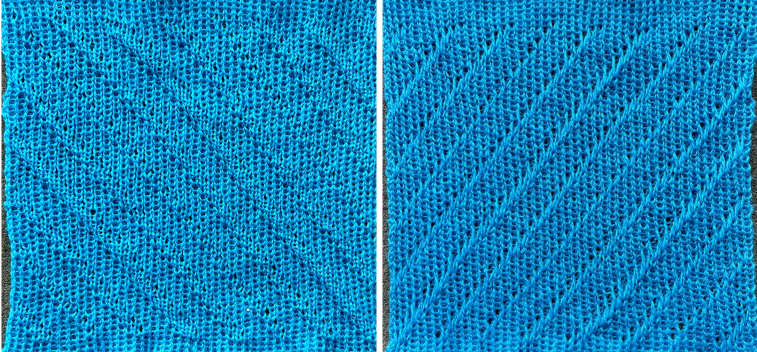 The next 2 repeats tested, both 24 stitches X 48 rows:
 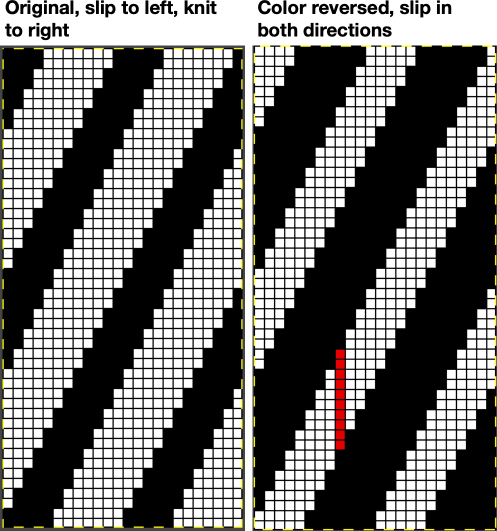 The red line is a reminder that the slipped stitches are being held for as many as 8 rows. It is best to use thin yarn that does not break easily and to watch for the knit stitches riding up.
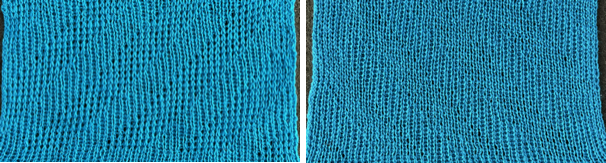
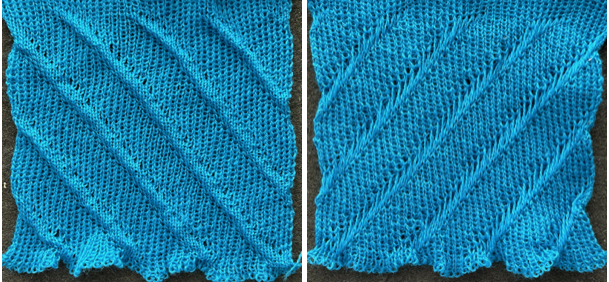
Slipping in one direction produces a very subtle texture, 
 while the color-reversed design produces even-sized identifiable folds
 Adding lettering or small shapes and maintaining the diagonal can result in distortion of the motifs.
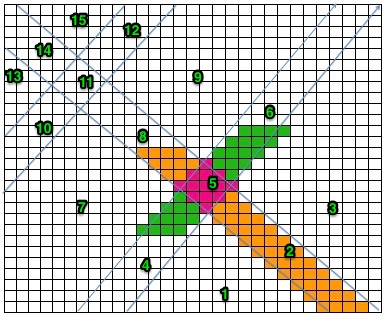
One option to add such motifs is to form the knit by beginning on 3 stitches as in this shared swatch and planning the stripes to heights and widths that accommodate adding designs or fonts. 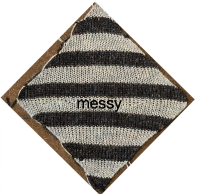 Short-row intarsia will also produce diagonal striping, from simple to complex as seen in this chart, with knitting sequence numbered for each segment.
  A limited number of rows may be knit in stocking stitch in areas following shapes not simply to travel to the opposite side and reverse shaping, but also to add small rolls or hems.
Another use might be to add small vertical motif details or patterning in their usual orientation.
The limit appears to be a maximum of 8 rows of alternative patterns, in order to keep the short-rowed areas from developing into distorted edges, which may be variable depending on the yarn and pattern used.
This first swatch was knit using progressively thinner yarns, wool, wool rayon, and a 2/24 acrylic in the FI segment. FI is a slip stitch that narrows the knit. The dark acrylic color stitch definition here gets lost. The band is seen pulling in the short-row segments on both sides. The shaping in both the top and bottom segments is by 2 stitches at a time. 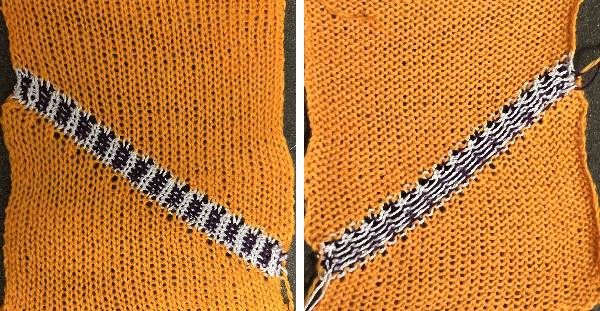 The result in different yarns of equal thickness, with the FI band knit at a tension one full number looser than the stocking stitch areas, with the top and bottom solid color segments now shaped 3 stitches at a time.
 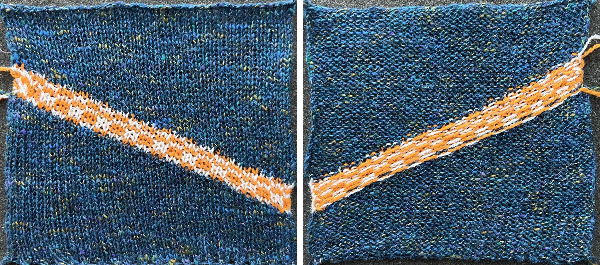 There is a trick when making A-line skirts to change the triangles that would poke out normally at the bottom if shaping were to begin immediately used as a design feature in many runway knits recently. If between an inch or 2 are actually knit up straight before shaping starts, the problem is eliminated. Depending on the design this may be a solution or it may read as a patterning error.
There are some conventions and “rules” for short-row techniques, but they do not always apply.
Keeping good notes helps to make successful experiments reproducible.
Two more tries began to experiment with working on the first and last groups in the holding techniques on a different number of stitches than the remaining shapes, noting differences. In the first an all-knit row is made across the short-row eyelets, reducing the planned FI band from 6 rows to 5. A rough spot in maintaining even stitches on one side is noticeable. 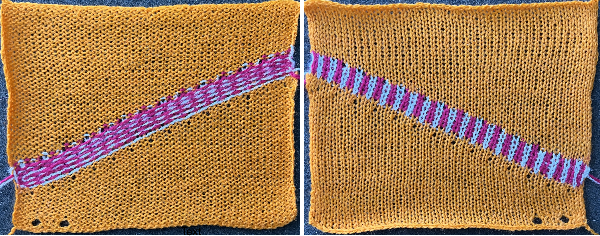 Progress: holding happened at the start of the bottom wedge, the FI was knit at 2 tension numbers looser than the stocking stitch, for 6 rows.
 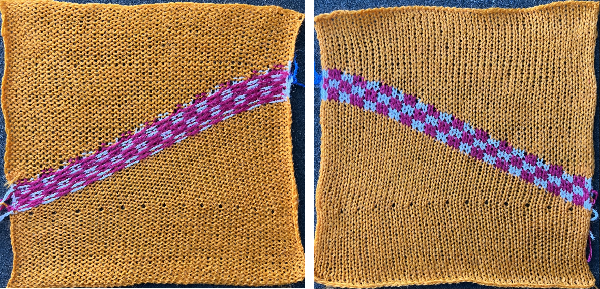 The goal in the short row shaping for the triangles is to maintain vertical edges that appear as straight as possible to the eye. One need not work on large swatches, small ones can provide clues as to differences resulting from variations in the starting side of the short-row shapings.
 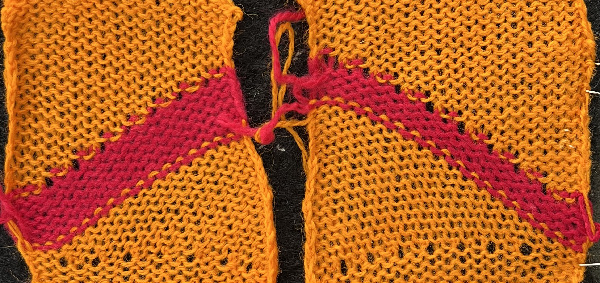 Studying the results can lead to many variations. There are student theses and careers based on exploring limited techniques to the max.
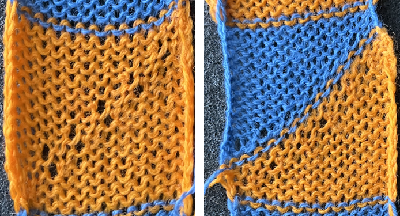
Building a theoretical true square or other predictable shapes is subject to the yarn and tension used. Beginning with a small sample, this shows the order of knitting 2 triangular shapes with the carriage beginning to knit each shape from alternate sides. In this case, 2 stitches are to be brought in and out of holding at a time. 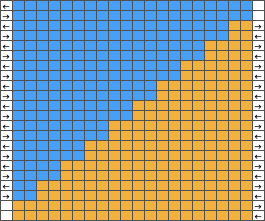 Because each color knits for 2 rows, small slits happen in the fabric resulting in eyelets. They may be used as design features, or attempts can be made to reduce their size. One way to do so is to have plain knit rows between holding selections to keep the small slits from intersecting and becoming double height. On the left swatch, one yellow row was knit to the left before reverse shaping in the same color. In the swatch on the right, in addition, 2 rows were knit in the blue prior to reverse shaping.
  Reviewing the concept and developing a chart for larger swatches: the cyan color cells represent stitches in the hold position and the white cells stitches that will be knit.
At the top of the first wedge, most needles will be in the hold position, return them all to the B position manually before knitting the next row.
With the carriage on either side, set it for KCI with the cam buttons to slip for a free pass to the opposite side, the first FI pattern row will pre-select. Holding need not be canceled, since no needles are brought far enough out for the technique.
Cancel the slip setting, change the cam setting for FI knitting, place the pairs of colors in their corresponding feeders, and knit 6-8 rows of pattern.
Bring all needles out to hold except for the first desired group, if the holding lever has been canceled, reset it and commence reverse shaping. 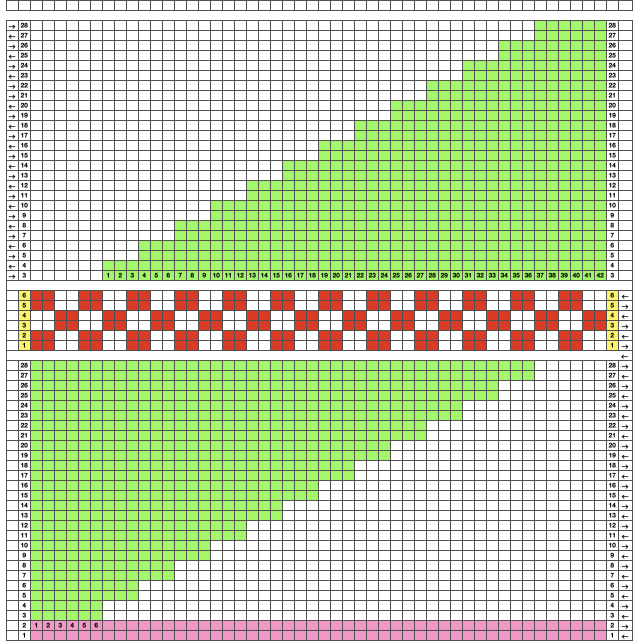 Merrily knitting along and you forget to loosen the tension for the fair isle stripe:
  And what if the FI were to actually follow diagonal colored stripes? The approach is the same. I am right-handed, my default is often to begin on the right. Left-handed knitters can mirror charts as needed to make them easier to follow.
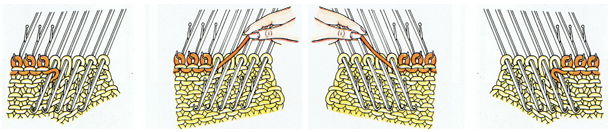
The first triangle is shaped from right toward left, subsequent ones begin on the left, then to wrap or not wrap becomes the question. 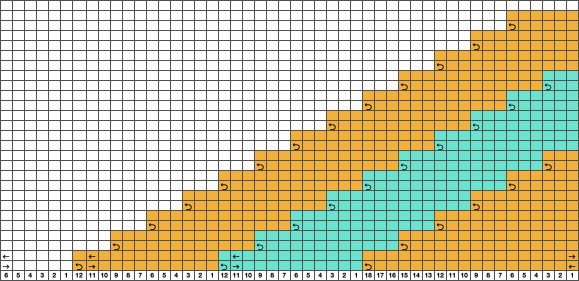 Review of wrapping, which does not disturb the stitch on or the position of the wrapped needle:
  I obstinately use random yarns at hand, sometimes too thin for the task at hand, true here. Any type of intarsia, of which holding is one, will be accompanied by lots of yarn ends that will require weaving in. Some of the stitches were wrapped here, some not, and maybe the eyelets could be considered a pleasing design feature. The 8 rows of FI, knit at 2 full tension numbers higher than that used for stocking stitch, minimizes the size of the eyelets all on their own on both sides of its stripe. Errors in bringing an added group or not into work may not always be immediately visible, frogging this type of knitting can be painful.
I would not use the last 6 stitch modification in any future swatches. 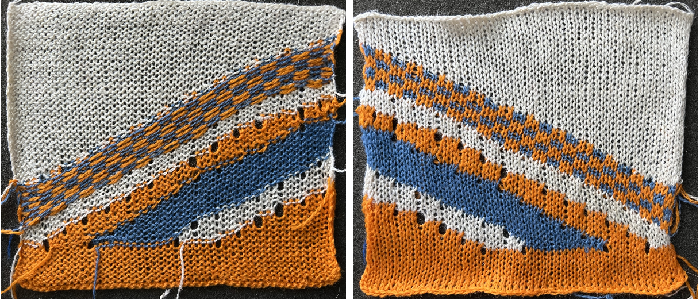 Elizabeth Zimmermann published many patterns for hand knitting utilizing garter stitch and striped diagonal wedges for garment shaping.
Multiple colors per row patterning may be maintained by beginning planning with diagonal straight lines, seen here in a 32X32 repeat.  Opened in img2track
  The design will be elongated, and 256 passes are required to finish a single repeat
  Each color may be edited to suit. Quick visualizations of a few of the possible repeat arrangements using the file as is
  Avoiding lots of extra knit rows by eliminating one of the colors.

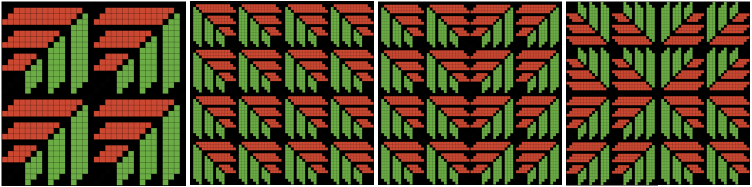 The larger designs may need to be knit in sections depending on the available memory in the knitting machine model being used.
Machine-knit stitches do not form as close to square ones found in garter stitches. Rendering the full-scale garment on a knit leader would make knitting to gauge while avoiding tons of math calculations possible.
DIY is a bit like assembling paper cut-outs that are required to fit together, first attempts at planning do not always succeed. One may begin at different parts of the piece and seam two halves together if necessary in order to keep matching stitch formations in both directions. Stripes may be added to form secondary intersecting shapes. 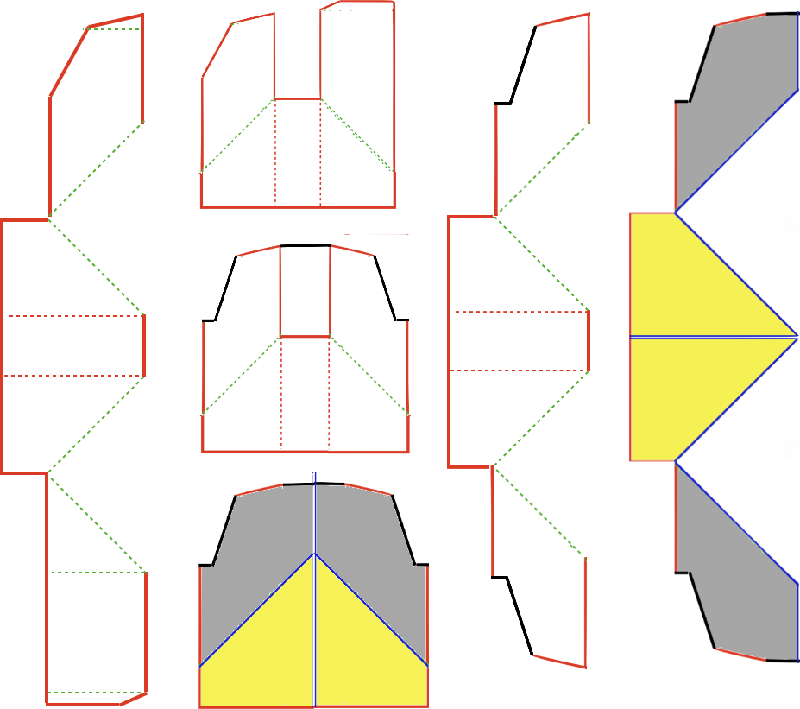 On the left is a simple one-piece vest concept with no miters in the back panel, which may be knit from the bottom up or as two pieces with a center seam.
The bolero style is repeated in 2 separate pieces with mirror shaping in the second and would be joined at the center back.
The knit gauge is easier to maintain in short or small wearables. 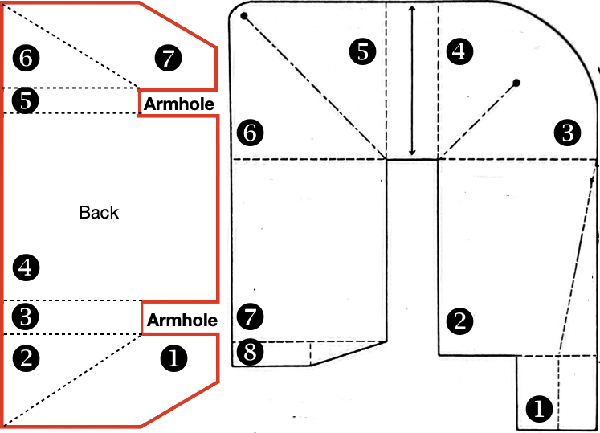 Many garments may be made following the concepts for creating “pies”.
Decades ago batwing sweaters based on a sideways circular knit concept were standard presentations at knit seminars. Short-row diagonal graduated wedges were followed by varying amounts of all knit rows.
This idea for a short sleeve garment is from a Japanese magazine. In creating such illustrations because of the scale of the publication, the aspect ratio is distorted. In the final garment, the bottom circumference can in fact be far narrower than it might appear to the eye in the sketch and may be gathered or left released depending on design goals. The neckline diameter at the end of the project, after joining one shoulder, is gathered with evenly distributed decreases to the desired measurement prior to knitting the collar. 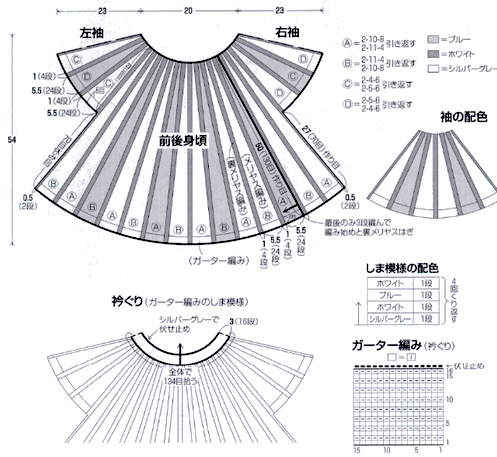 A way to form a long sleeve item, using binding off and casting on stitches in addition to shaped wedges followed by all knit rows.
  Knitting a garment on the bias at 45 degrees will produce a knit fabric that drapes differently.
Horizontal patterning can turn into diagonals and chevrons, and fancy decreases may be used in the center shaping of the garment.
Pre-computer programs and knitleaders, an easy way to sort out shaping for garments, was to begin by drawing on large sheets of graph paper. An all-square grid is fine.
Calculate a 10 cm/4 inch knitting gauge to the second decimal point before any rounding off. For example, if the gauge works out to be 5.728, and the measurement needed is 19.5 inches, the multiplied value result is 111.696, which can be rounded off to a 112-row line on the graph paper.
Working in cm can actually lead to easier calculations and is required when using a charting device.
Each cell in the graph paper grid equals one stitch and one row.
For knitting on the straight grain, based on gauge, draw series dots placing them on the beginning and the ending pots for each measurement, and connect them with straight lines.
Curves such as those necessary for necklines may be composed of short straight-line segments.
When knitting from the bottom up, continue with a colored pencil, filling in squares as they jog in or out, maintaining the new outline as close to the first as possible.
For the bias knit, whether on graph paper, the computer, or a charting device, begin by drawing a 45-degree line.
Rotate and trace the unmodified original straight-line image in place, follow the lines, and mark in and out jogs once more in color for contrast.
This is a very small chart so outline jogs in far larger pieces cannot be reflected. They would produce edges not as straight as in standard knitting, which will need to be considered when joining finished pieces.
As the piece is rotated, a wider grid base is required. Consider that the motif images as they are worked on the purl side will be mirrored horizontally on the knit side, a particular consideration if any text is introduced. 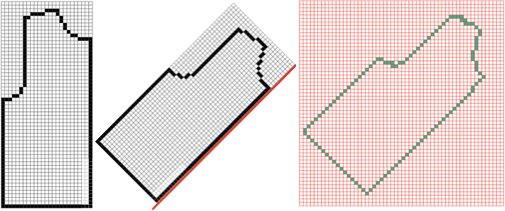
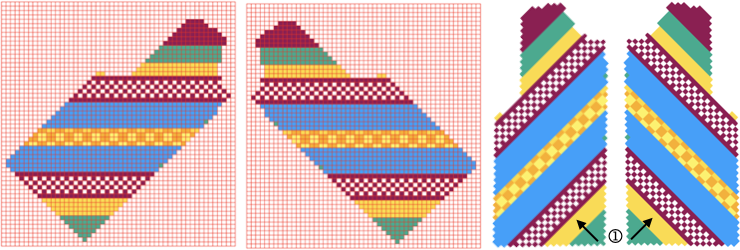 Comparing theoretical purl as opposed to knit views on the left, two purl views on the right.
 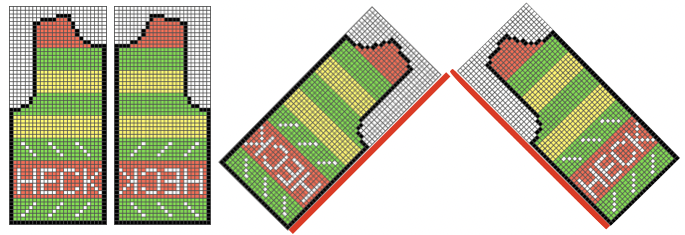 Fonts in various stitch and row counts are useful when planning knit text.
The point at which the text or pattern is introduced needs to have enough stitches in work on the machine to contain the intended words, ie for the above, a minimum ground, independent of shaping, would need to contain more than 9 rows if solid color stripes are to be added above and below it, and 26 stitches in width in this case.
A proof of concept swatch with arbitrary shaping on every other row illustrates the need for shaping based on a calculated gauge if a square is indeed the aim.
I knit on a 930 where mirroring is automated for programmed designs, so the text was programmed as drawn.
Sometimes less information is more. It became evident very soon that the placement of the text on the left was wrong if the aim was to have it centered in the final shape, and that more rows were needed at the top of the design.
On the right, the purl side as it faces the knitter is shown, with black pixels used to represent increases and decreases. The center red line separates the needle placements on either side of 0, and the text is shown in the default mirroring. 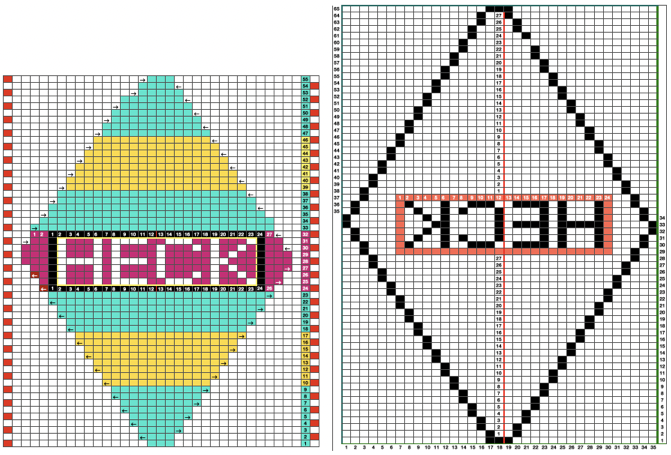 The respective swatches after their rotation preview one of the potential results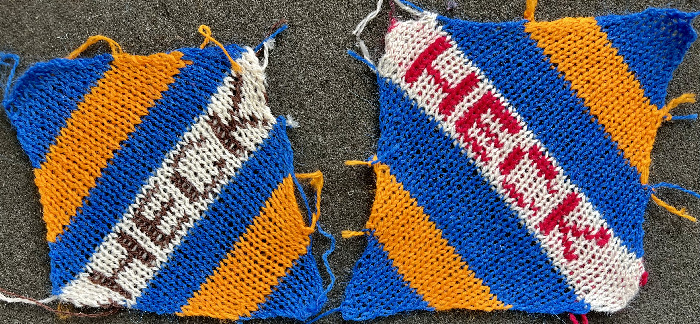
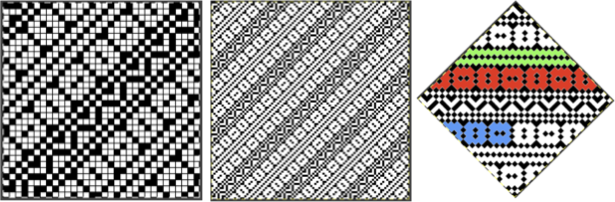
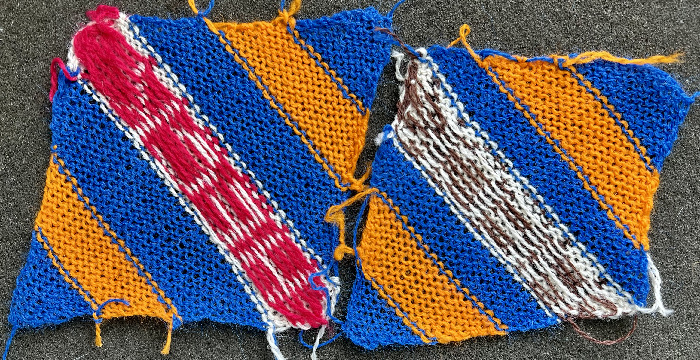 A true diagonal repeat may be planned for motif patterning knit from the bottom up. The drawback is that for executing a fair isle using more than 2 colors or with multiple color changes, partially illustrated on the far right, the 32X32 repeat would need to be rotated and knit as above.
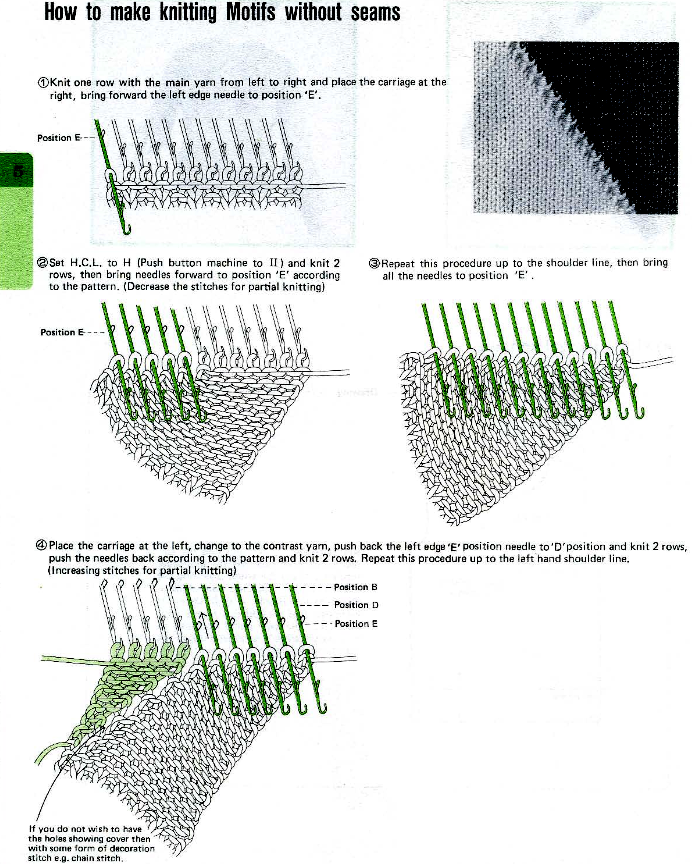
From the Brother machine knitting techniques book, a suggestion for dividing a sweater front into diagonal halves created by using the holding technique 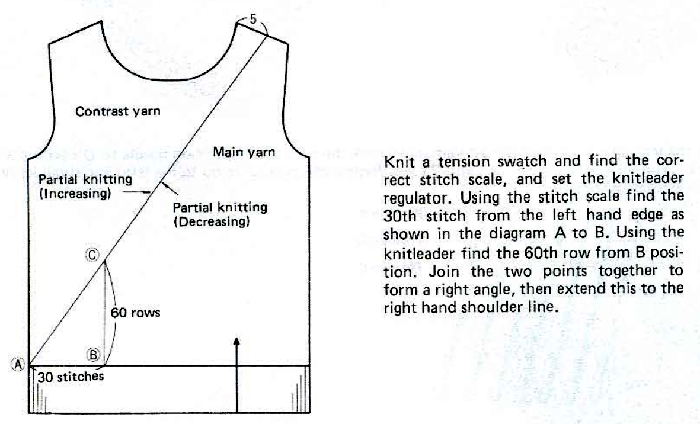
The idea of chaining the eyelet areas to reduce the size of the slits is an interesting one that up to now I have not tested.
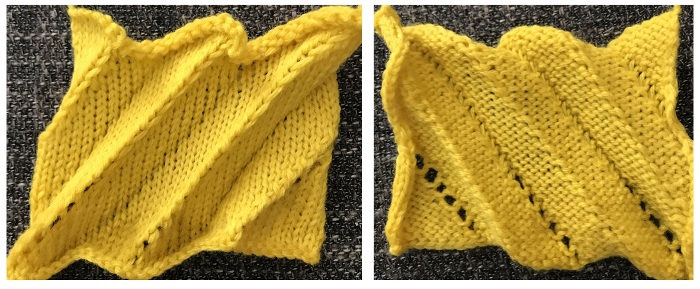

Long vertical button holes/ slits in knit fabric 1: intarsia
There has been a long thread in the machine knitting FB page lately that arose from a share of these 2 images. 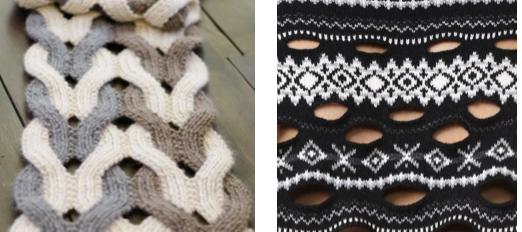 There are three hand-manipulated methods available on most machines. True intarsia knits all parts of a design simultaneously and is best suited for complicated designs. Short-rowing is best suited to diagonal shapes, while the slip method is to vertical shapes. Both knit designs one section at a time and have no floats between shapes on the purl side.
True intarsia is also called bobbin or tapestry knitting.
Members contributed their concepts along with some of their swatches illustrating the idea that effects similar to the cables on the left could be executed in intarsia.
One member shared an Instagram link with a body of work by cari + carl using the technique.
I have been knitting for decades. Intarsia on the knitting machine along with cables or most hand-technique-only finished garments is something I have avoided at times, simply because they were too time-consuming when knitting items for sale in shows or even galleries, at others because some evoke my personal flight response.
I used to hand knit as well, preferred lace, intarsia, and most definitely complex cables knit on 2 needles.
Prior to attending a design school as a student, I worked in a shop that happened to sell knitting machines but whose main income came from selling yarn and lessons to hand knitters. As part of my responsibility, I had the job of hand knitting bulky intarsia sweater samples which at the time featured large images, often of birds or other animals, that were sometimes wrapped over the shoulder and onto the back or sleeves.
As I began to work on Brother machines, I acquired all the related accessories. My intarsia carriages other than in demos were stored unused for years. I gave away my yarn-brake years ago, 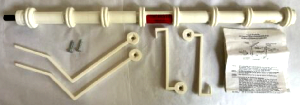 and very recently shipped my Brother 260 bulky intarsia carriage to a Parsons student, so by default any of my experiments at present will be knit on a standard km.
I was stuck on the idea at first of large stitch count cable crossings being made by using holding techniques and initially could not imagine how the same could be done using an intarsia carriage. It took a while for me to sort out in my brain that slits may be created in intarsia by simply not wrapping stitches as the knitting continues and maintaining color changes across the row of knitting, resuming yarn crossings in the areas that require joining.
Some considerations: using the intarsia carriage, the stitches are formed in stocking stitch, so the resulting knit strips will tend to curl to the purl side, far more noticeable in narrow strips, perhaps less so in yarns that will result in stitches that are permanently set by blocking. Using bulky yarns on appropriate gauge machines may also lessen the curling.
Experimenting with familiar yarns helps determine whether the familiar knit carriage tension when using them on the single-bed matches that achieved when the intarsia carriage is in use.
My Brother Machine Intarsia Standard carriage is the KA-8210 model: 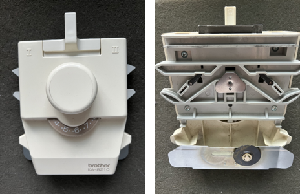 It was intended for use on early Brother punchcard models listed in the manual. Trippers were required to advance the row counter in later models.
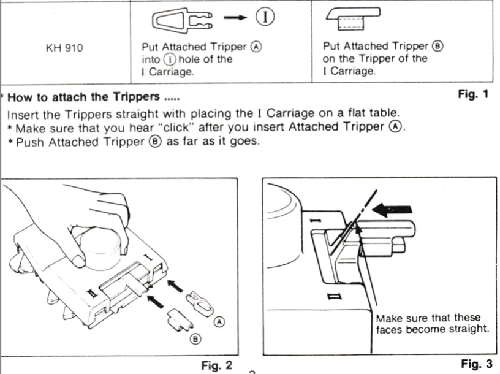 The B tripper doesn’t engage in my carriage, the A tripper does, and triggers the row counter in my 930.
The yarn placement for intarsia knitting is the same as that used in knit weaving.
“Sinkers” are provided with the accessory, and frequently turn up in the “identify this please” questions in forums. I have a tendency developed early on to use clothes pins as small weights when needed, used them in the swatch that follows, and if bobbins filled with yarns are used instead of the yarn balls or cones, their weight will be enough to keep yarn lengths manageable.
Each area of color has its own yarn supply, usually wound on bobbins.
Yarn bobbins are available in a variety of materials and sizes from cardboard to plastic or even wood. The overall shape may vary, but the concept of wrapping yarn around the center of a narrowing shape and slipping an end through a slot to secure it is shared by all types related to the image on the left. It is possible to make your own in similar configurations out of any material that will hold its shape.
The clamshell version became my preferred version of the tool. The small ones come in handy for holding ravel cords or even wire.  When knitting more than a swatch it is likely far easier to work without a ribber in place. I like to do all my knitting with the main bed anchored and angled with ribber clamps rather than flat.
 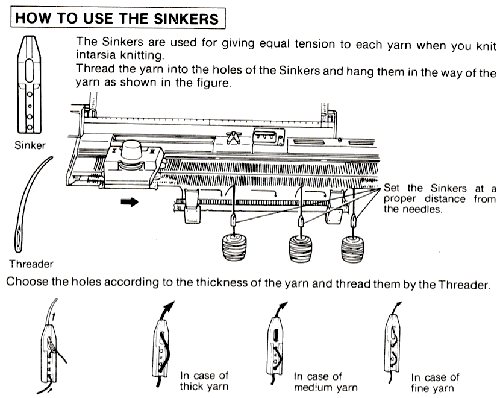 If the threader is missing from the supply of sinkers, floss threaders can help, and are also handy when beading on the machine. The used yarn here is 2/18
 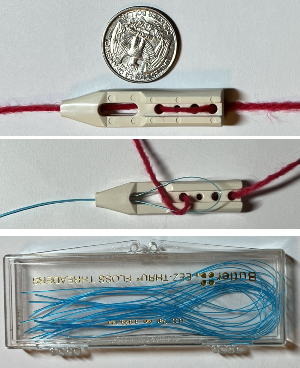 To knit: begin with a familiar yarn. This carriage may actually produce a different stitch size and resulting gauge than the result when using the same tension number on the knit carriage, a factor if the plan is to combine intarsia segments with the main carriage for any stocking stitch across all needles in use.
Brother knitters are familiar with the preselection of needles when patterning. When using the intarsia carriage all the needles in work, B, are aligned in the D position. They are seen below just behind the latches.
Knitting may begin on either side. Start on waste yarn and ravel cord if working on a large piece, cast on, and knit one row unless casting on in different colors matters.
Remove the knit carriage and continue using the intarsia carriage, beginning with it opposite the side on which the knit carriage had been removed, leaving a yarn end. 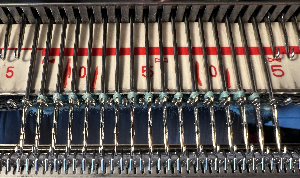 If any latches are closed, the stitches will drop on the next intarsia carriage pass. They will drop as well if the yarn skips being laid over any of the needles in the D position. There will be an eyelet at the very start of the process which is eliminated when the yarn ends are woven in. A reminder for Studio knitters: Brother needle positions are A, B, D, and E, C was present in very early models but was then eliminated permanently, while Studio kept the alphabet in proper order.
Laying on the yarn 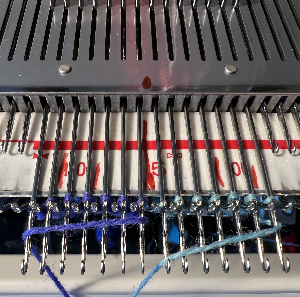 An illustration of the crossings to eliminate holes.
 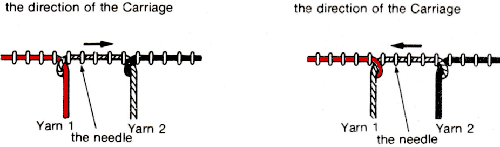 I had initially begun on an uneven number of stitches, then decided it was more practical to be able to use 7 prong tools for my planned cable crossing, so I decreased on each side accordingly.
Eliminating the crossings will deliberately cause separations between the colors.
If the intent is to cross the resulting strips, then the side of each where transfers stop matters. 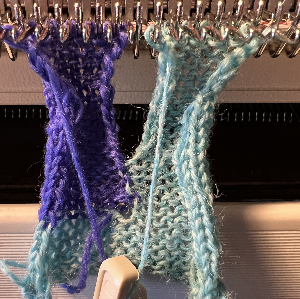 Using the appropriate tools remove the stitches onto them.
 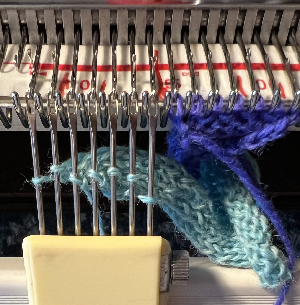 The yarn ends need to be kept free for the next intarsia carriage pass, the needles are aligned in the B position after the cable crossing is created.
  Remove the carriage by sliding it off the bed or using the release knob
 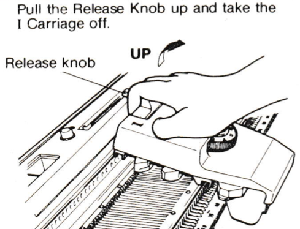 Return it to the opposite side to make a free pass and return to the side of the needle bed where the necessary yarn ends will be available to proceed.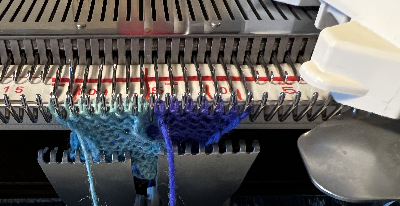
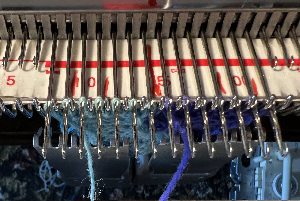 Resume wrapping to join the strips once more
 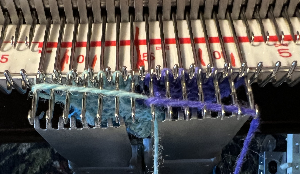 Knit to the desired length, and bind off in one or more colors.
When off the machine the stocking stitch strips will curl. 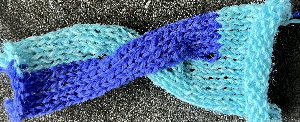
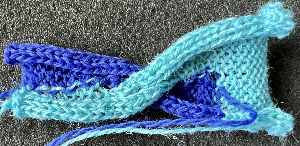 Here the knit is exposed to steam and some light pressing
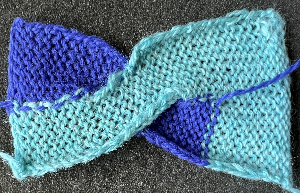 This gigantic swatch, for me, is the end of my intarsia knitting, though it is best to never say never.
Tips and techniques for the Studio AG 50 Intarsia Carriage
Brother Intarsia without an intarsia carriage
If cable crossings are the goal for this and following slit techniques, planning the crossings in color can help track the process. This is one of my earliest illustrations for doing so, from my Excel days, followed by a series of later blog posts on the topic.