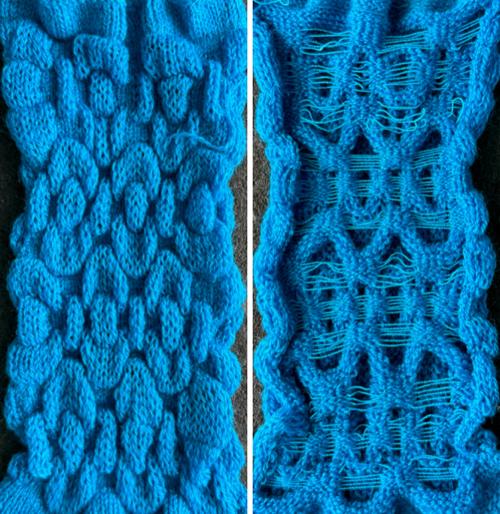
Bubbled textures can be created in a variety of ways, such as with hand techniques, i.e., ruching, or automated, commonly with slip stitch designs. Machine and yarn tolerance are considerations when having multiple stitches and rows skipped, at times, an impressive number of times.
A reminder of the differences between slip and tuck stitch formations.
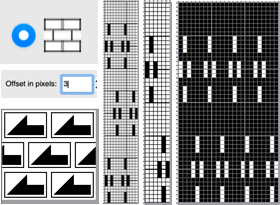
In both, stitches in non-selected needles grow in length until they are knit again. In slip stitch, needles are skipped, forming floats (bottom knit/purl illustrations), while in tuck stitch (top illustrations), loops are built up in the same needle hooks as the held stitches, making for a less forgiving repeating needle no-selection choices. 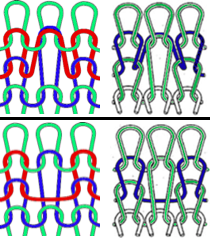 This repeat, with tuck happening for four rows, began with a 6X24 PNG.
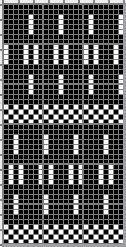
 Loaded into ArahPaint, it was drawn in a brick repeat, with a final PNG of 24X48,
 which in turn needs to be color-reversed to be used for tuck stitch. Punch card machine users need to punch all the black cells.

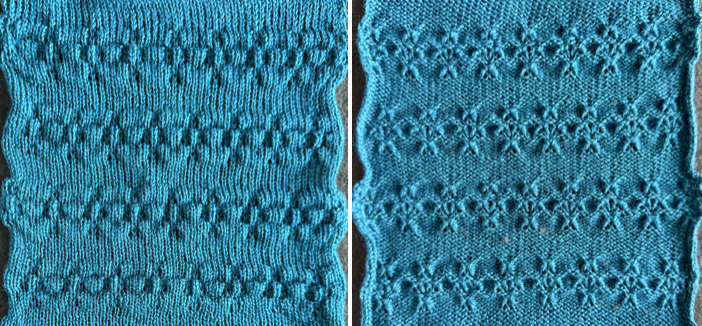
 The swatch was test-knit on 53 stitches, using a 2/8 wool, and measures 7.75 inches in width.
 Using the same yarn, color, and tension, wondering about making the texture more pronounced, I tested the same repeat with manually selected FI patterning, which produces a narrower width than stocking stitch. A programmable PNG, 6X48
 charted for punch card knitting.
 The swatch measures approximately half an inch less in width than the first sample.
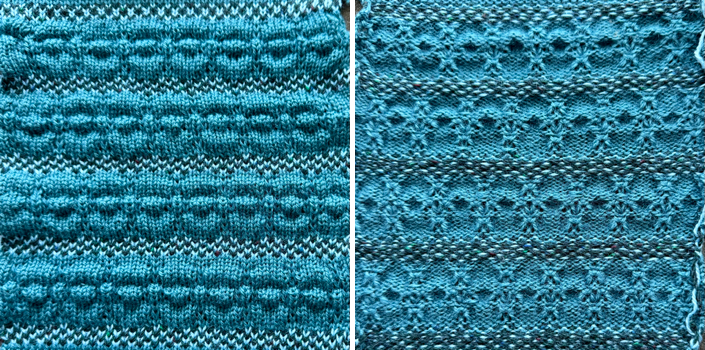 My stash of knittable elastic is extremely limited. Continuing to explore making small changes and exploring their effect, here the same design repeat was used, with elastic as one of the 2 yarns in the FI bands. The repeat is changed to standard as opposed to brick configuration, with textures lining up vertically. The width of the swatch, knit on the same # of stitches as the last sample, measures 6 inches in width as opposed to the non-elastic FI version’s 7.5, with a loss of .75 inches in comparable knit pattern height.
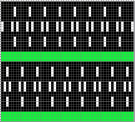
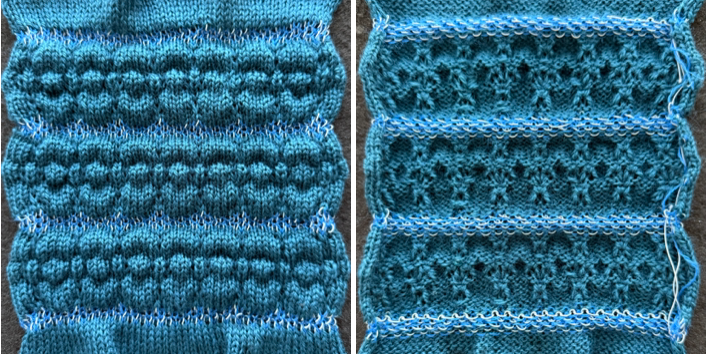 The main yarn was switched to 2/20 wool, and the pattern was divided by 4 rows knit using only the elastic, with a return to the brick configuration.
 The work on the machine
 has a very different appearance when off. The swatch is nearly identical to the last in width, but the shapes collapse, shrinking the overall height.
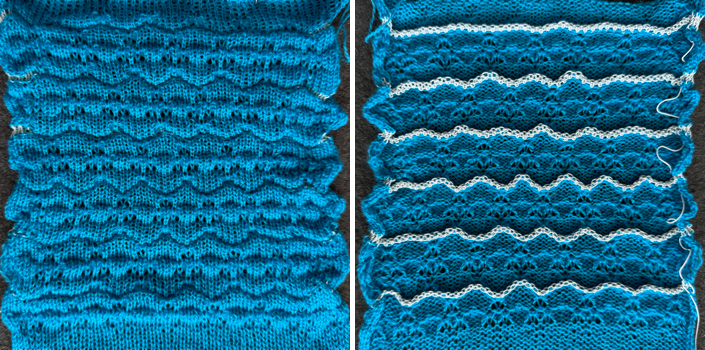 A few changes in the number of stitches and rows represented by white pixels for stitches that will be skipped, beginning with a brick arrangement, 24X80.

 The yarn used is a 2/8 wool; the swatch was knit in only one color to check yarn tolerance for stitches being held in needle hooks until they are knit off again, and with the intent of using it as the ground when adding another color to the mix. The test was on 60 stitches,
 and for 160 rows of pattern, measuring 6 inches in height.
 The second swatch began with the 24X40 design in simple vertical repeat,

 also tested on 60 stitches
 and for 160 rows of pattern, measuring 7.25 inches in height.
The dark-colored ground knits all stitches in all rows, where there is a pre-selection of every needle.
The yellow yarn is 4 ply, thicker than the dark, a 2 ply.
Secondary shapes formed by the textured gathers recognized by the eye of the beholder are part of this type of experimentation, not often predictable, and at times a fun surprise. 
A range of added textures, some created using the thread lace setting, can be found in the blog posts:
Knitting with “unusual” fibers/ elastic 3 5/22
Knitting with “unusual” fibers/ elastic 2 8/20
Knitting with “unusual” fibers/ elastic 1 1/20
Balanced designs are not the best to use with the thread lace setting, a sample that began with a 24X24 PNG  with added pixels to break up some long potential floats.

 The elastic is threaded through feeder A, the “bubble” yarn in feeder B, illustrated aside some of the work on the machine, appearing flat and stretched out.
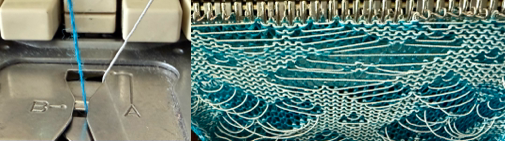 The elastic will shrink back when the finished swatch is steamed. The blue yarn is a 2/20 wool; the elastic is from an unmarked cone in my stash, a tad too thick, with a mind of its own, knit on 50 stitches.
End needle selection is canceled. If needles are selected in a pattern, they need to be pushed back to the B position so both wool and elastic will knit together.
The finished width after steaming is 4.5 inches.
Whether the shapes are recognizable and wearability are open to question. 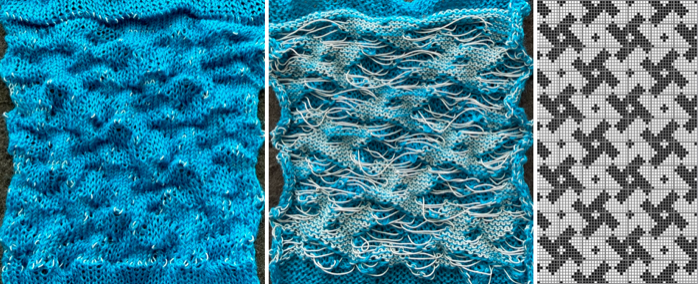 A more successful swatch, returning to the family, aiming for larger-scale shapes; the yarn is 2/20 wool, the elastic is a 280S cotton wrapped, the starting brick repeat is 24X52.
 Keeping in mind the respective functions of the black and white pixels, the image is color-inverted for use with the thread lace setting.
Side edges with non-selected needles will knit both yarns together from clean vertical columns, i.e., in this 56X104 repeat. 
 The actual swatch was knit on fewer stitches on one side of 0 than the other, explaining the different side edges. If any needles were selected, they were pushed back to B manually before the next carriage pass. After some light steaming, the result is a bubbly texture that measures only 3 inches in width.