Color separations meet Gimp rows color invert and custom scripts

This will be another work-in-progress post, a rough draft.
It is released early and will receive frequent edits and additions.
I have just begun to exchange information with two individuals, with the intended possible outcome resulting in providing Vibe coded scripts for GIMP or free online generators to automate the desired separations.
“Vibe codingis an approach where an AI generates code from natural language prompts.

The goal is to include and consider punchcard machine users, meeting the limitations of stitch width where motifs must fit together within the 24-stitch limit, so individually they must be composed of factors of that number: 1, 2, 3, 4, 6, 8, 12, and 24.
Each card height, to feed properly,  requires a minimum of 36 rows punched for continuous designs. Cards not on rolls are a standard 60 rows in height, multiple cards may be joined together if needed.
Needle selection is centered and fixed on the needle bed.
Added info is found in  Brother KMs: punchcards and their use.

I learned about machine knitting from what others presented during international and local seminars at the height of the craft, or published in magazines and hardbound editions. Stitch Painter with BitKnitter and DAK were at their inception.
Susanna Lewis has always been a personal favorite and a huge influence.
As time went on, I became interested in processing much larger files using whatever tools I became aware of in image processing or paint programs to generate patterns for producing the fabric I wanted to knit.
As a machine knitter, any charts or files I shared often began with numbering on the right and from the bottom up in Excel.
Row numbering on the right was a convention in blank punchcards and published charts; transfer lace passes added numbers and symbols on the left.
An added consideration in charting: while in 2-needle hand knitting, the work is turned over upon completion of each row, so charts are read in turn from the right and then from the left when purl rows are included in the chart. Knitting on the machine is fixed unless there is hand manipulation, ie, with a garter bar, and the knitter’s view is only of the purl side. In automated punched or downloadable patterns, every row is commonly represented, including punched holes with blank squares or black and white pixels.
Electronic models have a double-height button; in punchcard models, the card lock lever can be pushed back to the long triangle position.
I avoid elongation in long pieces, finding it easier to track unraveled rows to return to the proper program row and color when any errors or stitch mishaps occur.
Although the majority of my designing is now using ArahPaint, Gimp became my early go-to as a companion to spreadsheet programs, first Excel, then Mac Numbers.
Presently I have returned to using Gimp 2.10, finding the later 2 updates unpredictable when working with 8-bit images.
There are added baseline considerations in color separations, for example, the initial file must contain an even number of rows.
Experiments are beginning with black and white indexed images, and the goal is to conclude the process with PNGs in that same mode.

Mosaic color separations are different from those for DBJ.
The knit, also known as floatless fair isle to machine knitters, aims to have floats usually no wider than 2 stitches and for only one color, as opposed to 2 with each pass of the carriage in fair isle.
It is executed with color changes every two rows and cam buttons set to the tuck or slip stitch setting in both directions.
Two classic references: hand knitting for 24 and 40 stitch machines. In mosaics and maze conversion, the original file is not rendered double height before being separated. In other knit structures, the original file is commonly doubled in height before the separation, solving by default the even # row requirement.
Aside from the automatic color separation and what comprises the original file input, ie, indexed BW mode and an even number of rows, depending on the manual separation, the actual file on completion of the separation may need to be altered again before knitting, doubled in height.
The last double height can be achieved by altering the separated PNG before downloading it to electronic models. Symbols for that vary depending on machine or model year, in this case, 910 houses and trees, #4. The 950i  uses ships, but the button placements are in the same positions, and perform the same tasks, or the placement of the card lock lever in punchcard machines. I prefer punching or programming repeats that do not require the built-in elongation selections. Returning to specific rows after interruptions in knitting or correcting patterning errors during it are easier to track.
Whether the color separations are performed manually or with automated tools, the prerequisite is that the input file aligns properly when tiled. Often, published designs have added rows that will double when drawn in repeat, solved by cropping rows at the top and at one side, as addressed in other blog posts.

Using Gimp color invert.
A starting file,  used repeatedly in previous posts on mosaic knitting, 12X18.A brief review of DIY steps involved, taken for granted when performed unseen by software, follows.
The expected results can be visualized by tiling the repeat in Gimp using Filters> Map> Tile, and entering a multiple of the design, accepting the default ratio 120X180, or breaking the chain and entering a second number, ie, 126. The view of a magnified segment.  When working with Gimp, rectangle select, the aspect ratio can be set to the width of the repeat, 12, and 1 for the height of the selection.
Hold down the shift key to process the whole image beginning at the top left and continuing on every odd-numbered row.
The handles and dotted lines appear as one moves down toward the bottom. If a selection error is made moving down, while still pressing on the shift key, select edit, undo to remove the selection. The reversal takes place by choosing Colors > Invert only on selected rows after release of the shift key. With every other odd-numbered row selected and inverted,  the 3 images on the left show the separation, and the last on the right shows the separated file scaled to double height, which is actually needed to knit the mosaic successfully. When selectively scaling, ie, only for height, check that the chain is broken, and interpolation is selected/ changed to None. The change can be made permanent by altering the Tool Options default interpolation in program settings. The 12X36 file is ready to knit and is also shared in repeat. The first preselection row is from right to left, and the color changer.

This repeat for a larger design, 38X34, was separated using the custom filter, with the knit-ready result, 38X68, obtained in a single step

A design that combines the mosaic grid work with the straight horizontal design found in mazes began with a 26X26 repeat, followed by rotations and additions of a 26X20 partial repeatresulted in a 66X24 PNG   that, when viewed tiled on the screen, looked OK   the single repeat, separated using the script,66X48, was swatched using the slip stitch setting.

Both tuck and slip shorten the end knit along the all knit stitches beside them, which in this case form wide horizontal stripes. Those stripes in turn become distorted, seen here at the top and bottom of the swatch; the degree of 3D effect depends on the ratio of slip or tuck counts to knit stitches.
The repeat adjusted to a slightly different alignment if I were to personally use it in a final piece, 66X26, separated to 66X52The question then becomes whether more is less.
The original 26X26 design, separated to 26X52, shown drawn in repeat X3, 78X52, was test-knit using the tuck setting. The yarns used are Silk City wool crepe purchased as seasonal remnants decades ago. Its fiber content is typically 80% wool and 20% manufactured fiber like rayon or viscose. The surface of the swatch is far more 3D than its slip stitch relative. Returning to a 2015 post on working with online generated mazes, and the selection with the isolated repeat, 14X34rendered in BW the script “mosaic” separation,  14X68color inverted for knitting using either tuck or slip stitch setting. The sample, knit in tuck stitch for 134 rows, measures 9.25 inches in height.

DOUBLE JACQUARD
The abridged view of the same steps in the separation for knitting the original 12X18 row design as DBJ, where each color in each design row knits twice.  

The final file is composed of pairs of identical rows.
The process begins with the original image doubled in height, in this instance,  to 12X36.  Every alternate row is color-inverted, and then doubled in height for knitting to 12X72

12X72The first preselection row is from right to left, toward the color changer in Japanese KM models.
Because each color in each design row knits twice, the design is very elongated, even when knit with birdseye backing. The random color choice was not the best in the related sample. If the goal then becomes to have each color knit only once to reduce aspect ratio distortion, or if other knit stitch structures and combinations are planned, additional processing is required.
For strictly 2-color knitting, with BW starting images, electronic knitting machines automate each pixelated BW row for knitting each color only once per row with the flick of a button, generally labeled KRC.
The starting side for the preselection row is from left to right.
The 2 rows for the first color are split between the top and bottom of the programmed repeat.
The actions performed automatically: In the post ArahPaint in knit design 6: color separation,  this suggested method proved faulty when tested here. The result shows the dramatic difference in scale when each color in each row knits only once, but there are noticeable white stitches that are breaking vertical red lines, not intended and not the result of a programming error. Analyzing the result: the first and last row of the design are unaffected by the separation, and when knitting lengths, that same design row will repeat twice.
This proposed method shifts the first design row to the top, maintaining the 12X36 dimensions, and is then color-inverted, rendering a 12X36 file that is ready to knit. The first preselection row is from right to left toward the color changer.
regrouping, 12X36 with the bottom row shifted to the top, the separation, also 12X36The steps in the separation
1: the original image, 12X18
2: the original doubled in height, 12X36
3: move the bottom row to the top of the repeat, still 12X36
4: as an optional guide, a column was added on the right, increasing the width to 13 pixels, marking pairs of rows to be inverted. The added pixels were originally red; when color inversion was used, they were also converted to blue pixels
5: number 4 with the blue and white pixel column removed, the ready-to-knit repeat, also 12X36. The swatch is knit using birdseye backing, an added technique that helps to maintain the aspect ratio of the original design.
The visible extra white loops on the side are due to yarn feeds in mast issues that have gotten added to my list of “well, I have not run into this before!”  

Duplicating the KRC model, with added changes, but the same result: the hand-selection method to illustrate the color invert steps, from left to right: the 8X8 PNG start,
rendered double height to 8X16,
with the bottom row moved to the top,
the separation illustrated with marks for the placement of the inverted rows in blue,
and the knittable final repeat, 8X16Sample color separated using a Vibe-Coded script to obtain the 8X16 result:
the goal is to knit each color in each design row only once, matching the electronic automated electronic KRC selection, with a critical difference: the preselection row is from the right, followed by color changes every 2 rows. Testing a larger design repeat, 43X44color separated to 43X88knit with birdseye backing, with preselection starting from the right

More to ponder: the method used to have each design row knit twice produces files that can be altered again in double bed work for other stitch structures, or used as they are in single bed slip stitch that knits carrying one color at a time for 2 rows.

Reviewing charts for different separations, including use of more than 2 colors: depending on the published source, sometimes letters are assigned, others numbers, and they sometimes differ in identification sequences.
Continuing with Double bed separations, the longest to execute manually, while considering different stitch structures:


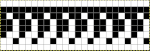
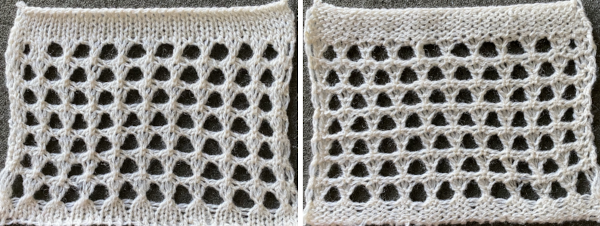
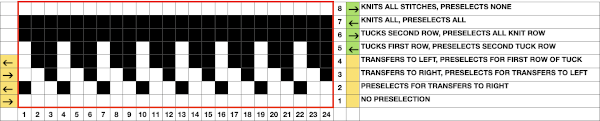
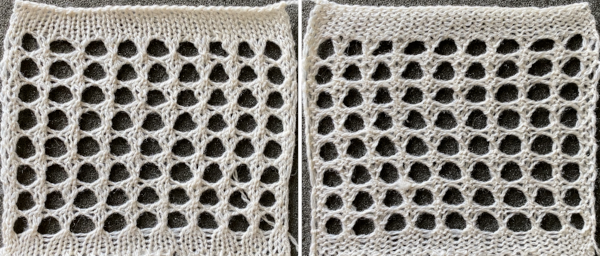
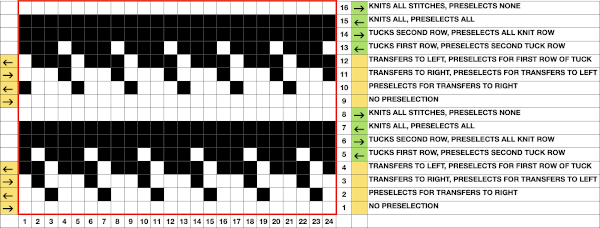
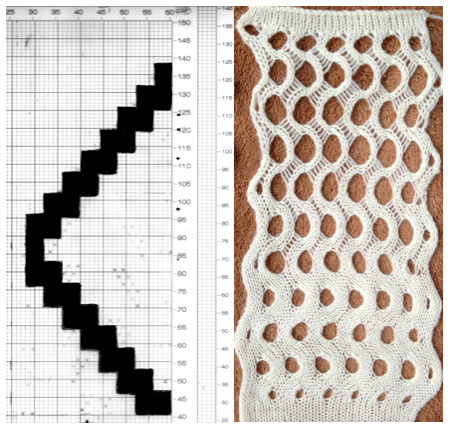
Large scale mesh, a punchcard repeat adapted for electronic

Previous posts including fabrics in this family:
2011: Large-scale mesh, breaking the rules 
2013: Large eyelet lace, hand transferred (or not)
2020: Revisiting large eyelet lace, hand transferred (or not)

This was the punchcard provided in the first post, knit with 4 passes of each carriage, the knit carriage set to tuck in both directions Brother punchcard machines do not advance pattern rows when two carriages are used for needle selection as each carriage begins to move from the opposite side, the same preselection is repeated. This means editing is required at times if the same designs are to be used on electronic machines, particularly true in lace combination fabrics. The process has been discussed in posts on automating lace edgings with slip stitch settings.
End needle selection is canceled in both carriages, if any end needles are selected prior to a lace carriage pass, they need to be pushed back to B position manually in order to avoid transfers resulting in decreasing stitch counts or dropped stitches.
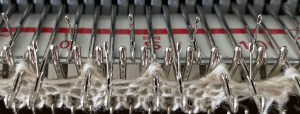
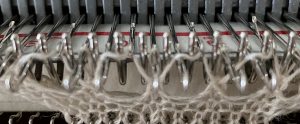
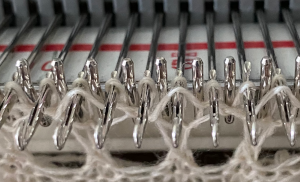
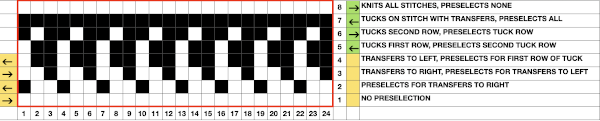
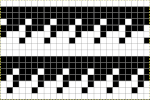
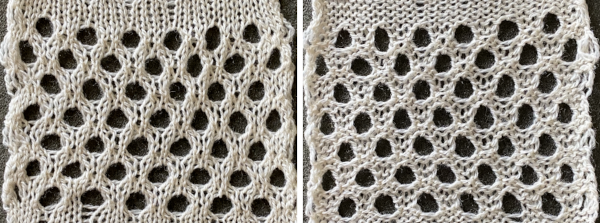
All versions proposed below share transfers that result in 3 stitches on a single needle, with two empty needles on each side of them.  Here the needles are preselected for the next pass which will begin to fill in the double space, the needle in D position will knit, the one in B position will tuck;   this is how the yarn is laid over those 2 needles after the first tuck row is completed,  and both when using the card and in the first electronic repeat there will be a third tuck loop that is laid over the needle holding the 3 stitches. This is the appearance of the stitch formations just prior to an all-knit row  Here analyzing the actions of the punchcard, marking rows according to card actions, the repeat is expanded to include the extra duplicate rows. Though the repeat remains 24 stitches wide, it is no longer usable for use on a punchcard machine. For knitting on the 930, the design requires flipping horizontally in order to knit properly. The third tuck row may be eliminated to produce an extra all-knit row, resulting in a slight difference in the shape of the eyelets Lastly, the repeat may be amended with extra stitches and rows between each eyelet  


Unconventional uses for punchcards 3: lace in rib

Lace patterns for drop stitch: cast on as preferred, transfer MB stitches to ribber, where all stitches will be knit on every row. The main bed will be knitting the stitches that will be dropped (lace carriage will not be used), cancel end needle selection, program your repeat, push in both part buttons. As the carriage moves across the bed selected “lace” pattern needles will knit, the non-selected will be skipped.
Continue to knit until no needles are selected. At that point disconnect the main bed and ribber carriages, change the setting on the main bed to knit, remove the yarn from the feeder, bring the knit carriage alone across for 2 rows, and stitches will be dropped. After the disconnected carriage is returned to the opposite side, rethread, and connect again to the ribber carriages, set the knit carriage to slip and it once again will knit selected needles. Repeat the process for the length of the swatch. If on an electronic machine with 2 carriages: the number of rows is usually an even number, so an additional knit carriage with no yarn could be positioned on the opposite side to the one selecting pattern, set to do plain knitting, holding no yarn, and it will drop the stitches on “plain knit rows” on lace card without requiring the other additional steps and cam button changes.

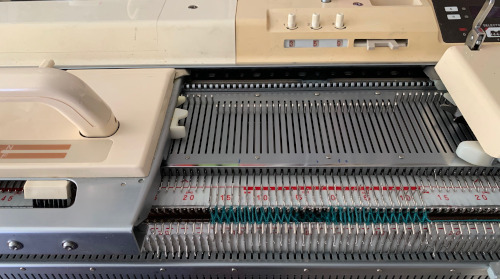
Transfer lace on the top bed: the question periodically comes up with regards to the possibility of using the lace carriage when knitting every needle rib fabric. The lace carriage does not operate with the ribber bed in use in the standard up position, there is not enough clearance between the beds for it to travel from one side to the other across the needle bed. It is possible to drop the ribber down one click, opening up the space between the beds, supposedly to allow for the use of thicker yarns.
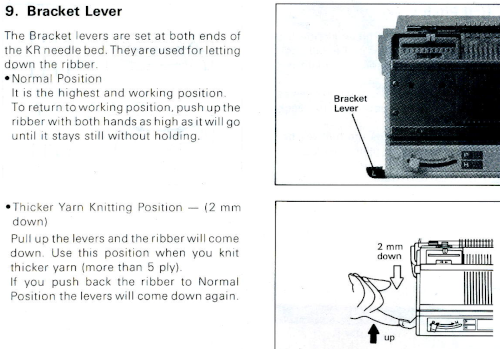
My machine is old enough for the ribber to be bowed in the center, increasing the space between the beds there. Trying to use that position for every needle rib in my desired yarn I got yarn breakage in the center of the bed, some skipped stitches, and the sides of the needle bed were still up too high for the LC to have a clear passage. The problem appeared to be due to its brushes hitting the gate pegs. With the brushes removed, but with some grinding against those same gate pegs the LC was able to move along the top bed. At least on my machine, I am giving up on the idea of using it, even if only to preselect needles, let alone make transfers.
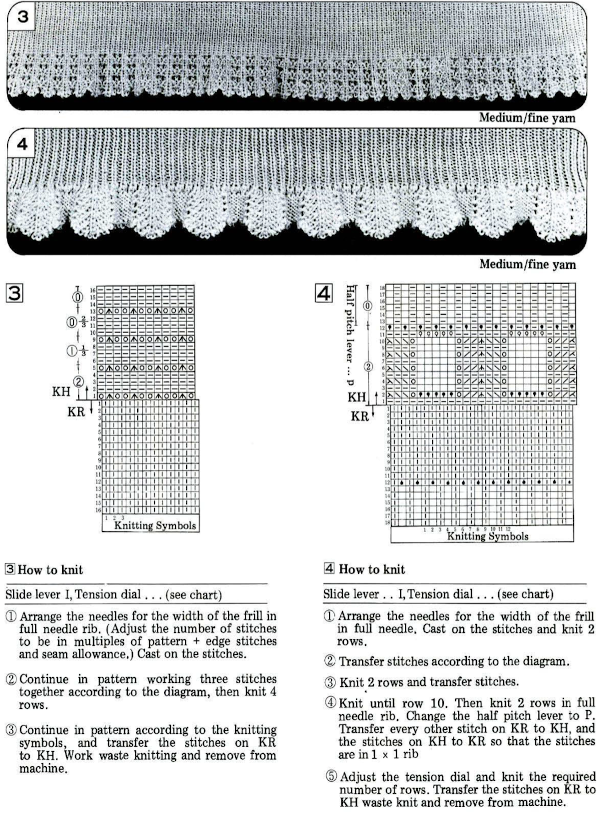
This page is from the Ribber techniques book. The fact that transfers are broken up with blocks where there are no transfers, including some with stitches transferred to the opposite bed, makes it easier to track transfers than if using all over designs. Standard pronged tools are sufficient to move the single stitches or groups of three. 
It is possible to transfer larger groups of needles on the main bed to create lace patterns, done of necessity in two-color brioche, but here I am seeking to modify lace punchcards so that the fabric based on them may be created successfully with as few errors and dropped stitches as possible.
My first attempt was made using a second knit carriage set to slip in both directions to preselect needles for transfers,  using a small lace repeat to test the idea. The advantage of this method is that the original lace repeat does not need to be altered in any way. The disadvantage, aside from requiring a second carriage to use, is that the width of the piece on the machine is limited.  The ribber carriage is in use and needs to remain at least in part on the machine bed on the far right, limiting the number of needles for possible use on the right side of 0 to about 20. The same work could be done using only one knit carriage as well, but that would require changing the cam buttons from slip in both directions to knit and back to slip at the appropriate points, one of the methods that make it possible to knit lace on the 260 bulky machines

The repeat used is for this swatch is from StitchWorld, and is knit using the second knit carriage for needle preselection.  Because each block contains lace transfers in only one direction, the fabric, even though it is a rib, reflects that in the biasing first in one direction, then in the opposite.
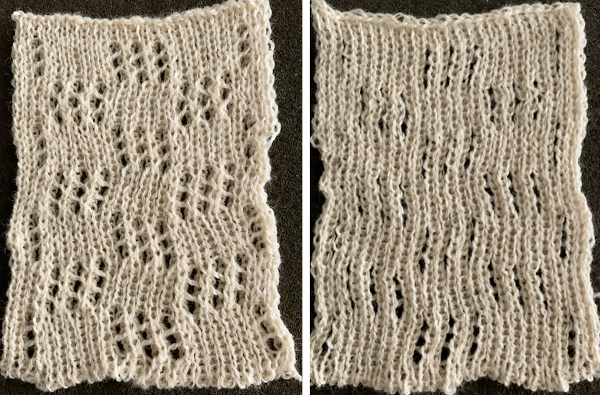
It helps to be clear as to whether one is producing lace repeat for use in a punchcard or an electronic model which in turn will require mirroring, such as when using Ayab or when using slip stitch selection with the knit carriage in combination with lace carriage selections to create shaped lace edgings. Testing on a small swatch will help determine whether mirroring is required for any specific design. Electronic machines usually produce the design as seen on the knit side, punchcard machines as they would be seen on the purl, thus making mirroring a requirement depending on the source for the design.
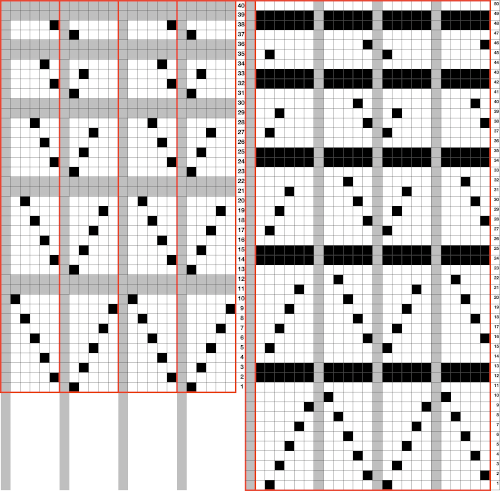
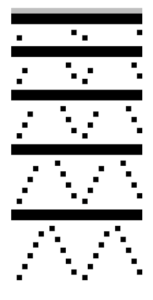
I usually begin by modifying my chosen repeat in a spreadsheet. On the left, the pairs of blank rows in the original repeat are temporarily colored in grey. It helps to be consistent. One repeat begins with a full motif, the other with half, which can be confusing when first starting out. The plan is to begin by producing a trim or edging, an all-over pattern for significant lengths appears daunting. Dropped stitches in single bed lace are no fun, in rib they may not even be noticed until the knitting is off the machine. The difference between the two repeats: the 2 grey rows on the left are replaced by black pixels or punched holes, with a blank row placed above and below each of the black row pairs. The design is now expanded from a 40-row height to a 50-row one suitable for use in a punchcard machine This explains some of the desired knitting actions Using the method described in other posts, this was the screengrab imported into Gimp. The grey line is a reference point. Cropping the image to content will allow the last blank row to be preserved by having the grey one there. After the crop, it can be bucket filled with white, or when the image is, in turn, bitmapped to B/W, you may find it disappears. Image scale is then used to reduce the repeat for knitting. This is the repeat used to knit the swatch in my 930. If working from it, punchcard knitters need to mirror designs from an electronic source such as this and will find it easier to do so by turning the card over, marking the holes that require punching on that side, doing so, and then inserting the card in the reader in its usual orientation.  The 930 .png: Prior to knitting the pattern using the ribber, it pays to test the repeat single bed to get a sense of where the knit rows occur and to make certain the transfers are happening in the correct direction and in what place on the needle bed. There should be no side by side empty needles, and in this design, the first pairs of transfers result in 3 stitches on one needle in the center of each shape, not side by side holes as seen here in the false start prior to mirroring the image Making things work: both carriages will be operating to and from the left-hand side. The process is facilitated by the use of an extension rail and a color changer. The knit carriage alone will operate to preselect the needles that will need to be hand transferred to create the lace pattern. With the following modification of the repeat, all transfers are made moving away from the knit carriage. So if the KC is on the right, transfer to the left, if it is on the left, transfer to the right. The paired carriages will create the two all-knit rows between lace segments. The blank rows above and below the two all punched or black pixel rows are there to return the carriages to the proper, left side to begin preselection for the next row of transfers. If any end needles are preselected on the knit bed, push them back to B.
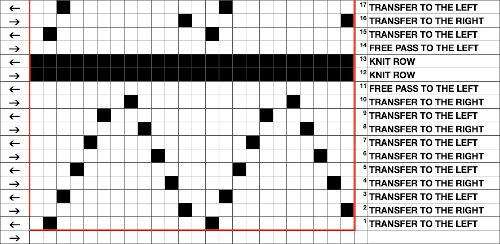
It is best to knit 2 rows of full needle rib before beginning transfer, that will ensure that stitches on both beds are formed properly. I did not, had a spot on the cast-on where the loops were not properly placed on the comb, and that is reflected in the area that looks like a stitch was dropped. Begin with a zig-zag row from left to right, knit 2 circular rows, carriages will be on the right. Knit a sealing row to the left, followed by 2 all knit rows, ending with carriages once more on the left side.
COL: remove the yarn from the Knit carriage, hold it in color changer by pushing the adjacent feeder number
separate the 2 carriages
cancel end needle selection
KC is set to slip in both directions, it will remain there for the duration of knitting the pattern, make certain all main bed needles are in the B position
KC operates alone to the right and preselects the first row of transfers
COR transfer preselected needles to the left, away from the carriage. Make certain all needles are in the B position before the next carriage pass. KC will preselect for transfers to the right as it returns to the left side.  Repeat the process until all needles are preselected for an all knit row as you knit back to the left
COL pick up the yarn, engage the ribber carriage knit 2 rows on all needles
Repeat: *COL: remove the yarn from the Knit carriage, separate the 2 carriages, operate KC alone making transfers away from the carriage until all needles are preselected as you knit to the left. 
COL pick up the yarn, engage the ribber carriage knit 2 rows on all needles** until ready to continue in every needle rib.

This method is slow, I found it oddly meditative. It offers an opportunity to review stitch formation, thus avoiding dropped stitches. Hand transferring lace preselection on the single bed as well can sometimes make a fabric achievable that is otherwise cursed by dropped stitches and fiber issues.
Automated shapes across rows of knitting using slip stitch only

WORK IN PROGRESS

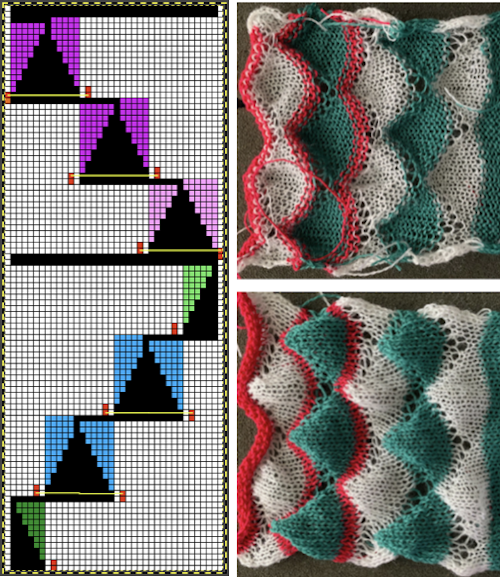
Full automation of “held” shapes using slip stitch alone is possible, involves careful planning of the design repeat, an understanding of necessary sequences in “holding” techniques, and results in large, long repeats for recurring shapes.
The starting side for preselection rows varies depending on the design.
Pattern knitting is worked with both cam buttons set to slip, end needle selection must be canceled.
All stitches on the knitting bed must be cleared with each pass of the carriage from side to side.
As shapes grow, test periodically for any yarn loops accidentally caught on the gate pegs.
The overall downloaded program needs to include repeats planned for the number of stitches in work on the needle bed. This is the standard requirement for Ayab, on my 930 the default img2track programming is for a single motif.
If working on an odd number of needles, whether the needle selection is pushed to the right or left of center varies depending on the brand of machine used and changes if horizontal mirroring of the design is added.
It is helpful  to begin with small, narrow repeats for practice. Assorted samples from previous posts:
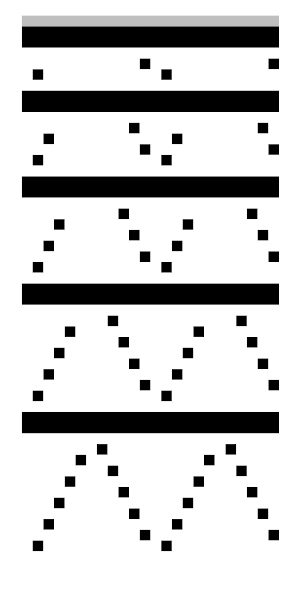
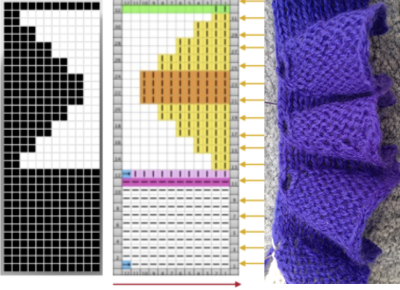
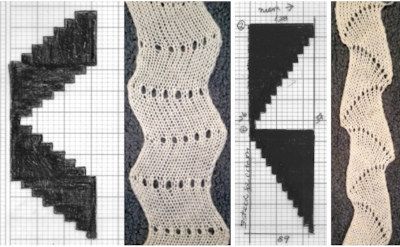
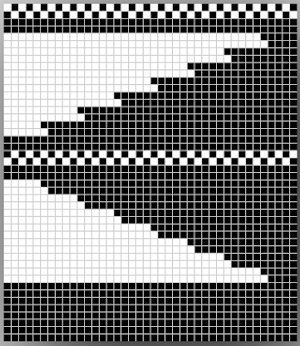
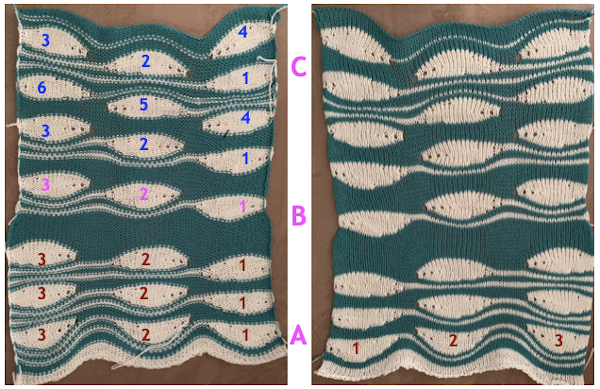
a ruffle also using the garter bar a couple of zig-zags only one of many pleat variations that may be enlarged and planned for the width of the bed in knitting items such as sideways skirts repeats planned for texture bumps and slits shell shapes Testing the idea on a limited width with small intended shapes helps one iron out errors in logic or knitting sequences,  I prefer to start with a colored chart, making it easier to follow movements of the yarn, carriages, and color changes The chart was then loaded in Gimp, the Mode changed to bitmapped B/W, and the image then scaled to the final width of 74 X 96. For this exercise, I chose to keep the shapes equal distances apart (marked in green), mirrored the image on my 930 to produce the shapes in the same direction. In this instance, as is often encountered in lace knitting, an odd number of rows between repeat segments will allow for the carriage to start from the opposite side in order to reverse the direction of the shaps. The first preselection row may start from either side depending on whether the downloaded image is mirrored or not, whether by intention or automatically by the machine model’s auto settings. The default isolation in img2track is fine, ayab knitters are required to program the repeat in width to match the number of needles in use, so this would work for both I did run into an operator problem: had managed to save the repeat so rather than being all B/W there was a single row of color at its base, which caused mispatterning only when that #1 design row was knit.
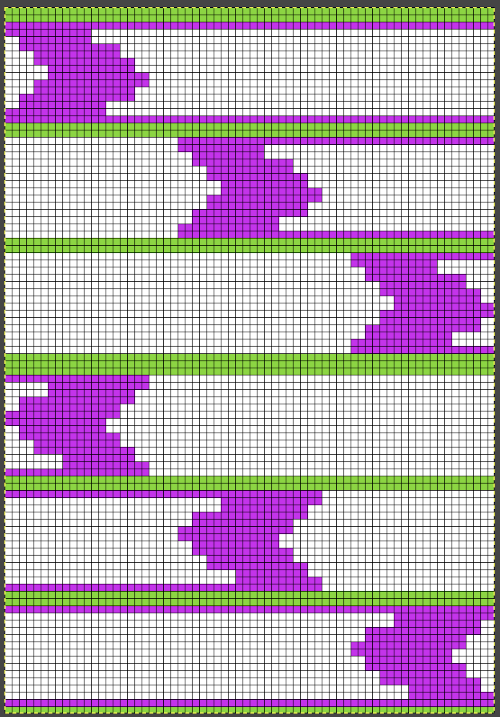
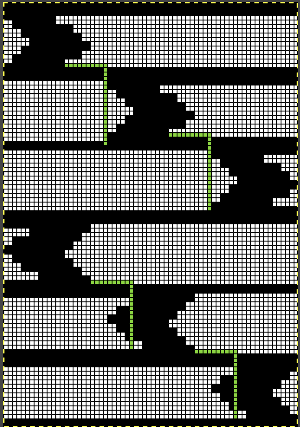
With that amended, the selection problem was eliminated The same shapes always starting on the same edge A will distort that edge. Extra rows of the alternate color can vary shapes of the striping between them. Single shape rows could be floated much farther apart on solid ground, or one to which other colors or techniques are added, and finally, the reversing shapes produce a more balanced height at both sides.
Beginner’s corner

WORK IN PROGRESS

Copyright can be a touchy, sometimes murky subject. In my teaching days at a design school, each instructor was responsible for accumulating what amounted to a “textbook” with any expected readings and required information for students attending the classes. There was an arrangement with a single copy center that actually paid a fee set by the government in order to be allowed to provide a service. Teachers supplied boxed material on a single-sided copy per page sheets, withdrew it at the end of the term. The copy center would make double-sided copies from each sheet in the original, bind them, making them available for purchase for only the cost of what it may have been to customers using copiers to make their own per sheet. My intro to knitting “book” evolved into 330 pages, costing students as far as I can recall about $30. An overall bibliography and often credit in sections were included. This all was happening pre-internet browser searches and easy downloads.
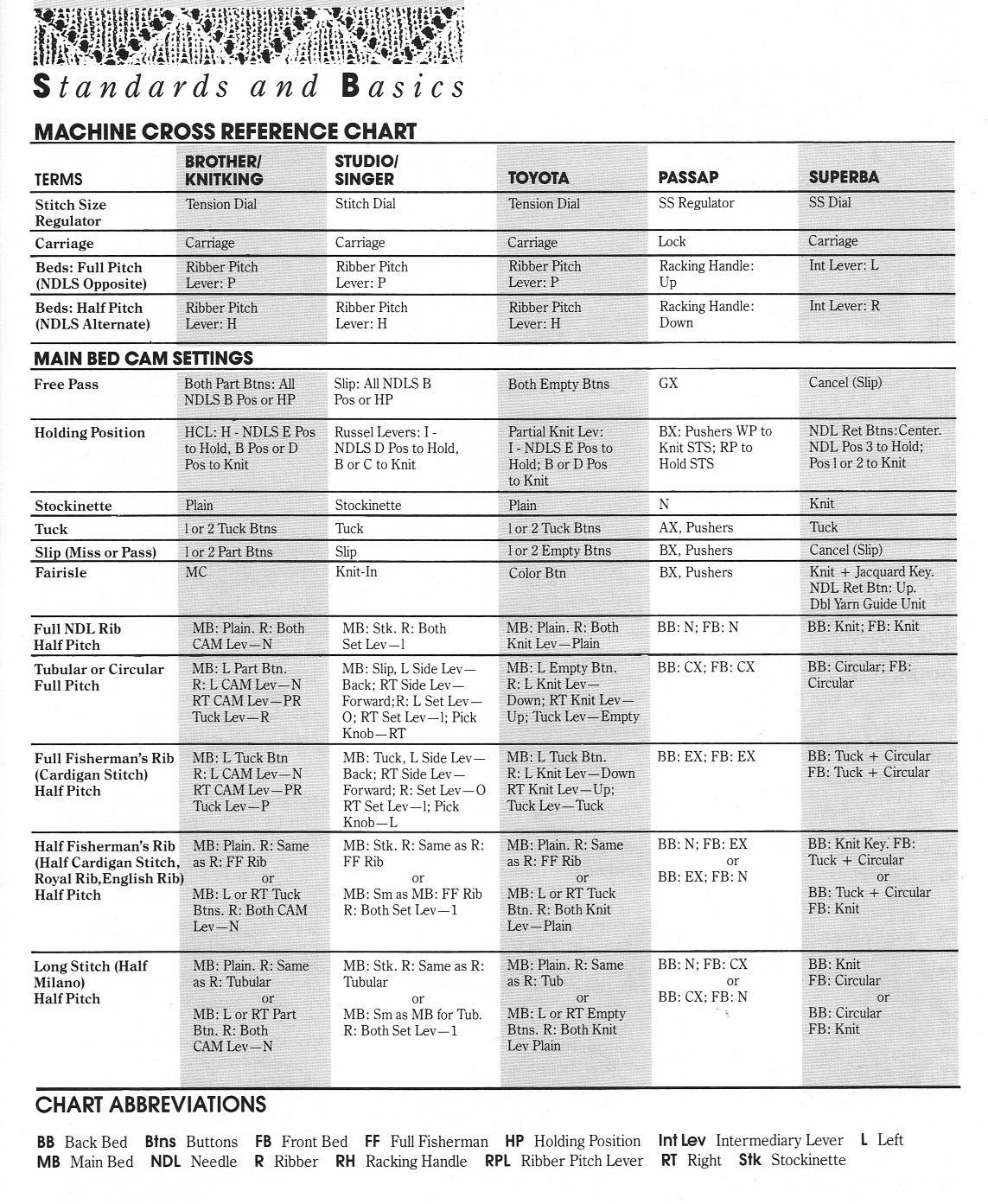
I have often not included a definition for some of the terms used in my posts. Also, I did not share information from manuals and company publications until they, in turn, became easily available online, long after the companies that published them went out of business.
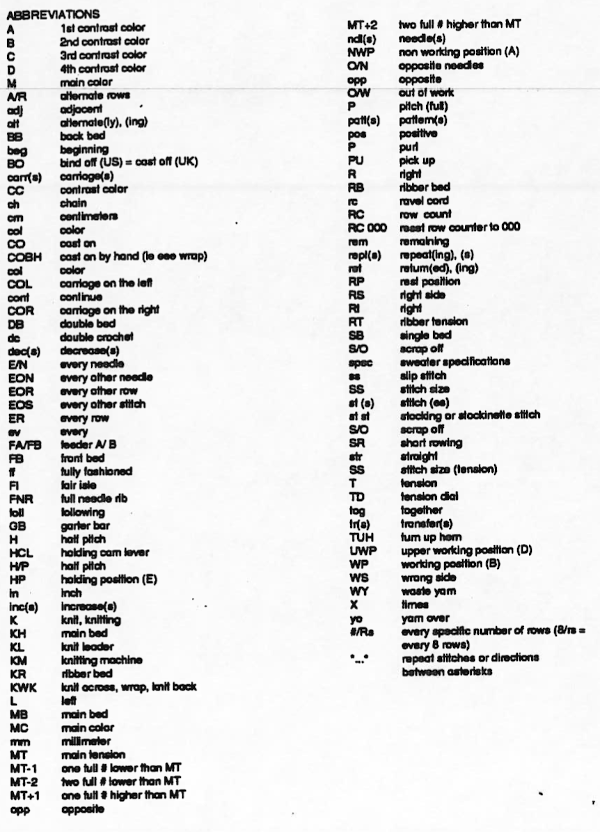
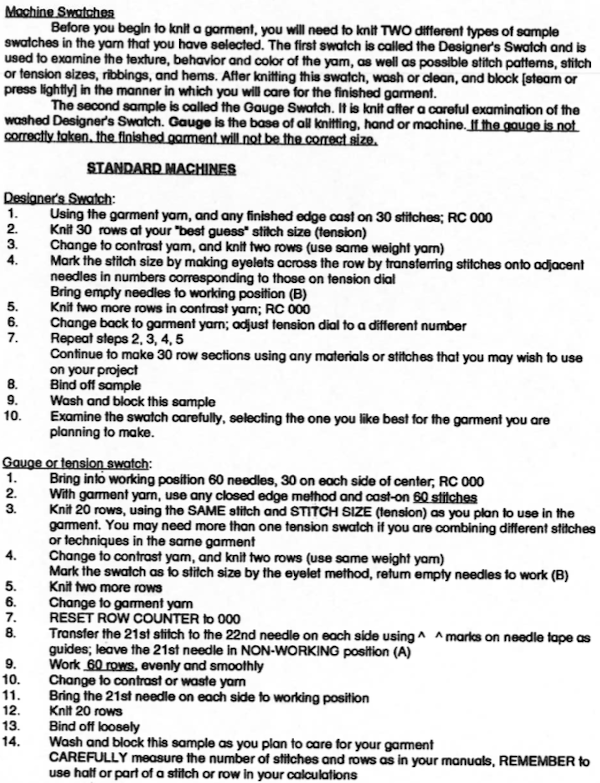
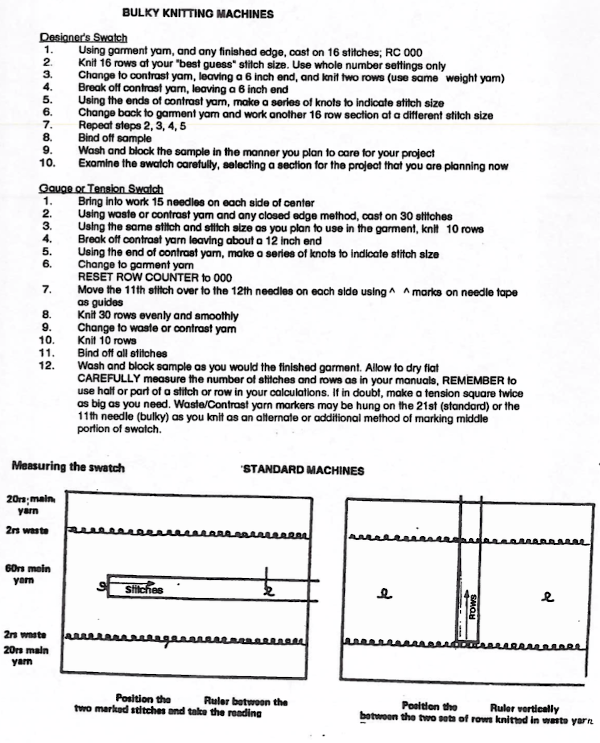
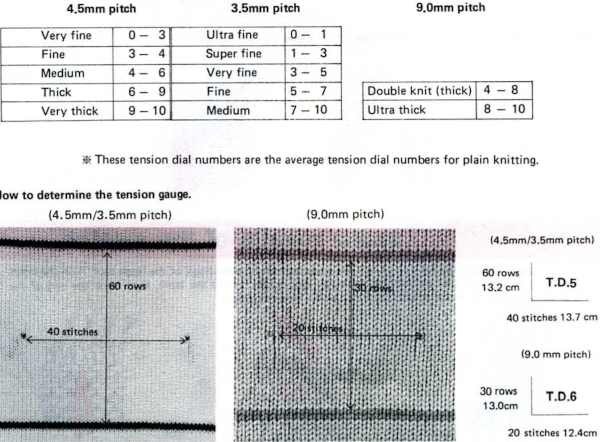
A list of common abbreviations: Test and gauge swatches

From the Brother Knitting Techniques Book
I personally prefer to measure gauge on the purl side, where to my eye the start and end of the color transitions appear clearer.
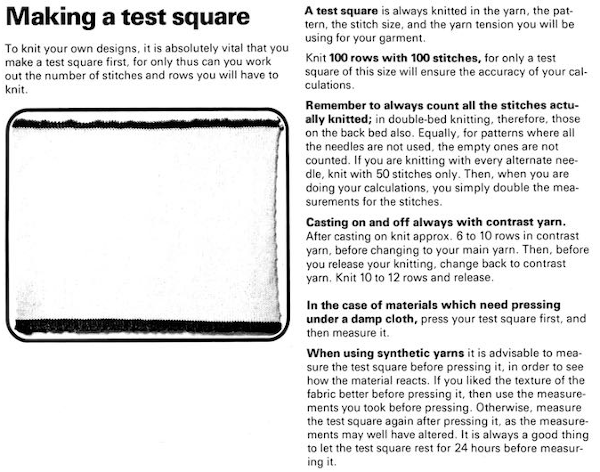
The Passap advice was quite different. This is from the Duomatic 80 manual
and it was followed by tables that helped with calculation conversions based on measurements. When using Japanese machines while executing some DBJ or highly textured stitches, a larger swatch should become the go-to when measuring gauge for garments by default. Using 100X100 combined with the use of metric measurements facilitates the maths and use of devices such as the knitleader, where measurements in millimeters are required.

A “long swatch” exploring a card from a “censored” selection from the factory-supplied punchcard packet in as many techniques as possible became a required assignment In KM model manuals a list was sometimes provided suggesting what cam settings might be suitable for each card
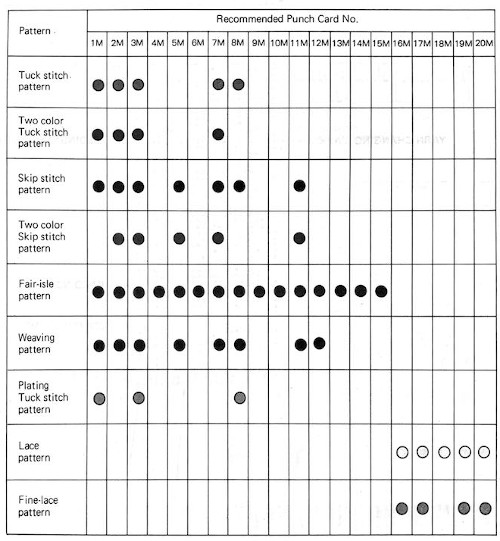
Factory supplied cards were usually marked with a number and letter as seen above, but oddly as model numbers changed, sometimes either or both of the latter would change as well. A table of my own after a quick review of my stash:
1S, 2R,3J/S, 3P, 4D, 5J, 6P, 7G, 8S/J, 9G, 10D, 13G, 101, 102, 103, 107, 108, 109


Carpet or pile stitch knitting on Passap and Brother KMs 2

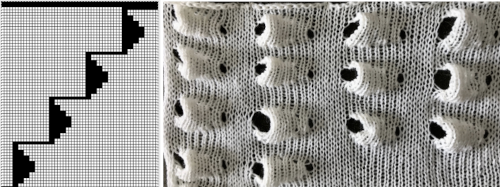
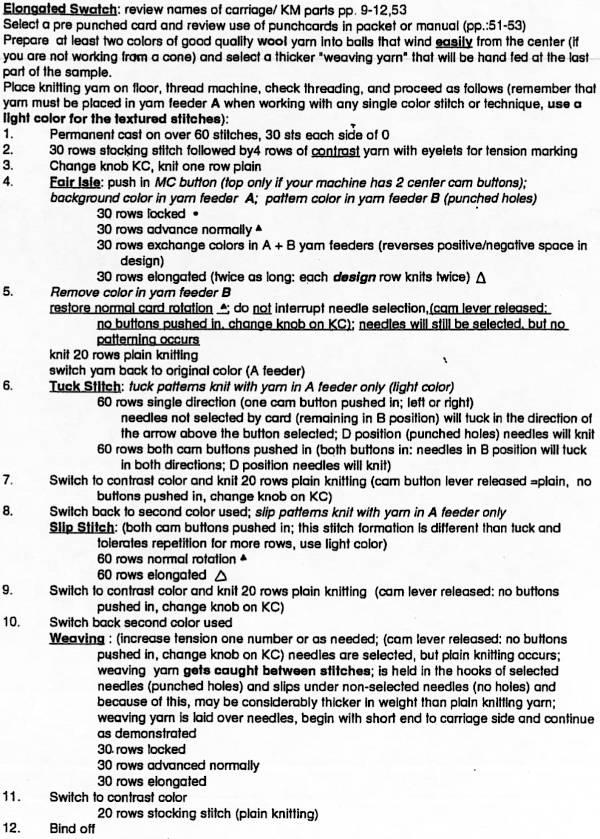
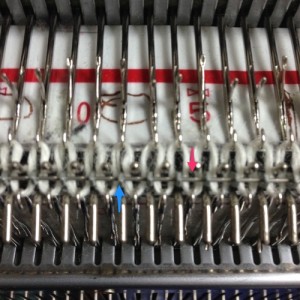
Trial swatches do not necessarily require a permanent edge. The main bed cast on with all open stitches is familiar to knitters accustomed to using a single bed Brother cast on comb. A quick version of the same type of cast-on is also doable when both beds are in use, and the goal is to knit all stitches only on one bed or the other. The broken toe cast on for rib is so-called because if comb and weights are hung in the wrong location on the needle bed when stitches on the opposite bed are dropped, so will the comb be along with weights, heading for your feet. If the ribber is going to be the bed doing the knitting that anchors dropped stitches or pile in Brother kms, please note prongs of ribber comb line up directly in front of main bed needles (blue arrow) and to each side of the loops on ribber bed needles (red arrow). The ribber comb wires will anchor down loops on the needle bed where plain knit rows will be formed. As mentioned above, this method will result in stitches all being open, does not produce a permanent edge, is suitable for quick swatching or for waste yarn at the bottom of the weighted fabric. It is possible to perform this cast on with ribber comb with wire already inserted in both brands, but the broken toe method is potentially less hazardous to needle health. brokent_toe_arrowsAnalyzing what is required to move between km brands with the goal of achieving 2 color or isolated pile motifs: in Passap with the back bed set to FX, one arrow key, EON pusher/ needle selection changes every 2 rows. In Brother, this may be achieved on the main bed by pushing in one tuck button and programming a repeat.  The alternate, adjacent cam button, left in its normal position, will knit every stitch when knitting direction is reversed regardless of whether any needle selection is happening. On the ribber, lili buttons may be used for alternate needle selection. Its levers determine whether tucking or slipping, in one direction or both, occur. The number of stitches on the ribber must be even. An easy visual check is to check markings on needle tape, which consists of what I refer to as dashes and blanks. For an even number begin with one, end with the other.  Passap will automatically revert to the alternate pusher for patterning on the subsequent 2 rows. In using lilis this is not an automatic function, and some handwork is required to obtain the same effect by changing the first needle selection every third row as seen in this post.

If the ribber is chosen as the loop making the bed, the needle selection on it needs to be manual for any pattern other than across whole rows. In my swatch, to knit across all needles the ribber carriage is set to slip in one direction, knit in the other. The all knit rows in pile knitting need to follow the ones with tuck loops on the opposite bed.  Extra needles are on the main bed, which creates fabric backing. The ribber carriage can be disengaged and used to drop stitches after all knit rows on the main bed.

In the actual knitting, if a plain one color pile with plain color backing is the goal, some rules may be broken. The thickest, most stable pile is achieved when the yarn anchoring the loops is as dense as possible. If the goal is to knit every stitch across each row to create loops and in turn drop them, one is, in fact, working an every needle rib. This makes it possible to create tuck loops on either bed creating the backing across the whole row because in fact there are stitches on each side of the tuck loop on the opposing bed anchoring it in place. Normally when 2 or more needles tuck side by side, rather than the stitch formation usually seen in tuck patterning, the loops do not get anchored, drop off, and create a float like those seen in slip stitch patterns.

In my first sample, the fabric is cast on the main bed, the loops are formed on the ribber. The carriages are set for the main bed to tuck traveling to the right, knitting to left. The ribber is set to slip to left, knit to right. The ribber is used to drop the stitches, simply by disengaging it from the main bed and running it across from one side to the other. Dropping stitches occurs (on either bed) after all stitches have been slipped there for one row (no needle selection if patterning). The starting side for my swatches was on the left of the machine. It is helpful to have a ruler or tool to help push loops down between the beds after dropping each row of loops and also to occasionally drop the ribber in order to check whether any loops may be caught on gate pegs.

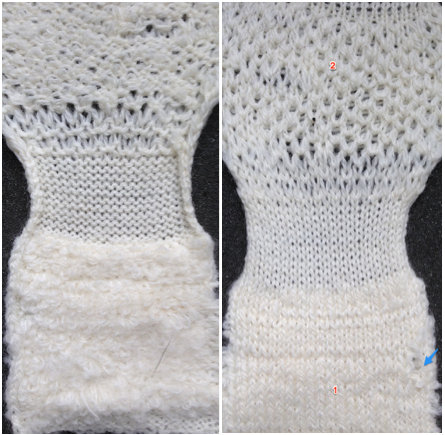
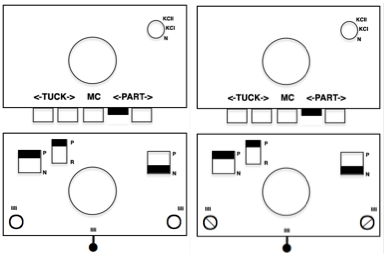
In this swatch, I had some problems (blue arrow) on the right side related to changes in tension while determining what might be the best. Section 1 has every needle tucking on the main bed. Section (2) begins to try to emulate the Passap pusher selection using an EON 2 row tuck repeat on the main bed, resulting in things going awol and loose, even at the tightest tension possible on the main bed. Any time patterning is used on the main bed, end needle selection is canceled (KCII). The tuck repeat2 row tuck

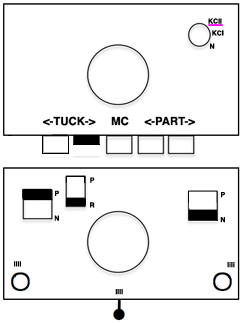
the settings (here lili buttons are not in use1X1 card MBno lili2

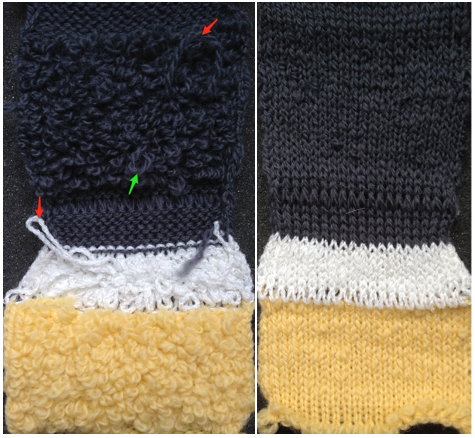
ribber loops2To create every needle loops for pile on the main bed: CO is on the ribber. With settings on the image below left (no lili buttons in use), the ribber tucks loops on every needle traveling to the right, knit all stitches moving to left. Moving to the right the main bed knits on every needle, slips the whole row moving to the left, giving the opportunity to drop stitches off. With settings on below right, lili buttons are in use, and the ribber now produces an EON needle selection, every row. Left alone the selection is what would be seen using the 1X1 card on the main bed, its repeat 1X1tuckloops on MBThe yellow yarn is a 2/8 good quality wool knit at 4.2 on the main bed, 3.2 on the ribber. Switching to a rayon twist of similar thickness created instant havoc. The dark grey was a mill end, tighter twist 2/8 wool. Red arrows show what happens when loops are caught up on gate pegs and not immediately noticed. The green arrow indicates longer loops that can happen when knit stitch on either side on the opposite bed do not knit off properly. The result is a dense wool fabric, so the tendency to roll at the top and bottom of each piece toward the “knit” side of the fabric needs to be considered at the top and bottom edges of finished pieces.

knit with no lili buttons in usemain bed loops2

In 2 color knitting, or creating isolated motifs whether on one color or striped ground, anchoring loops by tucking on every needle is no longer possible, making reverting to EON needle selection on ribber a necessity. The results are dramatically different. These swatches were made using lili buttons or hand selection on ribber, loops on the main bed. If things don’t work in one color, they will not in 2, so one color, every needle pile is a place to start evaluating the results

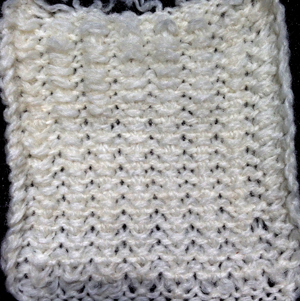
1X1 lili selection left me with “where are the loops?”white_lili

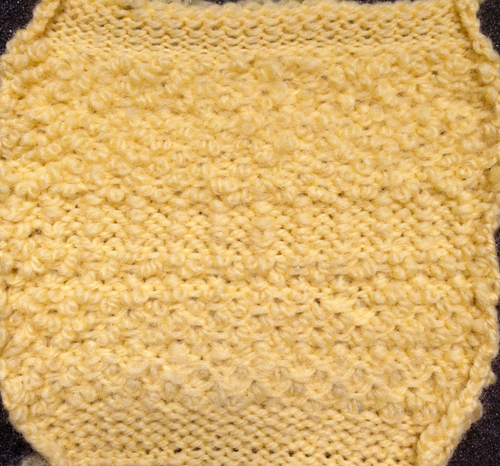
In the bottom section here I tried 1X1 hand selection for 2 consecutive rows,  the narrow band in center back was back to 1X1 to separate areas using lilis, at the top I used lili buttons and brought an extra needle into work on ribber before traveling to the right every third row (making needles in work on ribber an odd number), returning it to out of work before knitting back to right. Dropping stitches every 4 rows makes tracking the sequence easier. The resulting pile is far more “subtle” than samples worked with every needle tucking on the bed creating the backingyelllow-lili_500

So far I still have had no luck with getting anything that does not look like a variant of drop stitch lace when attempting patterns separated for 2 color knitting, either in embossed one color, or in striped 2 color versions.

For stitch dropping tools for different machine brands see Brother KMs “pile knitting”/ ribber stitch dropping tools

Zig Zag ladder lace 2: hand knit

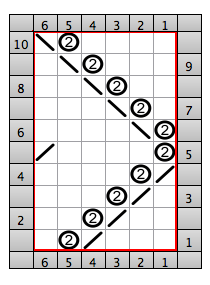
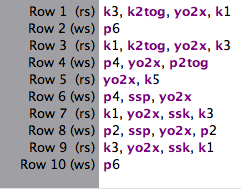
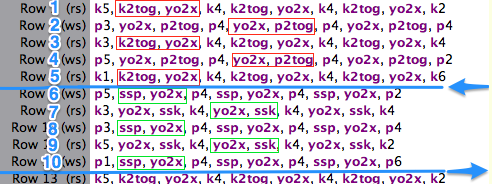
I work primarily on a Mac, Maverick OS. Intwined software has had some issues operating in Mac consistently in the latest OS versions. The chart to text can be a really nice feature. The repeat, drawn here with symbols in the built in stitch library, shows errors in row 2 and 4 of the accompanying text.single repeatmistakes single

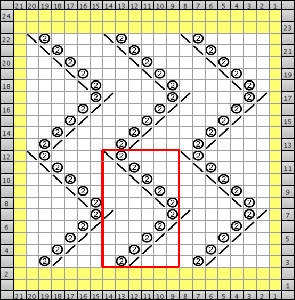
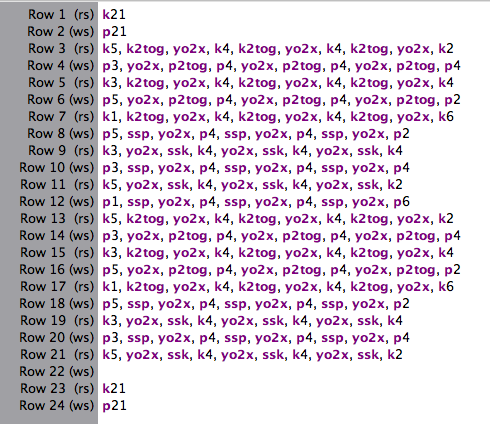
On a larger canvas, the original repeat is outlined below in red. Yellow indicates knit border stitches around ladder lace pattern repeats; row 22 is absent from the text that accompanied the larger chart.

full chart

full directionsSkitch is a free program, available for both Mac and Windows, that allows the opportunity for of highlighting or further editing a graphic. Taking the information above, here I added numbers that reflect actual repeat rows, used the arrows as a reminder of change in direction of zig zag, and the red outlines vs green indicate changes in type of knit decrease. It is easy to add as much or as little additional information as one feels helpful. There are controls for line thickness, shadows, etc.

actual repeat

JKnit is another program that may be of interest to anyone who prefers to track their projects, progress, and much more on their iPad or iPhone. The Lite version is free for both devices.

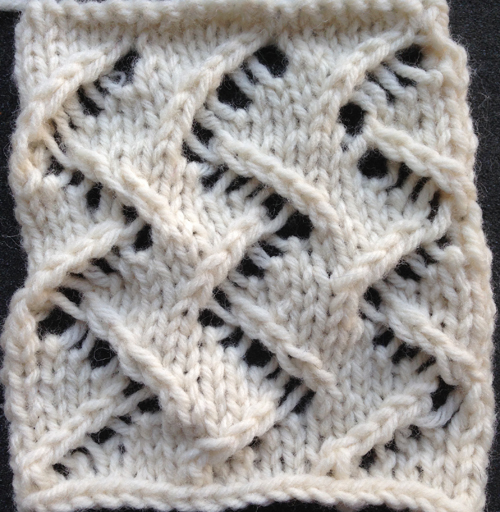
Below is an image of the hand knit swatch, unblocked, which appears three dimensional; transfer  lace has traditionally been blocked to lie flat and maximize eyelets. The fabric may be very interesting without blocking. If a slightly thicker yarn with “memory” is used, the piece may be steamed lightly, and the pattern segments will tend to shift in and out from the flat surface, whether the piece is hand or machine knit.IMG_1901

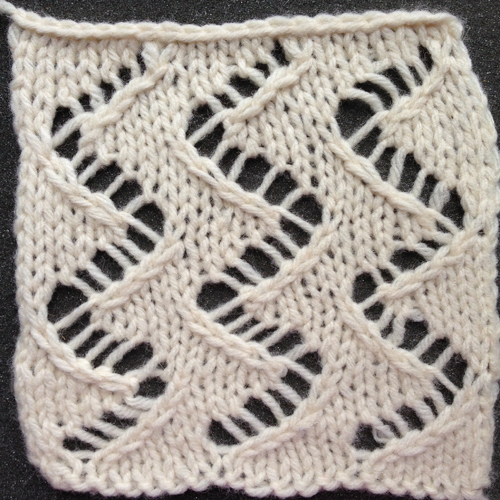
The yarn used was a “throw away” swatch testing acrylic. A very quick, light press and a bit of steam and here it is in the resulting killed, forever flattened version

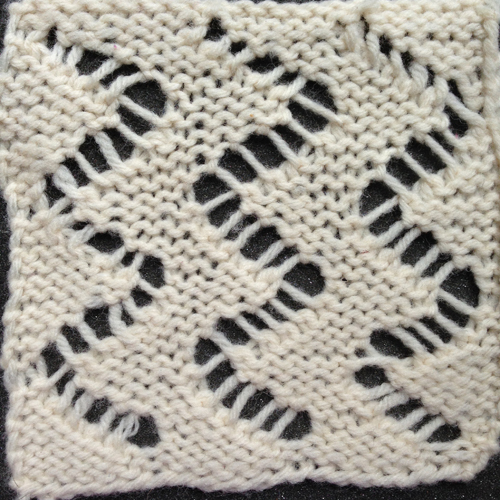
IMG_1905  and it reverse side

IMG_1906

Frome lace chart to punchcard 4: a border tale

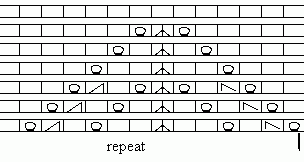
A forum post inquired on adapting the following border repeat for use on a punchcard Brother KM, using the lace carriage: the repeat is 14 stitches wide as was given below

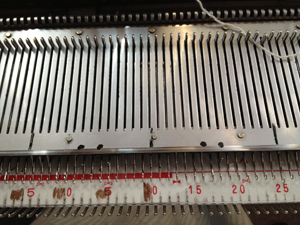
Because of repeat restriction in punchcard knitting, the best way to match the above chart is through the use of hand techniques. The image below shows needle bed markings (in water-soluble pen) to help in tracking hand transfers; the long line is the location for the center triple stitch after stitch transfers, the dots place the first single transfers made toward the center long line on the KM, away from the single needle space between them

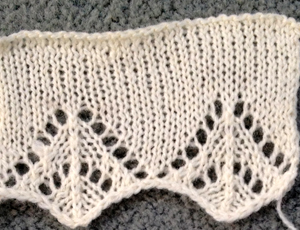
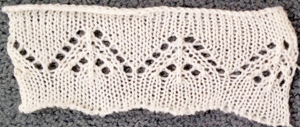
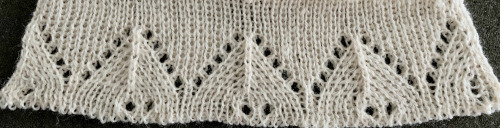
this is the result of the hand transfers; the fuzz on the left is a manufacturer’s yarn knot

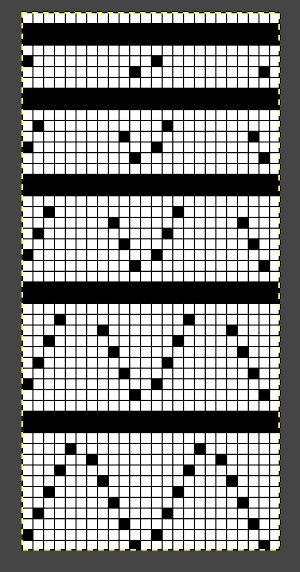
a simplified repeat  keeping some of the elements, but missing that center ridge, adjusted to a 12 stitch repeat for use with punchcard; the missing lace hole was an error in punching out the card

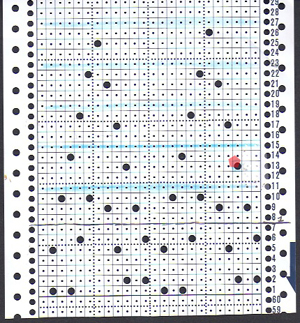
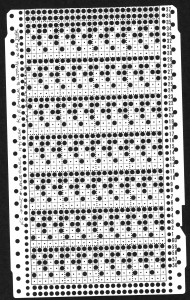
the card for it, showing the correction also marked in red

since the intended use is for a border, it is not necessary to punch more than above; the first row for selecting to right with the lace carriage is marked, blue shows location for knitting 2 rows with knit carriage; the sequence is an easy 4 passes with the lace carriage, followed by 2 with the knit carriage

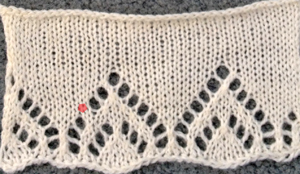
another option’s results, creating the center ridge as in the hand-knit: not identical, but related

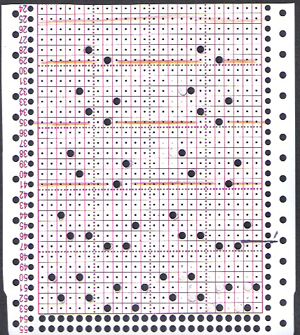
the corresponding card: knit 2 rows after every 6 passes with LC, except for the last repeat segment, where LC makes 4 passes prior to continuing with KC and knitting beyond the border

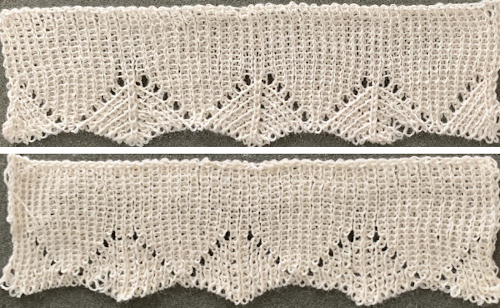
If using cards I would recommend knitting several rows with waste yarn before casting on (as loosely as possible) and continuing in lace. The very bottom will want to curl toward the knit side of the garment, so cast on the edge may require additional treatment to keep it from doing so.

for one more repeat please see next post